- Chinese prices and Indonesian constraints support seaborne offers
- Indian portside markets soften as domestic alternatives improve
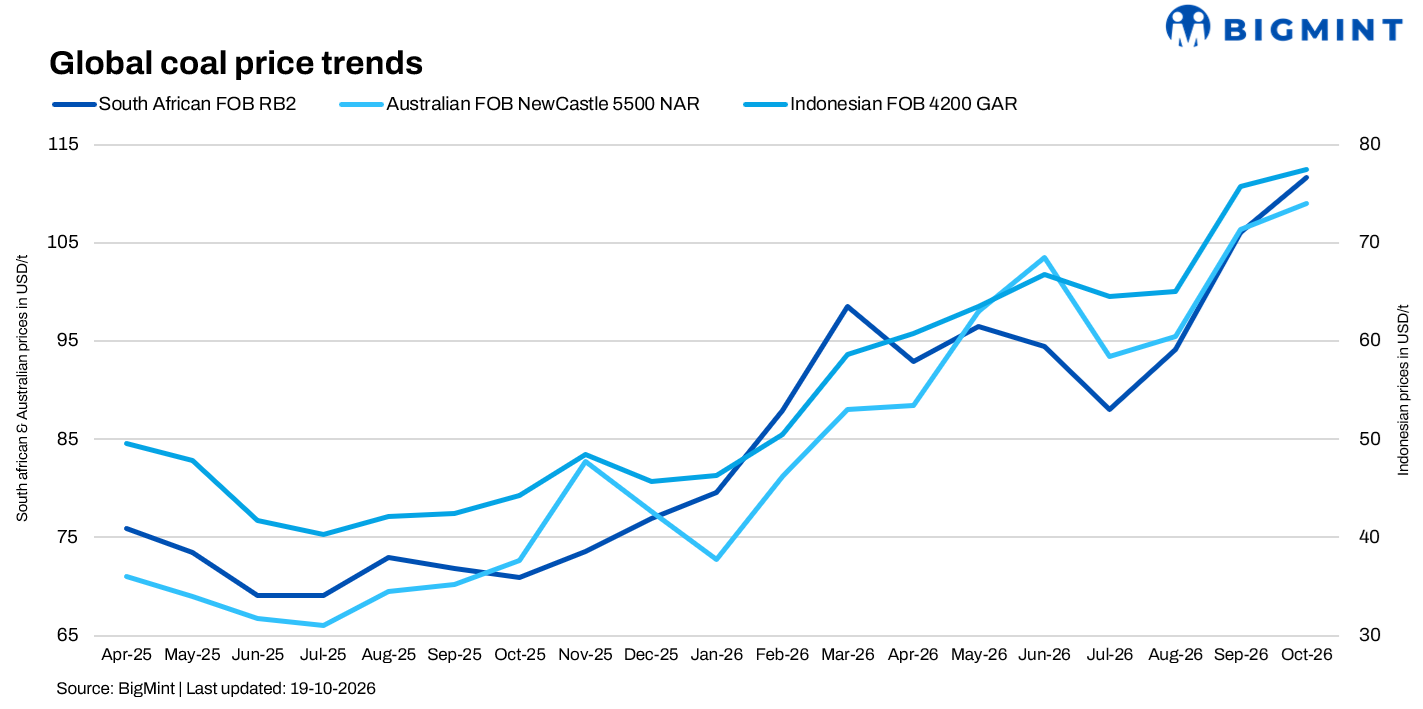
Asian thermal coal markets strengthened during the week ended 16 October 2026, supported by higher Chinese domestic prices, Indonesian supply constraints and demand for winter cargoes.
However, rising offers did not translate into equally strong transactions. Buyers remained sensitive to delivered costs, while Indian consumers benefited from improving domestic availability and fresh imported cargoes.
The result was a widening divergence between firm export prices and cautious purchasing at destination markets.
China provides the clearest price signal
Chinese domestic coal prices recorded their strongest weekly increase in the four-week series reviewed.
The Qinhuangdao 5,500 NAR marker rose RMB31/t to RMB1,028/t, equivalent to $152.95/t. Other grades also strengthened, with percentage increases ranging from approximately 2.8% to 3.8%.
Higher domestic prices encouraged interest in imported coal, particularly for winter procurement. Railway maintenance and the pace of domestic supply recovery remained important influences on availability.
Nevertheless, firmer prices and enquiries do not establish a uniform shortage. Buyers continued to compare domestic and imported supplies rather than accept every higher offer.
Australian 5,500 NAR records higher transactions
Australian 5,500 NAR coal provided the clearest physical transaction signal. A November-loading 20,000-tonne parcel traded at $116/t FOB during the latest week, compared with November transactions at $111-112/t a week earlier.
A separate $115.50/t Cape transaction remained unconfirmed. November Panamax business was also recorded at API5 plus $2.75/t.

Previous Indian portside levels calculated from reported weekly changes. International entries distinguish markers, bids, offers and trades; they are not a single comparable assessment series.
Australian coal also received support from Japanese, South Korean and Taiwanese demand, alongside expensive gas. However, fuel switching depends on available generating capacity and operating economics.
For Newcastle 6,000 NAR, the supplied weekly series contained bids and offers but no fixed-price trades. January quotations therefore indicate negotiating positions rather than a confirmed clearing price.
Indonesian logistics and policy constrain supply
Low water levels in key Indonesian rivers continued to hamper barging and loading. Such restrictions can delay the conversion of mine output into cargoes ready for export.
Domestic supply obligations also affected availability from some branded mines, supporting premiums on export offers.
Uncertainty over 2027 RKAB production approvals and domestic obligations complicated term negotiations. Sellers were seeking contractual protection against changes in permitted output or export availability, while some discussions remained on hold.
These pressures support offers but do not quantify the volume of coal unavailable. Conditions differ between mines and loading locations.
November 4,200 GAR quotations included an $80.50/t bid and $82/t offers. Separate market feedback recorded a specification-specific cargo to China at $81.50/t FOB, illustrating why transactions should be assessed individually.
Smaller Asian markets seek alternatives
Bangladesh, Vietnam and Thailand showed interest in medium- and higher-energy cargoes. South Korean enquiries included higher-energy, low-sulphur Indonesian material.
Expensive preferred grades encouraged buyers to examine alternatives, but competing coals were also firm. Switching therefore did not necessarily reduce delivered fuel costs.
Chinese tender offers reinforced the selective nature of demand. November 5,500 NAR material was offered at RMB1,040/t DDP, compared with RMB997.5/t for November delivery in the earlier October data.
Lower-energy offers were more varied. Tender submissions establish seller expectations, not concluded purchases or market-clearing prices.
India moves differently from export markets
Indian portside Indonesian coal prices softened as buyers purchased cautiously and domestic coal became more competitive.
On 16 October, 5,000 GAR stood at approximately INR 11,700/t ex-Kandla and INR 11,600/t ex-Vizag, down INR 100/t week-on-week. The 4,200 GAR grade eased INR 50/t to INR 9,800/t and INR 9,700/t respectively.
Non-coking stocks at ports tracked by BigMint increased 0.32 Mnt to 13.39 Mnt during 4-10 October. Improved availability reduced the urgency to accumulate expensive inventories.
Domestic competition strengthened too. Ex-Bilaspur 4,500 GCV coal stood at INR 6,200/t, while 5,000 GCV was INR 8,700/t. Weaker sponge iron economics further restrained purchasing.
South African and US supplies face affordability resistance
South African export offers remained firm, but Indian sponge iron producers largely bought against immediate requirements. A brief railway interruption on 10-11 October highlighted logistics risk; services resumed, limiting evidence of a lasting export shortage.
Fresh US cargoes eased western-port scarcity. NAPP retail indications clustered around INR 18,200-18,800/t by 13-16 October, below early-October highs.
Cement producers continued evaluating imported coal against expensive petcoke and domestic alternatives. Coal quality and usable heat remained decisive.
Freight provides mixed relief
Freight did not move uniformly higher. Australian Panamax freight to Paradip increased to approximately $25.50/t, while South African freight on the route declined to $22.60/t.
Kalimantan Supramax rates to western India also softened. However, Singapore VLSFO bunker prices rose to around $910/t, keeping vessel operating costs elevated.
Lower freight on selected routes could moderate landed costs, but did not eliminate the pressure from firm coal offers.
Outlook
The market’s central tension is between constrained replacement supply and buyers’ ability to pay.
Chinese prices and Indonesian loading difficulties support export offers. Indian port inventories, cheaper domestic coal and weak industrial margins limit their immediate transmission into local prices.
Further gains will depend on completed purchases, sustained winter requirements and actual cargo availability. Post-festive Indian restocking could improve demand, but remains a prospective driver rather than an established recovery.
Leave a Reply