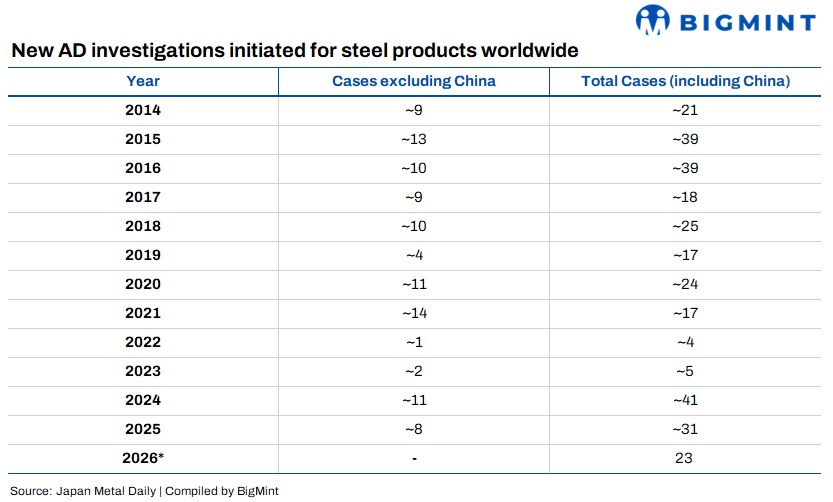
- Antidumping cases increased to 41 in CY’24 from 4-5 in CY’22-23
- Rising non-tariff measures, such as steel standards, restricting free trade
The number of new anti-dumping (AD) measures targeting steel products worldwide is expected to reach a high level again this year. As of early September, there were 23 cases, approaching last year’s total of 31 for the entire calendar year.
Not only are AD measures expanding, but safeguard measures (emergency import restrictions), tariff measures based on each country’s domestic law, and non-tariff measures are also increasing. The narrowing of freedom in steel trade and the concern that steel materials that have nowhere else to go will flow into each country are likely to trigger a chain reaction of new trade measures that is unlikely to subside anytime soon.
While the number of new AD projects remained at only four-five per year from 2022 to 2023, it reached a record high of 41 in 2024, the year China’s steel exports exceeded 100 mnt. Since then, new projects have continued to emerge in a variety of countries and for different types of materials.
AD cases against Japan
The number of AD cases against Japanese steel products is also increasing. This year, Mexico has started an investigation into heavy steel plates, and India has begun an investigation into hot-rolled steel sheets and grain-oriented electrical steel sheets (GOES). There are also ongoing investigations, such as one by the EU concerning cold-rolled steel sheets, which is expected to be finalised by the end of the year, and another by Brazil concerning tinplate.
Furthermore, since June, Thailand has been conducting a review of its AD measures regarding hot-rolled steel sheets (sunset review). It is unprecedented for so many cases against Japan to be progressing simultaneously, forcing Japan to respond to investigations.
Impact on steel prices
What’s even more striking are the measures being imposed comprehensively on all countries, rather than targeting specific nations. This year, the EU has launched an investigation into GOES, South Africa into cold-rolled steel sheets, and the Eurasian Economic Commission, composed of Russia and five other countries, has begun an investigation into tinplate.
As domestic laws offer greater flexibility than the Stabilization Guarantee (SG), some countries are imposing tariff measures. Typical examples include Section 232 of the Trade Expansion Act in the United States and the successor measures implemented by the EU in July for 26 steel products, replacing the safeguard. As a result, steel prices in the US are steadily rising, and in Europe, ArcelorMittal, the largest manufacturer, has announced a EUR 20/t price increase for its hot-rolled coils to EUR 790/t (approximately $915/t) for November shipments.
Rising non-tariff walls
Among non-tariff measures, there are moves to use mandatory standards requiring imported steel materials to meet domestic standards. In India and Indonesia, obtaining and renewing certifications has become difficult in some cases, and most recently, Mexico announced that it would apply mandatory standards (NOM) to construction steel materials from August, but the specific HS codes and certification procedures remain unclear, effectively making exports impossible. Amid the review of the USMCA free trade agreement, barriers to imported steel materials are also rising in Canada and Mexico, stemming from the US.
Note: This article is published as part of an article sharing agreement between Japan Metal Daily & BigMint
Leave a Reply