- October coal loading rises 22.5% y-o-y
- Higher dispatches yet to see stock rebuilding
Indian Railways’ record coal loading in October signals a substantial response to rising electricity sector fuel requirements. However, power-plant inventories show that higher transportation activity has yet to create a sustained surplus of deliveries over consumption.
Coal loading increased 22.5% y-o-y during 1-18 October 2026, with 87 additional rakes dispatched daily compared with the corresponding period last year, according to a Ministry of Railways release issued on 22 October.
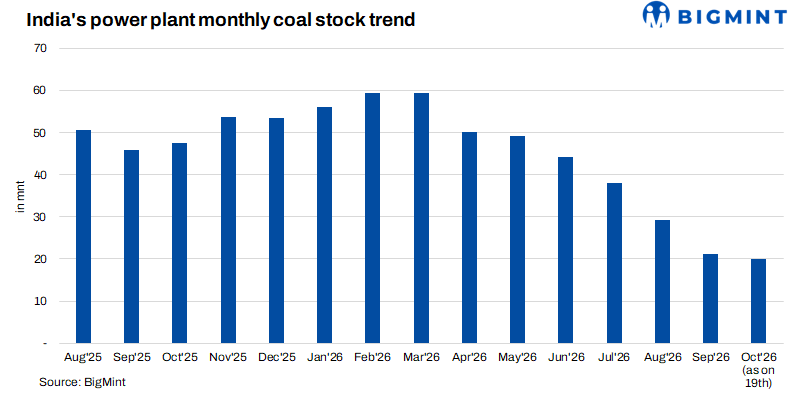
The improvement is significant. Yet CEA National Power Portal data show that power-plant coal stocks declined to 19.78 mnt on 21 October, with 100 plants classified as critical.
The challenge has therefore moved beyond increasing train loading alone. The next test is whether the entire delivery chain can supply enough coal, consistently and to the right plants, to rebuild depleted inventories.
Railways steps up coal evacuation
The October loading increase follows stronger railway performance through the first half of FY27.
During April-September, Indian Railways dispatched an average of 430 coal rakes daily to thermal power plants, up 7.1% year-on-year. This implies approximately 401 rakes daily in the corresponding period last year-an increase of around 29 rakes a day.
September rake dispatches increased 14% year-on-year, according to the release, with October showing a further acceleration.
The October figures of 22.5% growth and 87 additional daily rakes mathematically imply approximately 474 rakes a day against 387 a year earlier. These are indicative calculations from rounded figures, rather than separately disclosed railway totals.
Importantly, the release explicitly identifies the first-half figure as thermal-power-plant traffic, while describing October’s headline measure as coal loading. The two should not automatically be treated as identical traffic categories.

Coal India’s dispatches run ahead of production
Coal India produced 45.32 mnt during 1-21 October against a cumulative target of 46.93 mnt. Dispatches reached 46.55 mnt, exceeding the corresponding target of 44.65 mnt.
The dashboard reported production growth of 22.3% and dispatch growth of 19.2%. Dispatches exceeded production by approximately 1.23 mnt, indicating that existing coal inventories continued to support deliveries.
Singareni produced 3.683 mnt and dispatched 3.690 mnt, achieving 105.3% and 100.7% of their respective cumulative targets.
These figures demonstrate a supply response at the mining end. They do not establish how much coal reached individual power plants: dispatches cover different customers and transport modes, and coal can remain in transit after leaving a mine.
Higher train loading has brought supplies closer to balance
During 15-21 October, monitored power plants received 18.15 mnt of coal against consumption of 18.81 mnt – a shortfall of approximately 0.66 mnt.
Receipts covered 96.5% of consumption. This is close to balance, but insufficient to rebuild stocks.
Daily performance remained uneven. Receipts exceeded consumption on 17 October, and stocks briefly improved. However, sizeable deficits returned on 19 and 21 October.
On 21 October alone, receipts were 2.33 mnt against consumption of 2.62 mnt, leaving a deficit of approximately 0.29 mnt.
Such fluctuations matter when inventories are already thin. A strong loading performance across a fortnight can coexist with inadequate deliveries at particular plants on individual days.
Greater exposure remains at non-pithead plants
Domestic-coal-based plants held 17.56 mnt on 21 October, down from 18.01 mnt on 15 October. Their critical count increased from 84 to 94.
Within this group, non-pithead plants held approximately 13.88 mnt, equivalent to 27% of normative stocks. Pithead plants held 3.68 mnt, or 48% of normative requirements.
This difference highlights the importance of dependable transport for plants located away from coalfields.
The plant-level position was also uneven. Haryana’s Panipat station held 21,000 t, equivalent to 10% of normative stock, after receiving 4,900 t against daily consumption of 11,500 t on 21 October.
Nevertheless, the available data do not isolate whether individual shortfalls arose from rake availability, loading, transit, unloading, coal allocation or other operating factors. National train-loading growth cannot resolve those questions by itself.
Imported coal-based plants also draw down inventories
Plants designed for imported coal held 2.22 mnt on 21 October, down from 2.43 mnt on 15 October. Six remained critical.
Their stocks were healthier in aggregate at 56% of normative requirements, compared with around 30% for the broader domestic-coal-based group. Even so, their inventories were also declining.
The pressure is therefore not confined to domestic railway deliveries, although rail evacuation remains central to supplying inland power stations.
BigMint assessment
The railway loading record demonstrates that India’s coal logistics system is responding forcefully. Higher mine dispatches and additional train movements have helped bring power-plant receipts much closer to consumption.
But sustained inventory rebuilding has not begun.
The immediate priority is maintaining higher loading while improving delivery consistency across routes and receiving stations. Faster wagon unloading and return, reliable mine-to-siding movement and targeted deliveries to critical plants will determine how effectively additional train capacity translates into fuel security.
For consumers, the decisive indicator is now whether receipts exceed consumption for several consecutive weeks. Until that happens, record loading represents meaningful progress, while depleted power plant stocks leave the system exposed to renewed demand or delivery disruptions.
Leave a Reply