- Chinese copper smelter maintenance could tighten refined metal supply
- Rio Tinto commits $1.9 billion to Queensland bauxite expansion
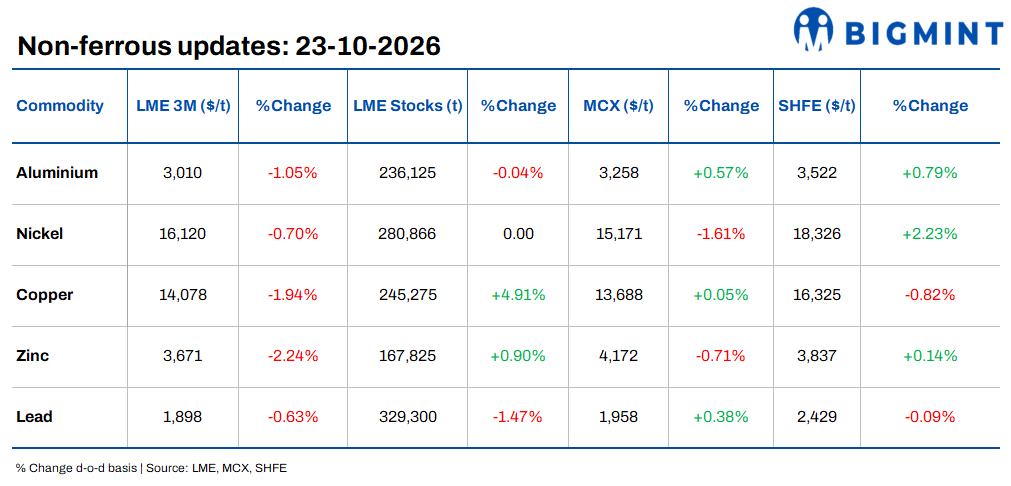
LME base metals traded lower on 22 October. Zinc recorded the steepest d-o-d decline, falling 2.24% to $3,671/t, followed by copper, down 1.94% to $14,078/t. Aluminium slipped 1.05% to $3,010/t, while nickel declined 0.70% to $16,120/t. Lead registered the smallest decline, easing 0.63% to $1,898/t.
LME inventories recorded mixed movements. Copper stocks posted the largest increase, rising 4.91% to 245,275 t, followed by zinc, up 0.90% to 167,825 t. Lead inventories fell 1.47% to 329,300 t, while aluminium stocks edged down 0.04% to 236,125 t. Nickel inventories remained unchanged at 280,866 t.
Domestic market overview
India’s non-ferrous market showed mixed movements, with aluminium scrap prices unchanged, P1020 ingot lower and copper armature scrap weaker.
Aluminium tense scrap (loose) remained unchanged at INR 239,000/t ex-Delhi and INR 243,000/t ex-Chennai. P1020 aluminium ingot declined by INR 500/t, or 0.15%, to INR 327,000/t from INR 327,500/t. MCX aluminium gained 0.57% d-o-d to INR 3,258/kg.
Meanwhile, copper armature scrap (Cu 99%), ex-Delhi, fell by INR 10,000/t, or 0.75%, to INR 1,325,000/t from INR 1,335,000/t. MCX copper edged up 0.05% d-o-d to INR 13,688/kg.

Other updates
Oil rises as Middle East supply concerns intensify
Brent crude gained 0.7% to $113.98/barrel on 23 October as geopolitical tensions heightened concerns over regional supply security. In particular, Houthi attacks on Saudi Arabia and escalating tensions near the Bab el-Mandeb shipping corridor renewed concerns about tanker movements. Meanwhile, Saudi Aramco evacuated its Dhahran headquarters amid intensifying fighting. Separately, Libya’s oil production faced disruption after a valve closure affected the Hamada and Tahara oilfields. Together, these developments have kept attention focused on potential supply disruptions and the security of key energy transport routes.
Chinese copper smelters plan further production cuts
Chinese copper smelters are preparing additional maintenance as concentrate shortages and lower sulphuric acid prices continue to squeeze processing margins. In total, seven smelters have reportedly scheduled maintenance lasting 30–60 days during October and November, potentially reducing refined copper supply by around 80,000 tonnes. Meanwhile, the widening gap between smelting capacity and available feedstock is adding pressure to the sector. Consequently, the impact on copper prices and physical premiums will depend on the actual scale of production losses.
Indonesian nickel producers consider output reductions
Chinese-backed nickel producers, including Tsingshan, GEM, Lygend Resources and Zhejiang Huayou Cobalt, are discussing potential output cuts at Indonesian high-pressure acid leaching (HPAL) plants. Under one proposal, participating producers would reduce output by around 30%, primarily affecting mixed hydroxide precipitate used in battery-grade nickel production. However, no final agreement has been confirmed. Meanwhile, weak nickel prices, higher ore and sulphur costs, tighter ore quotas and water shortages have weighed on operating economics. As a result, the effect on nickel supply will depend on whether the proposed cuts proceed and how extensively they are implemented.
Rio Tinto commits $1.9 billion to Queensland bauxite project
Rio Tinto plans to invest $1.9 billion in the Kangwinan bauxite project in Queensland, Australia, targeting first production in 2029 and full output by 2032. The project will add 20 million tonnes/year of gross production capacity and replace output from the ageing Andoom mine. It will also raise Weipa’s annual capacity from approximately 38 million to 44 million tonnes. Furthermore, the investment will help compensate for the planned closure of the Gove mine in 2029, strengthening long-term raw material supply for Rio Tinto’s aluminium operations.
Southern Copper evaluates $680 million Cuajone expansion
Southern Copper is assessing a $680 million expansion of its Cuajone mine in Peru to increase milling capacity by 33%, from 90,000 to 120,000 tonnes/day. Under the proposal, the expanded operation could deliver average annual production of 55,000 tonnes of copper and 1,400 tonnes of molybdenum. Additionally, the company is studying a larger option that would raise capacity to 150,000 tonnes/day. However, the expansion remains under evaluation, and no final investment decision or commissioning schedule has been confirmed. Therefore, any additional supply would depend on the project’s eventual approval and implementation.
Leave a Reply