- Stronger dollar and yields pressured prices
- Weak Chinese demand limited consumption-led support
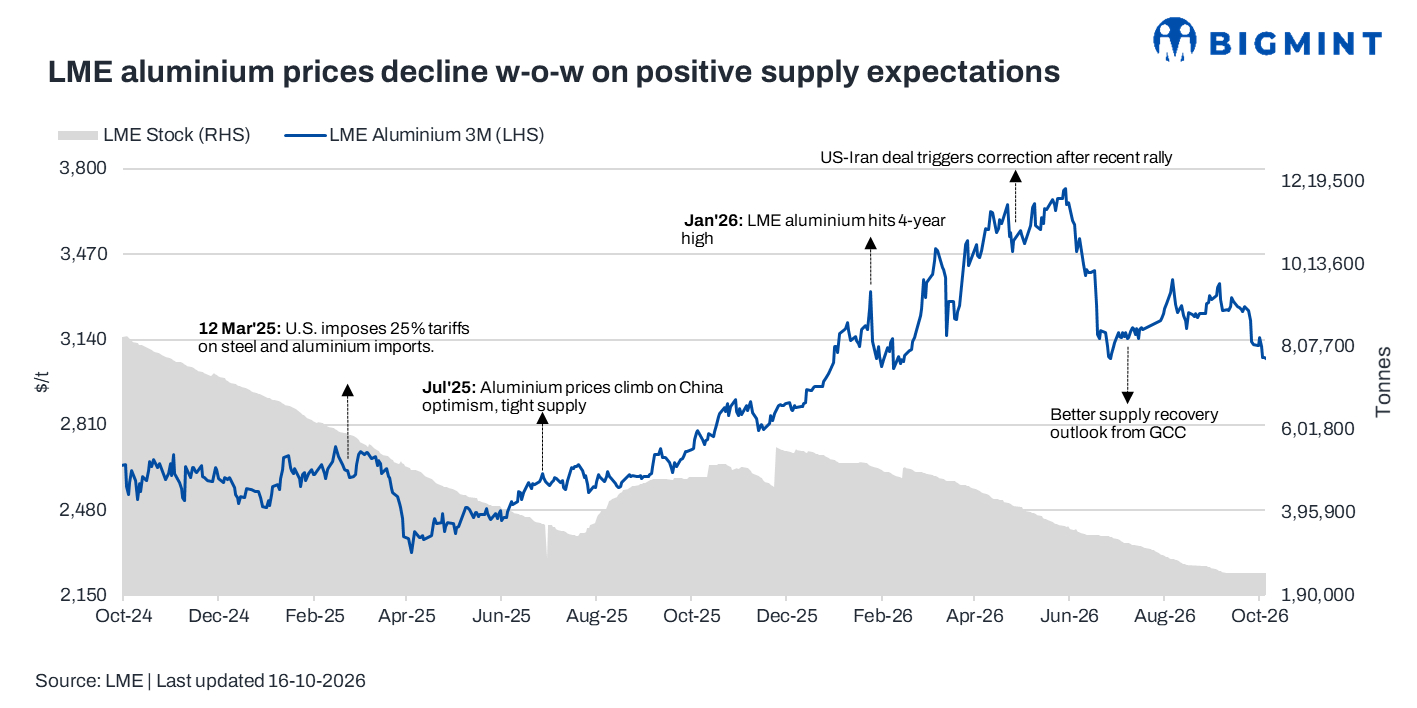
LME three-month aluminium prices declined by $80/t, or 3% w-o-w, to $3,024/t from $3,104/t in the week ended 16 October, reflecting continued weakness in the global aluminium market.
Meanwhile, LME aluminium inventories declined by 850 t, or 0.4% w-o-w, to 238,325 t from 239,175 t. Prices continued to decline despite falling LME aluminium stocks at registered warehouses.
Factors weighing on LME aluminium prices
LME aluminium prices remained under pressure during the week as expectations of improving global supply and subdued demand outweighed concerns over supply disruptions. Although Iranian missile attacks on Gulf smelters and restrictions around the Strait of Hormuz have disrupted nearly 3 mnt of aluminium production capacity, prices have remained just above $3,000/t, indicating that the market has largely discounted the impact of these disruptions. Faster-than-expected Middle Eastern smelter restarts, expanding Indonesian production capacity, and higher Chinese aluminium output and exports reinforced expectations of improved metal availability. Lower Japanese import premiums also signalled subdued demand and reduced supply tightness, limiting support for LME prices.
Broader macroeconomic pressures and cautious buying further weakened market sentiment. A stronger US dollar and elevated US Treasury yields reduced investor appetite for dollar-denominated metals, while subdued downstream demand in China limited consumption-led price support. Meanwhile, expectations of rising global supply and uncertainty over the pace of demand recovery overshadowed declining LME inventories. These factors kept aluminium prices under pressure despite persistent geopolitical risks and ongoing supply-chain disruptions.
Outlook
LME aluminium prices are likely to remain under pressure in the near term amid expectations of improving global supply, a stronger US dollar and subdued downstream demand. Faster-than-expected Middle Eastern smelter restarts, rising Indonesian capacity and higher Chinese production could weigh on prices.
Leave a Reply