- Lower coke costs offer limited relief to steelmaker
- Blast furnace maintenance increases amid squeezed mill profitability
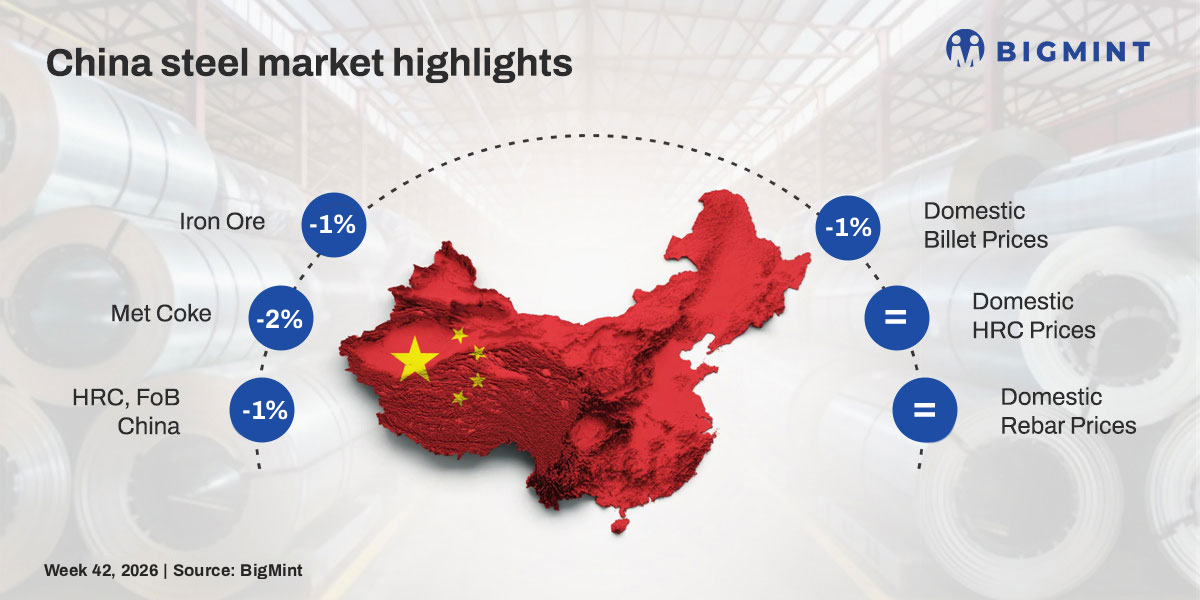
China’s domestic steel market remained under pressure during the week, as weak downstream demand and cautious buying limited price support. Meanwhile, elevated mill inventories and squeezed steelmakers margins added to the challenges, keeping a sustained recovery out of reach. Against this backdrop, HRC prices edged up marginally, while rebar and billet prices declined w-o-w. Additionally, falling met coke, coking coal and iron ore prices pointed to continued weakness in raw material demand.
Inventories in early-October
The China Iron and Steel Association (CISA) reported that total steel inventories at key CISA-affiliated mills stood at 16.97 million tonnes (mnt) during early October (1-10 October 2026), up 1.32 mnt or 8.4% from 15.65 mnt in late September. On a m-o-m basis, inventories increased by 450,000 tonnes (t) or 2.7% from 16.52 mnt in early September. Furthermore, y-o-y, stocks rose by 1.09 mnt or 6.9% from 15.88 mnt in the corresponding period last year.
This increase came amid weak downstream demand and cautious buying following China’s National Day holiday, which slowed steel stock clearance. Although major mills reduced production in early October, subdued demand continued to limit inventory drawdowns, keeping stock levels elevated and adding pressure on steel prices.
Domestic steel prices show mixed trends
Domestic HRC prices edge up w-o-w: China’s Domestic HRC prices remained largely stable w-o-w, with a marginal increase of RMB 3/t ($1/t) to RMB 3,178/t ($475/t) as of 16 October from RMB 3,175/t ($474/t) in the previous week. However, SHFE HRC futures for the November 2026 contract declined by RMB 11/t w-o-w to RMB 3,245/t from RMB 3,256/t previously.
Despite the marginal increase in spot prices, the HRC market remained under pressure as demand recovery following China’s National Day holiday fell short of expectations. Prices continued to decline early in the week, while transactions of lower-priced material improved towards Thursday. Meanwhile, steel mills began reducing output amid squeezed profit margins. However, supply remained relatively high, and the improvement in trading activity was insufficient to support a sustained price recovery.
Additionally, Chinese HRC export offers declined by $5/t w-o-w to around $505/t FOB Rizhao from $510/t previously, as softer raw material costs and weak domestic demand weighed on prices amid subdued trading activity.
Baosteel, one of the world’s leading steel producers, kept its domestic hot-rolled coil (HRC) prices unchanged m-o-m for November 2026 sales, following a RMB 200/t ($30/t) increase for October sales.
The price revision came amid subdued downstream demand and easing raw material costs, which continue to limit support for finished steel prices. Demand recovery remains uncertain amid continued weakness in China’s property market, while lower coking coal and coke prices have eased steelmaking cost pressures. Meanwhile, continued losses among steelmakers could prompt production cuts, potentially helping reduce supply pressure.
Domestic Rebar prices edge down w-o-w: China’s domestic rebar prices were marginally down by RMB 3/t ($1/t) w-o-w to around RMB 3,158/t ($471/t) on 16 October from RMB 3,160/t ($472/t) in the previous week. Meanwhile, SHFE rebar futures for the November 2026 contract declined by RMB 8/t ($/t) w-o-w to RMB 3,076/t ($/t), from RMB 3,084/t ($/t) in the previous week.
Rebar prices fluctuated within a narrow range following China’s National Day holiday, as the recovery in construction demand remained weaker than expected. Although activity at some construction projects improved during the week, overall demand growth remained limited and trading activity subdued. Meanwhile, squeezed profitability prompted steel mills to increase blast furnace maintenance, while environmental controls and equipment maintenance in several regions contributed to further shutdowns. However, the improvement in downstream demand remained insufficient to support a stronger price recovery.
Meanwhile, Shagang Group, one of China’s largest steel producers, kept its long steel list prices unchanged for mid-October (11-20 October) 2026 sales. Rebar (16-25 mm) remained at RMB 3,450/t ($515/t), coiled rebar (8-10 mm) at RMB 3,580/t ($535/t) and wire rod (6-10 mm) at RMB 3,490/t ($521/t), unchanged from the first ten days of the month.
The decision came amid subdued trading activity and weak downstream demand, with low transaction volumes reflecting limited improvement in market conditions. Meanwhile, steel mill profitability remained under pressure despite two rounds of coking coal price cuts. Although lower coke costs offered some relief to integrated steelmakers, weak finished steel demand continued to constrain margins.

Raw materials prices
Weak steel margins and elevated port inventories weigh on buying interest: Iron ore fines benchmark prices (Fe 61%) declined by $1/t w-o-w to $90/dmt CFR China on 15 October 2026. Market sentiment remained subdued as limited improvement in steel mill margins and weak spot trading activity continued to weigh on demand. Market participants held mixed views on the impact of ongoing term contract negotiations for Pilbara Blend Fines (PBF), with some expecting stronger demand after their conclusion, while others anticipated a limited impact as buyers continued selective procurement at prevailing prices.
Meanwhile, iron ore port stock prices declined for the fourth consecutive day amid elevated inventories and weak steel mill profitability. Limited availability of actively offered stocks further constrained market liquidity, keeping trading activity subdued and reinforcing cautious market sentiment.
a) Spot pellet premium remain steady w-o-w: Spot pellet premium for Fe 65% grade pellet remain stable w-o-w to $26.25/t CFR China on 14 October.
b) Spot lump premium edge up w-o-w: Spot lump premium edge up by $0.005/t w-o-w to $0.2410/t CFR China on 15 October.
Met coke prices fall w-o-w amid weak steel demand: China’s second round of met coke price cuts took effect nationwide on 12 October, bringing cumulative reductions to RMB 200-220/t ($30-33/t) since 1 October. A third round of cuts is anticipated as weak steel demand, squeezed steelmakers margins and uncertain consumption prospects continue to pressure the market. However, resistance from coke producers facing limited profitability may moderate the pace of further reductions.
Although post-holiday restocking initially supported demand, the momentum proved short-lived as steelmakers remained cautious amid subdued end-user consumption and persistent margin pressures. Continued weakness in China’s steel sector is likely to constrain domestic coke procurement and limit the scope for a sustained recovery in international met coke prices, potentially weighing on market sentiment in India.
Meanwhile, the global coking coal market also weakened during the week amid subdued spot demand and cautious buying. Australian premium hard coking coal (PHCC) FOB prices declined by $2/t week-on-week (w-o-w) to around $268/t, while BigMint’s PHCC index fell by $2/t w-o-w to $293/t CNF Paradip on 16 October. Weakness in Chinese coke prices and limited restocking interest continued to dampen buying sentiment, adding further pressure to the international met coke supply chain.
Billet prices decline w-o-w amid weak domestic demand: Chinese billet prices fell by RMB 20/t ($4/t) week-on-week to RMB 2,940/t ($440/t) on October 16 from RMB 2,960/t on October 9. SHFE rebar futures declined by around RMB 23/t to RMB 3,074/t ($460/t), while billet export offers rose by $4/t to $464/t FOB.
Domestic steel demand remained weak as the Golden October peak season failed to deliver a meaningful recovery in consumption. However, declining social inventories, unchanged mill base prices and steady export demand provided some support. Logistics constraints and tighter export allocations also limited market activity.
Raw material trends were mixed, with softer iron ore and coking coal prices weakening cost support, while firm coke demand offered some offset. Overall, sluggish domestic consumption continued to weigh on billet prices, while export demand and lower inventories limited further downside.
Outlook
With downstream demand expected to remain subdued, China’s steel market is likely to stay under pressure in the coming week. Elevated mill inventories and squeezed steelmakers margins are expected to limit price recovery, although production cuts and maintenance may help ease supply pressure. Meanwhile, lower met coke, coking coal and iron ore prices may continue to weaken cost support, while further coke price cuts remain possible amid subdued steel demand. HRC prices may remain relatively stable as lower output offers some support, whereas rebar and billet prices may face continued pressure if end-user consumption fails to improve.
Leave a Reply