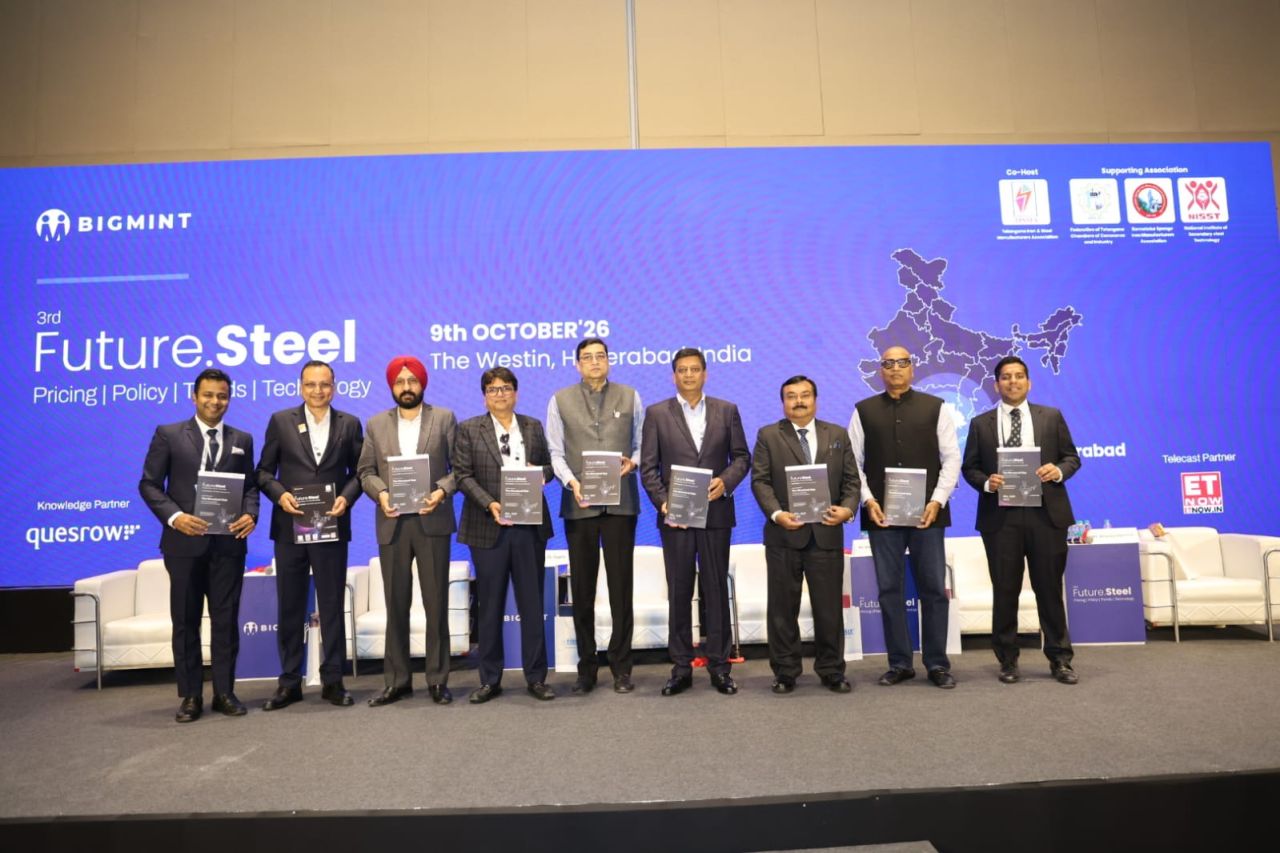
BigMint held the third edition of Future.Steel on 9 October 2026 at The Westin, Hyderabad, co-hosted by the Telangana Iron & Steel Manufacturers Association (TISMA). Industry participants discussed South India’s widening demand-supply gap, raw material security, green steel certification, price indexing and the growth strategies of regional steelmakers.
Key takeaways:
South India: Demand outpacing supply
- Demand in the South is projected to rise from about 35 mnt to 52 mnt over the next four to five years, with flat products accounting for about 10 mnt of the increase.
- The region’s current deficit of about 5 mnt is projected to widen to about 10 mnt by FY’30 despite roughly 15 mnt of planned additions, keeping it dependent on eastern India.
- The South has an HRC surplus of 1.5-1.7 mnt, but deficits in CRC, coated products, plates, alloy steel and structurals are widening. Plates have no regional production.
- The South contributes about one-third of India’s GDP but holds only about one-fifth of capacity. Its share of demand rises to 34-37% for high-value products.
- Southern mills are better placed to compete on value-added grades, service centres and proximity to customers than on scale, said Rahul Joshi of Quesrow Research & Strategy.
Inaugural: Telangana’s case as a steel hub
- South India contributes over one-third of India’s GDP but produces only 18-20% of its steel, an opportunity for Telangana to shift from consuming to manufacturing steel.
- Raw material availability and energy costs were identified as the key constraints for southern producers. FTCCI President KK Maheshwari expects a shortfall in HRC production.
- Despite being landlocked, Telangana’s central location, improving rail links and new inland logistics infrastructure, including a dry port, strengthen its case as a production centre.
- Metro rail, highways, irrigation, defence, EVs and renewables are expected to drive demand. One large infrastructure contractor said it consumes over 1.5 mnt of steel a year.
- Buyers judge steel on specifications, not on whether it comes from primary or secondary mills, said N. Gopal, calling for a five-year push on quality consistency in the secondary sector.
Raw materials: Falling ore grades, coking coal risk
- The share of 65% Fe+ ore in domestic output has fallen from about 20% in FY’17 to about 11% in FY’26, making beneficiation increasingly critical.
- Karnataka’s average ore grade has slipped to about 64% Fe from 66% Fe even as steelmakers tighten specifications, squeezing ore and pellet suppliers in the South.
- Coking coal remains import-dependent, with Australia supplying about 54%. Higher freight and geopolitical developments have raised prices, and supply security risk was rated high.
- DRI requirement is projected to rise by about 25%, and DRI-IF producers need pellets of consistent quality, with specifications that differ from BF grades.
- Acquiring mines is not enough; captive mines must be developed and operated efficiently to secure supply, a JSW Steel panellist said.
Green steel certification: Data gaps and manpower
- Under the Ministry of Steel’s taxonomy, steel below 1.6 tCO2/tfs is rated five-star, while steel above 2.2 tCO2/tfs does not qualify as green.
- NISST certified around 12 mnt of green steel in one year and over 9 mnt so far this year. Director Parmjeet Singh indicated that usage mandates could follow, though none have been announced.
- Rolling mills relying on default emission factors for inputs may never qualify as green. Pellet producers could certify their emissions and command a premium of INR 40-100/t.
- Certification costs about INR 3.5/t for a 1 lakh tpa producer. Process optimisation alone can cut emissions by 5-7%, and efficiency gains should precede a switch to renewable power.
- Trained manpower was flagged as the biggest open question for India’s 2030 capacity target. Certified producers received Green Steel Certificates on stage.
South India demand: Infrastructure pipeline, higher grades
- Major projects could add 6-8 mnt of steel demand in the South over the next three to five years, with heavy plates and pipes a significant share. The region has no plate production.
- National consumption is projected to rise from about 154 mnt in FY’26 to about 250 mnt by FY’31, with data centres, power and manufacturing as the next growth drivers.
- TMT demand is moving towards Fe 500D and 550D grades, and seismic construction is raising the focus on ductility and weldability. Builders are increasingly willing to pay a premium for quality.
- Regional producers supply about 20% of TMT demand, but rising quality awareness is pushing the market towards larger brands.
- Value-added uptake in Telangana remains limited, with builders reluctant to pay INR 2,000-3,000/t extra for welded mesh.
- Higher coal, power and raw material costs have raised steelmaking costs by about 25-30%, a panellist said.
Power quality: SVGs to cut tariffs and penalties
- With most states moving to kVAh billing and utilities penalising harmonics under IEEE 519, power quality has become a direct cost issue for steel plants, said Baldev Raj Narang of Clariant Power System.
- Capacitor banks typically plateau at a power factor of about 0.995, while static var generators (SVGs) respond within about 5 milliseconds and can hold it near 0.999.
- Payback was put at about 6-20 months, with many installations recovering their cost within a year.
- Captive solar capacity is adding higher-order harmonics that passive filters cannot address, requiring active or hybrid filtering.
Mid-sized integrated plants: A third route to capacity
- India needs to add about 10 mnt of capacity a year to reach 300 mnt by 2030 and 600 mnt by 2047, said Manoj Kumar of R. Singh & Associates.
- Blast furnace-based plants of 0.5-1 mtpa can bridge the gap between large integrated plants and 0.3-0.5 mtpa secondary units.
- Capex was estimated at INR 50,000-55,000/t for mid-sized BF plants, against INR 42,000-48,000/t for larger BF plants and INR 30,000-35,000/t for DRI-IF plants.
- Lower land, power and water needs allow such plants to be located near demand centres, though a 0.5 mtpa plant requires about 1.8 mnt of raw materials a year.
AI automation: Gains in the back office
- The biggest near-term gains from AI lie in automating manual data entry and verification in ERP systems such as SAP and Tally, said Yash Puri of NYX Solutions.
- AI agents can verify purchase documents and GST portal data within about a minute, flagging mismatches in price, weight and vehicle number before ERP entry.
- Converting POs directly into invoices prevents rate-entry errors, such as invoicing INR 200/t below the PO price, that add up across volumes.
- AI works as a layer over existing ERP systems, allowing companies to scale volumes without adding staff.
Price indexing: From negotiation to formula
- Steel prices now change daily and at times hourly, making a common benchmark essential as the market grows towards 300 mnt.
- One producer recently signed a 120,000 t/year contract referenced to BigMint’s Chennai price, at a premium or discount of about INR 500/t.
- Index-linked formulas cut negotiation time and build trust, replacing informal price tracking through calls and WhatsApp.
- A wire rod buyer said a steel index mapped to WPI would simplify price variation clauses in EPC contracts, but cautioned that an index improves transparency, not material availability.
- Raw material suppliers, including PSUs, are unwilling to commit beyond a week to 10 days, and over a full year contract prices tend to average close to spot.
- DRI prices often signal market turning points early. A broad participant base, statistical normalisation and independent audits were cited as safeguards against index manipulation.
Scrap outlook: ELV recycling gathers pace
- Process scrap from automotive stamping is concentrated in the North, at about 1.2 mnt, with lower generation in the South, said Kanthesh Shetty of Quesrow Research & Strategy.
- EPR obligations for vehicle makers are now mandatory, met through RVSF certificates on the CPCB portal, and will tighten further from 2026.
- Informal buyers offering immediate cash and better prices continue to limit volumes reaching formal scrapping facilities.
Jai Raj Ispat: Scaling a regional steelmaker
- Jai Raj Ispat aims to reach 5 mtpa of capacity within 10 years, expanding long products while adding flat and value-added products.
- Regional producers compete on efficiency, quality and customer relationships rather than capital. Endless casting and rolling has lifted the company’s yield to about 99%, against a typical 96-97%.
- The speakers described green steel as largely a marketing gimmick in price-sensitive India, though export buyers already set renewable energy requirements. They argued efficiency gains can make it pay without a premium.
- Price volatility can only be managed through working capital discipline and buffer stocks. Scale and competition were named as the biggest risks over the next five years.
MS Agarwal Group: Discipline, quality and expansion
- The group produces about 0.8 mtpa from three units and plans a further 0.5 mtpa, with work expected to begin next year, said Chairman Pramod Agarwal.
- Infrastructure spending and Telangana’s housing schemes are expected to keep steel demand strong over the next decade.
- Agarwal stressed financial discipline: no diversion of funds, prompt collection of receivables and no short-term funding for long-term investments.
- In contrast to the Jai Raj view, he expects buyers to become increasingly willing to pay a premium for green steel.
Leave a Reply