- BF rebar rises on project demand, IF market shows mixed trends
- HRC, CRC trade prices rise by INR 500-600/t after mill price hikes
- Flats prices may rise INR 1,000-1,500/t but inventory situation normalises
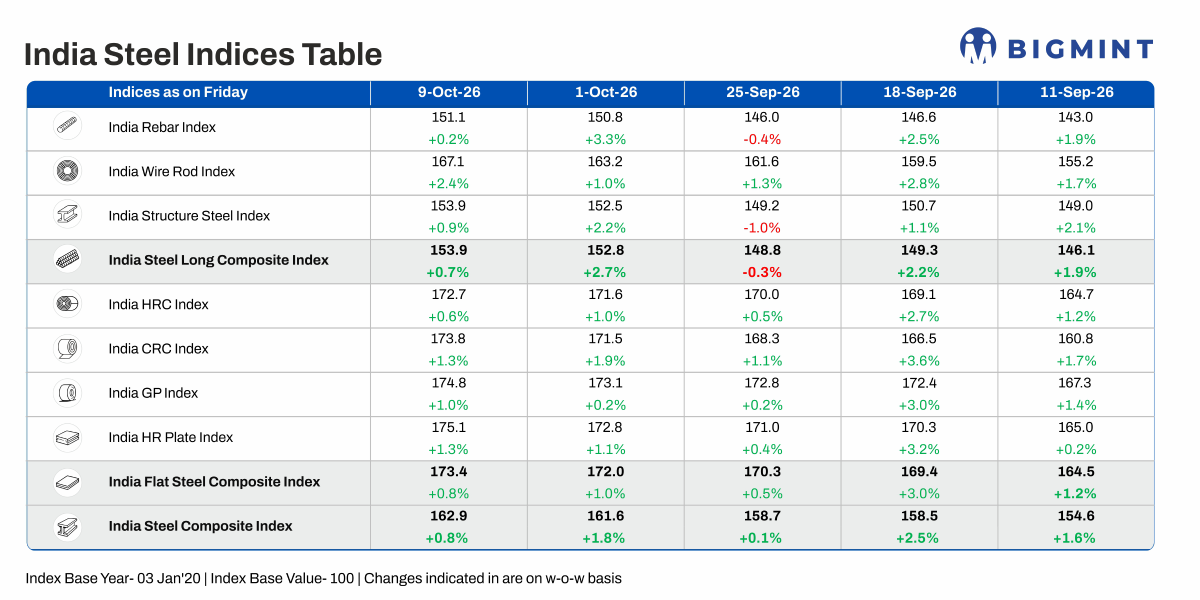
Morning Brief: BigMint’s India steel composite index increased by 0.8% w-o-w as of 9 October 2026, following a sharper 1.8% rise in the previous assessment. The index has now reached its highest level in four years and four months, with the latest level continuing to remain around the highs last seen in June 2022.
The w-o-w moderation in the composite index was accompanied by relatively balanced gains across the two major segments. The long steel index increased by 0.7% w-o-w, while the flat steel composite index rose by 0.8%. This compares with gains of 2.7% and 1%, respectively, in the previous assessment.

The latest movement suggests that the steel market remains firmly in an uptrend, but the pace of price acceleration is beginning to moderate after the sharp gains seen through September and early October. The underlying drivers, however, remain largely intact: tight availability in parts of the market, firm mill pricing, improving post-monsoon consumption and elevated input costs.
BF rebar physical market sentiment remains strong: BigMint’s assessment for rebar (IS 1786 Fe 550D, 12–32 mm, BF route) increased by INR 800/t w-o-w to INR 63,900/t on 9 October, up from INR 63,100/t on 1 October. Prices are ex-Mumbai for the distributor-to-dealer segment and exclude 18% GST.
The increase was supported by improved buying activity, particularly from project requirements. At the same time, several mills resumed production after scheduled maintenance, although the pace at which supply is returning to the market remains an important variable for price direction.
Project sales were heard at around INR 64,000-66,000/t landed, indicating that buyers are still willing to procure at elevated levels, partly because of expectations of further price increases and concerns over prompt availability. Several mills also raised list prices by around INR 1,000/t.
This is significant because the rebar market is showing a combination of improving demand and constrained supply rather than merely a cost-driven price increase. Trade-level BF-route rebar has consequently reached a multi-year high.
The secondary market picture is less bullish. IF-route rebar prices moved by INR 200-1,300/t across markets, supported by higher coal costs and elevated production expenses, but spot trading remained subdued-to-moderate. Mill inventories were estimated at around 8-10 days.

The primary route rebar segment is being driven increasingly by supply availability and project demand, while the secondary segment continues to face buyer resistance at elevated prices.
HRC gains supported by supply and mill pricing: BigMint’s bi-weekly assessment for HRC (IS 2062, Grade E250, 2.5–8 mm/CTL) rose by INR 600/t w-o-w to INR 64,700/t ex-Mumbai on 9 October, compared with INR 64,100/t a week earlier. CRC (IS 513, Grade O, 0.9 mm/CTL) increased by INR 500/t w-o-w to INR 74,600/t from INR 74,100/t on 1 October. Prices exclude 18% GST.
The latest increase appears more dependent on mill pricing and supply conditions than on a broad-based acceleration in consumption. Major domestic mills raised HRC list prices by INR 750-1,500/t and CRC prices by INR 750-2,000/t. Part of these increases has been reflected in the trade market, but the full extent of the hikes is yet to be absorbed.
Demand remains largely requirement-driven. Inventory availability is comfortable across markets, with ample material held by traders and distributors. This creates a different market dynamic from rebar. In rebar, the lack of prompt availability is supporting outright price increases, whereas in HRC the ability of mills to push higher prices will depend on how quickly trade-level buyers absorb the latest hikes.
Lower HRC imports, higher exports support prices: Import data provide support to the domestic price trend. India’s bulk HRC imports declined 10% m-o-m to 136,082 t in September from 151,741 t in August. September arrivals were also 23% lower q-o-q than the 552,313 t recorded in Q1FY’27. Lower shipments from China and Japan were the main reason.
Importantly, imported HRC does not appear to be directly competing with the bulk of domestic trade volumes to the same extent as headline import numbers might suggest. A significant portion is linked to downstream manufacturing, particularly pipes and tubes and export-oriented production, with the Advance Authorisation Scheme remaining an important channel.
At the same time, Indian HRC exports increased 17% m-o-m to 299,413 t in September. Exports were 29% higher q-o-q at 889,325 t, supported by bookings into the European Union following the opening of the new quota cycle.

The combination of lower imports and higher exports is providing significant support to flat steel prices.
Raw material costs continue to provide a floor: The broader cost environment is also preventing steel prices from correcting sharply. Despite a marginal w-o-w correction, coking coal prices are around 45% higher y-o-y, while domestic non-coking coal prices are edging higher amid lower auction volumes and dispatch related constraints.
BigMint’s Odisha iron ore index remains stable while pellet prices in central India increased INR 300/t w-o-w. and pellet prices had also increased.
Outlook
The steel market is entering a more balanced phase after the sharp price increases recorded during September and early October.
Rebar is likely to remain relatively firm because of tight prompt availability and project demand, although the return of production following maintenance could gradually ease supply pressure.
For HRC, further upside will depend increasingly on the absorption of recent mill price hikes. Market participants are indicating a potential upside of around INR 1,000-1,500/t. But demand remains need-based and inventories are comfortable, which could limit the speed at which higher mill offers translate into trade prices.
The supply side, however, remains supportive. Lower HRC imports, stronger exports and limited fresh export availability from Indian mills are keeping the domestic market relatively tight.
Overall, steel prices are likely to remain firm in the near term, but the next leg of the rally will increasingly depend on whether demand catches up with producer price expectations.
Leave a Reply