- Pacific Capesize remains supported by steady miner demand, tighter tonnage
- Atlantic and India-China markets face pressure from subdued enquiries, ample vessel availability
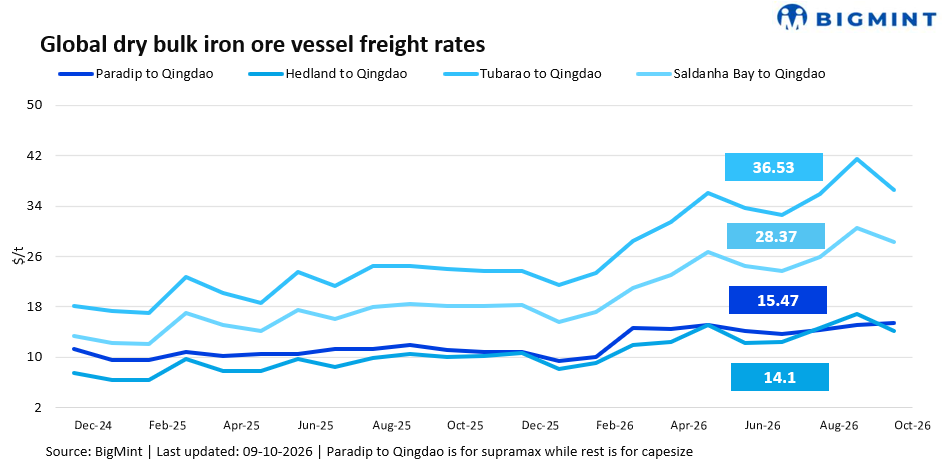
Dry bulk iron ore freight sentiment was mixed in the week ended 9 October. India-China Supramax rates softened amid subdued cargo enquiries, cautious Chinese buying and ample prompt tonnage. Lower regional demand and limited spot fixing activity further weakened owners’ bargaining power.
Pacific Capesize sentiment remains firm as Western Australia-China rates continued to strengthen, supported by steady iron ore demand expectations, fresh miner enquiries and relatively tighter prompt tonnage. Despite thin fresh requirements from traders, fixing activity remained healthy.
Atlantic Capesize sentiment remains weak, South Atlantic rates continued to decline amid a persistent surplus of ballasters, ample vessel availability and limited fresh cargo enquiries. Brazil-China fell sharply while Saldanha Bay-China eased, reflecting soft regional demand.
A shipbroker informed, “The freight market remains bullish, with owners holding firm on rates. We are currently fixing on a time-charter (TC) basis, although numbers remain challenging.”
Route-wise update

Freight and commodity indicators
- Baltic Dry Index declines: The Baltic Dry Index (BDI) fell by 140 points, or 4%, to 2,973 on 8 October from 3,113 on 30 September, reflecting continued weakness in the dry bulk freight market, primarily driven by the Capesize segment. The Baltic Capesize Index (BCI) declined by 419 points, or 9%, to 4,509, and the Supramax Index (BSI) increased by 10 points, or 1%, to 1,807. The decline in Capesize rates suggests persistent pressure from subdued cargo enquiries and weaker China-bound iron ore demand, while smaller vessel segments showed relative resilience.
- DCE iron ore futures decline sharply: The benchmark DCE iron ore contract fell by RMB 20/tonne (t), or 2.8% w-o-w, to RMB 682.5/t on 9 October, from RMB 702.5/t on 1 October. Prices remained under pressure from weak steel margins, subdued downstream demand and cautious mill buying, while expectations of post-holiday restocking may provide some support.
- Bunker prices rise w-o-w: Singapore Very Low Sulfur Fuel Oil (VLSFO) increased $51.5/t (6.1%) w-o-w to $896.5/t as of 9 October, from $845/t on 1 October. The rise reflects renewed crude-price and Middle East supply concerns, increasing fuel-cost pressure on vessel operators and supporting firmer voyage economics.
- Brent crude futures rise w-o-w: December Brent crude futures increased $3.74/barrel (bbl) (3.7%) w-o-w to $104.28/bbl as of 9 October, from $100.54/bbl on 1 October. The rise reflects renewed concerns over Middle East supply disruptions and geopolitical tensions, keeping crude and marine-fuel markets volatile and adding upward pressure on voyage economics.

Outlook
Dry bulk freight sentiment is expected to remain mixed in the near term, with Pacific Capesize rates likely to find support from steady Australian iron ore flows and tighter prompt tonnage. However, weak Chinese steel margins, lower DCE iron ore prices and cautious mill buying could constrain cargo demand. In the Atlantic, surplus tonnage and subdued enquiries are likely to keep rates under pressure, while elevated bunker costs may limit the downside and encourage owners to maintain firmer rate expectations.
Leave a Reply