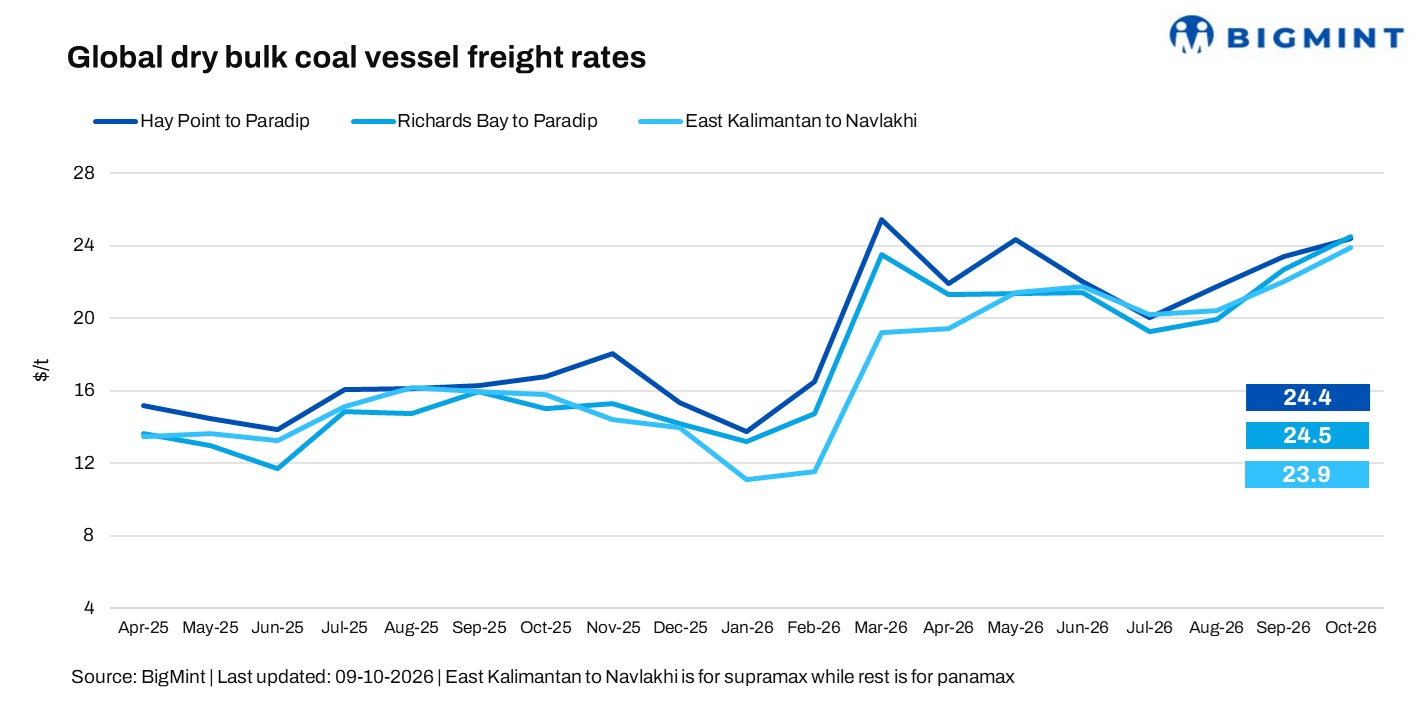
- Panamax gains on Australian coal demand, while South African route softens
- Supramax holds firm as owners resist lower offers amid selective Indonesian activity
India-bound coal freight markets showed mixed trends in the week ended 9 October 2026, with Pacific rates supported by steady cargo demand and vessel activity, while South Africa-India Atlantic freight softened amid subdued enquiries and relatively comfortable vessel availability. Market sentiment remained route-specific, with Pacific rates finding support from stronger demand, while limited fresh cargo activity in the Atlantic market weighed on freight levels.

Panamax firms on Australian demand, South African route eases
Panamax freight from Hay Point to Paradip strengthened, supported by firm Australian coal demand and improving inter-Pacific activity. The South African route moved in the opposite direction, with limited fresh fixtures and cautious chartering weighing on freight sentiment.
A shipbroker said, “the market remained firm, with further momentum expected next week as more inter-Pacific coal cargoes enter the market. Some traders unable to match Supramax freight levels have shifted their parcels to Panamax and Kamsarmax vessels, adding support to demand across vessel segments.”
“Market activity has been slow, with no firm fixtures emerging on Friday. Freight rates remain very high, and some buyers are finding it difficult to match current levels,” another shipbroker said, adding that import demand remained selective.
Supramax holds firm despite selective Indonesian demand
Supramax freight on both East and South Kalimantan-Navlakhi routes edged higher, supported by firm owner offers and resistance to lower rate ideas. However, high freight levels and selective cargo enquiries continued to limit stronger spot activity.
“Overall sentiment remains firm. Rates corrected slightly after reaching higher levels a few days ago, but the market continues to hold strong. Panamax rates are a little below recent highs, while Supramax rates have remained broadly steady,” a broker mentioned.
Owners are also showing a preference for time-charter business rather than accepting lower freight offers. The market remains sensitive to vessel availability, cargo timing and weather-related disruptions, which could influence fixing decisions in the coming days.
Dry bulk indicators diverge as bunker and crude prices rise
- Baltic Dry Index (BDI) declines w-o-w: The BDI fell 4.5% (140 points) to 2,973 as of 8 October, from 3,113 on 30 September, reflecting continued pressure on the broader dry bulk market. In contrast, the Panamax index rose 1.1% (27 points) to 2,411, while the Supramax index edged up 0.6% (10 points) to 1,807, indicating relative resilience in both segments.
- Bunker prices rise w-o-w: Singapore very low sulphur fuel oil (VLSFO) increased 6.1% ($51.5/tonne (t)) to $896.5/t as of 9 October, from $845/t on 1 October. Higher fuel costs are adding pressure to voyage economics and may reinforce owners’ resistance to lower freight offers.
- Brent crude futures rise w-o-w: December Brent crude futures climbed 3.7% ($3.74/barrel (bbl)) to $104.28/bbl as of 9 October, from $100.54/bbl on 1 October. Renewed geopolitical and Middle East supply concerns are keeping crude and marine fuel markets volatile, adding uncertainty to shipping costs.
- DCE coke futures recover w-o-w: January 2027 Dalian Commodity Exchange (DCE) coke futures rose 3.1% (RMB 61.50/t; $9.28/t) to RMB 2,020/t ($301.39/t) as of 8 October, from RMB 1,958.50/t ($292.11/t) on 1 October, signalling a modest recovery in futures prices.

Outlook
BigMint expects Panamax freight to remain supported by Australian coal demand and a stronger flow of inter-Pacific cargoes, although high rates may continue to limit charterer interest. South African freight will depend on fresh cargo enquiries and fixing activity.
Supramax sentiment is likely to remain firm as owners resist lower offers, while selective Indonesian demand could restrict stronger gains. Rising bunker costs and potential storm-related disruptions remain key factors to watch.
Overall, the market retains a firm undertone, but the next move will depend on fresh cargo flow, vessel availability and charterers’ willingness to accept prevailing freight levels.
Leave a Reply