- Domestic spot HRC reaches INR 64,000/t in end-Sep, equivalent to $670/t
- Dollar valuation still remains 17% below June 2022 levels
India’s steel hot rolled coil (HRC) market presents an important divergence. Domestic prices have reached their highest monthly average since May 2022 in Indian rupees, while their US dollar equivalent remains below mid-2022 levels. The interaction between a recovering steel market and a weaker rupee has different consequences for producers, buyers and importers.
BigMint’s provisional September 2026 domestic HRC average stands at INR 62,800/t ex-yard Mumbai, equivalent to $660/t. In June 2022, the same benchmark was around INR 62,000/t, or $790/t.
For Indian buyers, steel has regained its earlier price level. On a common-currency comparison, it remains approximately 17% cheaper. That difference matters when judging the strength of the rally and its impact across the value chain.
Currency changes how global prices reach India
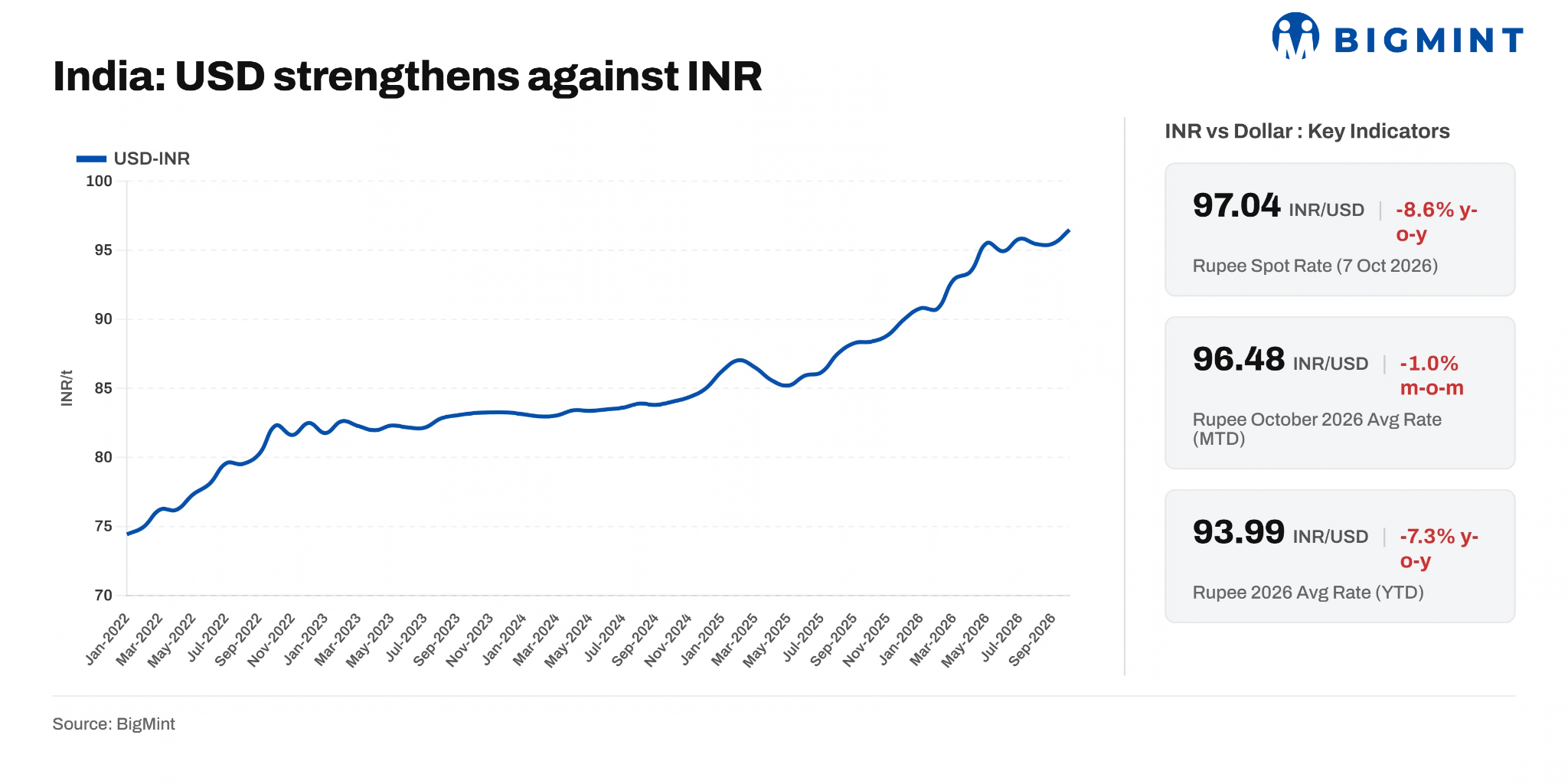
The rupee cost of one dollar increased from INR 78.09 in June 2022 to approximately INR 95.39 in September, representing a 22.2% appreciation of the dollar against the rupee.
This shift changes the transmission of international prices into the domestic economy. Lower overseas dollar quotations can be partly absorbed by currency depreciation before the benefit reaches Indian consumers. Rising dollar prices and a weakening rupee can, in turn, combine to increase procurement costs.
Currency also influences the level at which imported steel becomes competitive. At unchanged overseas quotations, a weaker rupee raises landed import costs and can provide domestic mills with greater pricing room. Whether mills can use that room depends on buying appetite, availability and the cost of competing supplies.
So the exchange rate affects the domestic price environment, but it does not independently determine the steel price.
September’s rally extends beyond depreciation
The latest increase is visible in both currencies. Domestic HRC rose from approximately INR 58,600/t in August to INR 62,800/t in September, while its dollar equivalent increased from $610/t to $660/t.
Both increased by approximately 7.3% m-o-m, with the exchange rate broadly stable.
Since December 2025, HRC has recovered from INR 47,100/t, or $520/t. The increase amounts to 33.4% in rupees and 25.9% in dollars.
Depreciation explains part of the stronger rupee-price recovery over time. September’s movement, however, represents an increase in the domestic steel quotation beyond the currency effect.
Higher prices do not automatically mean stronger margins
Currency affects both sides of a steelmaker’s business. Dollar export earnings translate into more rupees, while imported raw materials and equipment become more expensive.
A higher HRC quotation may consequently reflect improved pricing power, recovery of input costs, or both. The headline price alone cannot establish whether profitability has improved.
The more useful measure is the spread between realised steel prices and production costs, allowing for raw material purchase timing and inventory costs. Producers with different import exposure, export shares and hedging arrangements can experience materially different outcomes from the same exchange rate movement.
This makes the distinction between a price recovery and a margin recovery particularly relevant in the current market.
Domestic recovery outpaces Asian export benchmarks
India’s provisional September HRC export benchmark for the Middle East and Southeast Asia averaged approximately $540/t FOB compared with $510/t for China and $540/t for Japan.
Domestic HRC’s dollar equivalent of $660/t was around $150/t above China FOB and $120/t above India’s own Middle East/SE Asia export benchmark. Both gaps were approximately $60/t in December 2025.
The widening differences indicate that domestic prices have recovered faster than these export benchmarks. They cannot be treated as equivalent differences in mill netbacks because specifications, delivery terms, freight and other costs vary.
Nevertheless, the divergence raises a commercial question: how long can the domestic quotation gap widen before imports become more attractive or buyers resist further increases?
India’s EU-directed benchmark, at approximately $640/t FOB, remains closer to the domestic dollar equivalent. Its separate destination and product basis makes it a different commercial comparison from Asian export business.
Buyers face working capital challenge
Domestic buyers pay in rupees. A lower dollar valuation compared with 2022 limits direct relief to businesses procuring steel and selling finished goods within India. Higher HRC prices increase the cash required to maintain the same physical inventory. If downstream selling prices adjust more slowly, pipe producers and fabricators can face pressure on both margins and working capital.
Rising prices may initially encourage purchases ahead of further increases. Sustained market strength, however, requires downstream demand to absorb the higher costs. Order book coverage, actual dispatches and inventory replenishment are more useful indicators of durability than price announcements alone.
For export-oriented downstream manufacturers, currency depreciation may support overseas revenue, but the benefit depends on how much of their cost base also rises.
Outlook
Further rupee weakness could increase import costs and support rupee export realisations, while also raising imported input costs. A rupee recovery could ease those pressures.
Neither movement guarantees a matching change in domestic HRC quotations. The durability of the rally will depend on whether downstream demand supports current prices, whether overseas offers narrow the landed cost gap, and whether steel realisations improve faster than production costs.
India’s HRC at four-year high in rupees carries a real cost for domestic steel consumers. Its lower dollar valuation reflects the substantial exchange rate shift since 2022, while September’s increase confirms that the latest rally extends beyond currency.
The key question now is whether current prices can be sustained by demand and margins as the gap with overseas benchmarks widens.
Leave a Reply