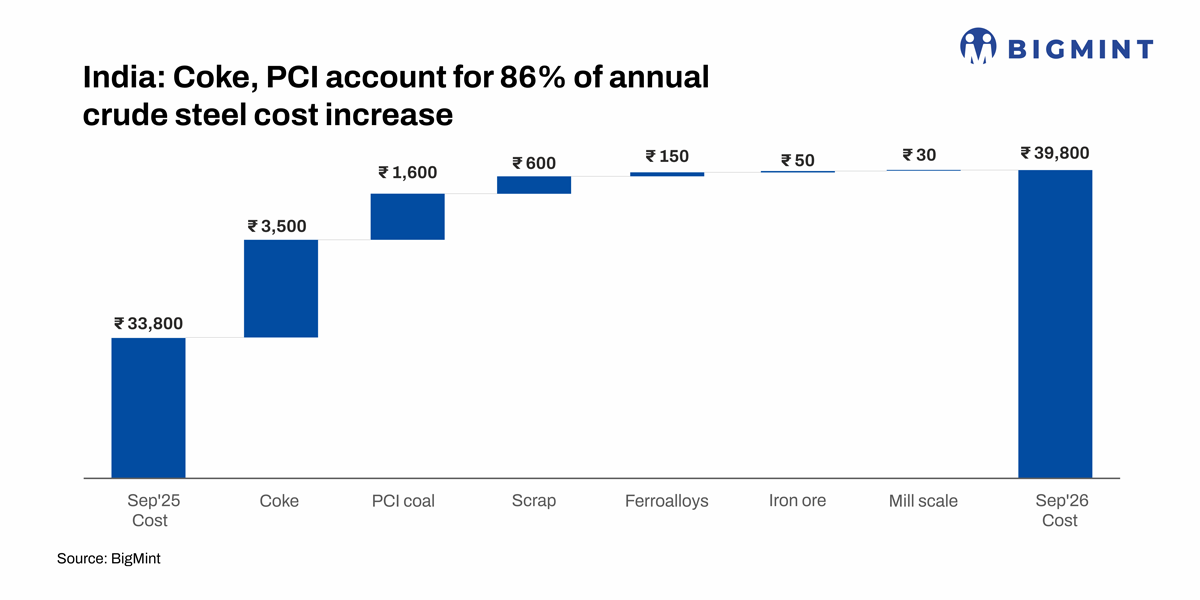
- Modelled crude steel cost rises to INR 39,700/t in September
- Coke and PCI drive 86% of annual cost surge
Data Deep Dive: India’s integrated steelmaking costs have risen sharply, with coal-based fuels accounting for most of the increase. The development strengthens the case for mills to recover higher costs through steel prices, although their ability to pass on the increase will depend on buying appetite and competing supply.
BigMint’s analysis of a reference blast furnace-basic oxygen furnace (BF–BOF) model estimates crude steel cost at INR 39,700/t in September 2026, up approximately INR 6,000/t, or 17.7%, y-o-y. This is the highest level in the January 2025-September 2026 period.
Costs also increased by around INR 2,500/t, or 6.6% m-o-m, in September, the largest monthly rise during the period, indicating that pressure accelerated towards the end of the quarter.

Coal-based fuels drive cost increase
Coke and pulverised coal injection (PCI) together contributed approximately INR 5,100/t, accounting for 86% of the annual cost increase. Coke added around INR 3,500/t, while PCI contributed INR 1,600/t.
Their combined share of modelled crude steel cost increased to nearly 41%, from about 33% a year earlier. Iron ore, despite accounting for almost 23% of total cost, remained broadly neutral.
Stable iron ore costs offer limited relief when coke and PCI costs rise sharply, making purchase timing, supplier diversification and fuel efficiency increasingly relevant.
Current costs move above historical budget levels
The increase in cost extends beyond a single month. Modelled crude steel cost averaged INR 37,900/t in Q2 FY27, up 12.4% y-o-y, while the H1 FY27 average reached INR 37,000/t, up 10.2%.
September’s cost was approximately INR 5,700/t above the FY26 average. For producers, this gap means budgets based on historical annual costs may understate current procurement exposure.
For buyers using cost-linked contracts, the increase brings fuel weights and adjustment periods into focus. Escalation requests need to reflect the relevant cost basket and procurement timing, rather than applying a uniform increase across all inputs.

Stronger steel prices offer support, margin risk remains
The reference analysis shows that benchmark HRC prices increased faster than modelled HRC costs over the year. The indicative price-cost spread widened from approximately INR 13,900/t to INR 20,400/t, an increase of around INR 6,500/t.
This suggests stronger benchmark pricing relative to the modelled cost base. It does not represent realised operating margins, which also depend on sales realisations, inventory costs, product mix and procurement lags.
The commercial risk lies in the timing of any reversal. If steel prices soften while fuel costs remain elevated, the spread could narrow quickly. Higher input costs provide a reason for mills to seek price increases, but sustained recovery requires downstream demand to absorb them.
Procurement discipline becomes more valuable
A simultaneous 10% movement in coke and PCI prices changes modelled crude steel cost by approximately INR 1,600/t. This sensitivity underlines the value of staggered purchasing and reviewing exposure to fuel price movements.
Changes to the coke-PCI balance also require careful evaluation. A lower-priced input does not automatically deliver equivalent savings, as replacement ratios, fuel quality and furnace operating limits determine the actual benefit.
Downstream buyers face a related challenge. Higher steel procurement costs increase working capital requirements, while slower adjustments in finished product prices can squeeze margins. The ability to pass on costs matters across the value chain.
Outlook
Coal-based fuel prices will remain a key variable for the modelled BF-BOF cost base. Relief in coke and PCI could ease production costs, while continued firmness would sustain pressure on mills to defend realisations. Global coking coal prices will be primarily shaped in the last quarter of CY’26 by the supply situation in China, which will remain a key variable.
The efforts of all leading BF-BOF producers to lessen their exposure to volatile imported coking coal prices through diversification, cutting down the coke rate through different means including higher PCI usage, trials with alternative fuels and biofuels and blending of domestic coal in the coke mix will be the key determinants in lessening the cost exposure of the primary mills.
Leave a Reply