- Coal supplies 72% of incremental generation as hydro output falls 20% y-o-y
- Generation grows at 7% CAGR since 2022; renewables expand but coal keeps rising
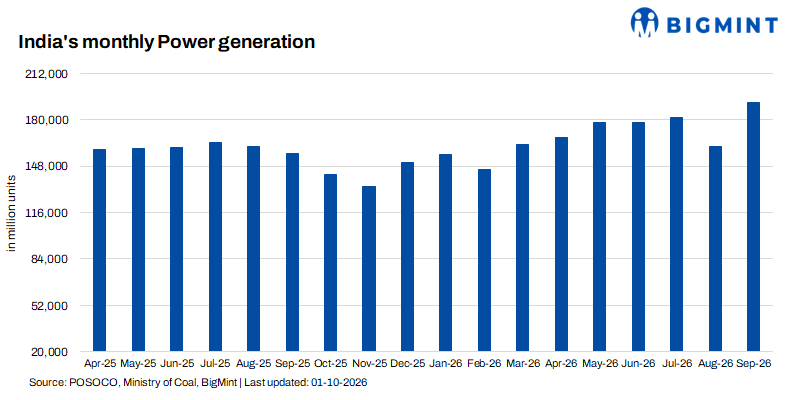
India’s electricity generation reached 535.73 TWh in Q3 2026, up 11.1% year on year and the highest quarterly total since 2022, according to official Grid India data monitored daily by BigMint. Renewable energy generation crossed 100 TWh for the first time in a quarter, yet coal supplied most of the additional electricity as hydro production declined sharply.
The quarter illustrates the central feature of India’s evolving power system: renewables are expanding rapidly, but rising electricity requirements and fluctuations in hydro output continue to sustain substantial coal generation.
Q3: coal and renewables expand together

Coal generation increased by 38.36 TWh, accounting for 71.6% of the net increase in electricity production. RES added another 24.64 TWh, equivalent to 46.0% of the increase. Their combined contribution exceeds 100% because hydro’s 14.48 TWh decline offset part of the gains from other sources.
Coal’s generation share consequently rose from 63.3% to 64.1%, even as the RES share increased from 15.8% to 18.8%. Hydro’s share fell from 15.4% to 11.2%.
Renewables therefore helped meet higher requirements, while coal also compensated for weaker generation elsewhere.
Hydro weakness reduces monsoon relief for coal
Q3 has consistently been the strongest hydro quarter since 2022. Hydro generation ranged between 62.13 TWh and 74.22 TWh during Q3 2022-2025, but fell to 59.74 TWh in 2026 the lowest Q3 figure over this period.
Coal generation still eased from the summer quarter, declining 4.7% from Q2 2026. However, that seasonal reduction was much smaller than the 8.0% decline in 2025 and 14.0% in 2024.
The figures show weaker monsoon-quarter relief for coal this year, although generation data alone do not establish the respective contributions of rainfall, reservoir conditions and operational factors to lower hydro output.
Combined hydro, nuclear and RES generation increased in absolute terms, but their share of total output declined from 33.8% in Q3 2025 to 33.0%. Strong renewable growth could not fully protect the non-fossil share against the hydro shortfall and faster overall generation growth.
Since 2022 – a larger system with a changing mix
A like-for-like January-September comparison shows total generation rising 31.0% between 2022 and 2026. Over the same period, RES output increased 89.9%, coal generation rose 27.6% and nuclear output expanded 52.3%. Hydro generation declined 7.4%.

RES is gaining a substantially larger role in electricity production, particularly since 2025. Its January-September 2026 output was already equivalent to 98% of its entire 2025 generation.
Nevertheless, coal remains the largest contributor to the system’s expansion. Of the 361.08 TWh increase in January-September generation since 2022, coal supplied 225.87 TWh, or 62.6%. RES contributed 125.39 TWh, or 34.7%.
Coal’s share is gradually declining, but its absolute generation remains higher. That distinction is essential when assessing future fuel requirements.
Generation grows at 7% CAGR; RES leads expansion
Total generation recorded a compound annual growth rate of 7.0% between January-September 2022 and the corresponding period in 2026. RES expanded at 17.4% annually, substantially faster than coal’s 6.3%. Nuclear also grew faster than the overall system, while hydro contracted.

The faster growth of RES is changing the generation mix. However, coal’s continued expansion demonstrates the scale of additional electricity that the system must supply.
2025 coal decline has not continued
Full-year coal generation fell 3.0% in 2025, while total generation increased only 1.1%. RES grew 22.2% and hydro 14.7%, allowing other sources to meet the modest increase in overall output while reducing coal generation.
January-September 2026 presents a different balance. Total generation rose 7.7% and RES increased 25.8%, but hydro fell 11.8%. Coal generation consequently increased 6.6%.
The reversal shows why one year of lower coal output cannot establish a sustained decline. The outcome depends on both electricity growth and the availability of alternative generation.
Nuclear reached 47.32 TWh in January-September 2026, but still accounted for approximately 3.1% of generation. Gas, naphtha and diesel supplied only 1.3%, leaving a limited contribution despite their Q3 recovery.
Record renewables growth, higher coal generation
India’s power system is diversifying, but electricity growth continues to absorb additional generation from both coal and renewables. Q3 demonstrates that record renewable output can coexist with higher coal generation when overall requirements accelerate and hydro weakens.
For coal suppliers and utilities, a declining generation share should therefore be distinguished from declining fuel demand. Coal-fired output remains substantial, although actual fuel consumption also depends on plant efficiency and coal quality.
The next test is whether renewable and nuclear additions can consistently outpace electricity growth while hydro recovers. Until then, coal will remain important for meeting incremental requirements and compensating for shortfalls elsewhere in the generation mix.
Leave a Reply