- H1CY’26 imports rise 1% y-o-y as higher US shipments offset disruptions from traditional suppliers
- Stronger Chinese buying, shifting global trade flows and tighter European supplies reshape procurement
- Importers increasingly diversify sourcing while favouring higher-recovery scrap grades
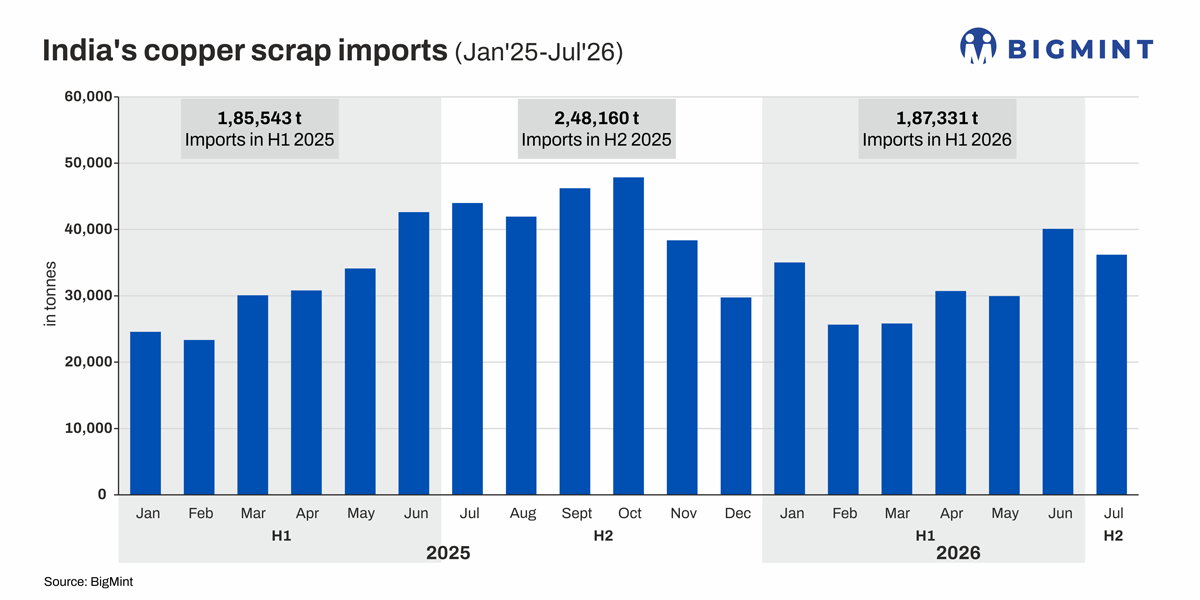
India imported 187,331 tonnes (t) of copper scrap during the first half of 2026, up 1% from 185,543 t in the corresponding period last year, according to BigMint data. The marginal increase came despite disruptions to supplies from several traditional sourcing regions, indicating that higher shipments from the United States and a broader supplier base largely compensated for lower availability from parts of the Gulf and Europe as global scrap trade flows continued to shift.
Imports moderated during February and March before recovering through the second quarter, with June arrivals reaching 40,090 t, reflecting improved procurement from alternative origins despite continued competition for premium scrap.
US offsets part of the shift in global trade flows

The United States became India’s largest copper scrap supplier during H1 2026, with shipments rising 56% year on year to 47,883 t from 30,645 t. The increase coincided with changing export patterns from the US. Shipments to India accelerated during the first half, while China no longer featured among the principal destinations after April. Thailand emerged as the largest buyer, followed by Canada and India, indicating that US exporters redistributed material across multiple Asian markets rather than concentrating shipments in a single destination.
Higher US shipments offset weaker supplies from several traditional suppliers. Imports from Germany declined 16% to 14,885 t, while shipments from the UK increased marginally by 3% to 15,612 t. Imports from Saudi Arabia also rose 6% to 25,042 t, helping maintain overall import volumes despite tighter availability from other regions.
The supplier mix therefore became more diversified, with North American and Middle Eastern cargoes replacing part of the shortfall from Europe and other origins.
China continues attracting premium scrap
China remained the dominant destination for UK-origin copper scrap during H1 2026, accounting for 39.3% of exports compared with 38.3% a year earlier, while India retained its position as the second-largest buyer.
The UK’s export pattern contrasted with that of the US. US cargoes became more widely distributed across Asian markets, whereas UK exporters continued directing the largest share of shipments towards China, highlighting the country’s ability to secure premium scrap despite tightening global availability.
Chinese demand strengthened as refined copper producers increased the use of scrap-derived feedstock after copper concentrate availability tightened and spot treatment and refining charges (TC/RCs) remained under pressure. Scrap accounted for 25.2% of China’s refined copper feedstock during H1, up 2.7 percentage points from the previous year.
Market participants said Chinese buyers continued offering stronger net returns for high-purity grades such as Millberry and Berry. Lower freight costs to Chinese ports, compared with shipments to India on several trade routes, further encouraged exporters to divert premium cargoes.
China’s secondary copper industry has also become more reliant on scrap as concentrate markets remain constrained. Negative TC/RCs have reduced the availability of copper concentrate, prompting refiners to maximise scrap usage wherever technically feasible.
Strong demand from manufacturers of electrical equipment, renewable energy components, consumer electronics and electric vehicles has further supported consumption of high-purity scrap grades. The combination of stronger buying interest, lower logistics costs and higher realised prices has enabled Chinese consumers to compete more aggressively for premium material, leaving Indian importers facing tighter availability and higher procurement costs.
Procurement strategy shifts towards cleaner grades

The changing supply environment was also reflected in India’s import mix, with imports of Berry scrap rising 75.7% year on year to 30,887 t, while other grades rose 57.9% to 35,037 t. By contrast, Brass Honey imports declined 25.7% to 44,219 t, Druid fell 10.4% to 42,976 t, Birch dropped 9.9% to 24,334 t, and Barley decreased 12.8% to 9,878 t. The shift indicates that buyers increasingly adjusted procurement towards grades offering higher metal recovery and better availability as competition for premium scrap intensified across global markets.
European supply remains a longer-term watchpoint
European availability remained constrained as slower industrial activity reduced scrap generation across several markets. Traders also reported tighter availability of obsolete scrap, limiting exportable volumes.
The European Union’s proposed waste shipment regulations, scheduled to tighten recyclable material exports from May 2027, did not affect H1 trade directly but continue to create uncertainty over future supply. Several market participants said European exporters have become more cautious in committing long-term volumes as the regulatory framework evolves.
Outlook
India’s copper scrap market is expected to remain influenced by changes in global trade flows rather than domestic demand alone. H1 data indicate that importers successfully maintained overall scrap availability by diversifying sourcing and increasing purchases from the US, even as competition for premium material intensified.
The sustainability of that strategy during the second half of the year will depend on the availability of North American supplies, the strength of Chinese demand for high-grade scrap, and developments in European export policy. While India’s import mix is likely to remain fluid, continued supplier diversification should help cushion the impact of disruptions from any single sourcing region.
Leave a Reply