- US tariffs disrupt Canadian aluminium supply chains
- Freeport smelter restart to ease refined copper tightness
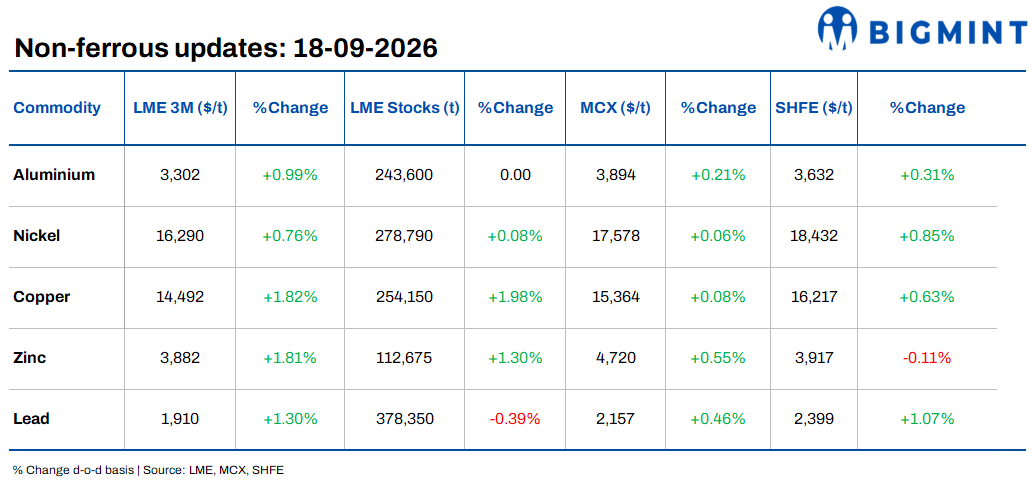
LME base metals prices traded higher on 17 September. Copper recorded the strongest gain, rising 1.82% d-o-d to $14,492/t, followed by zinc, which advanced 1.81% to $3,882/t, and lead, which gained 1.30% to $1,910/t. Meanwhile, aluminium climbed 0.99% to $3,302/t, while nickel rose 0.76% to $16,290/t.
The rise came as easing pressure following the Fed’s interest rate hike, a softer dollar, and renewed Chinese buying supported prices. Copper benefited from stronger demand and low inventories, while zinc gained on destocking and supply concerns. Aluminium drew support from seasonal demand and falling stocks, while lead and nickel followed the broader rebound.
LME inventories recorded mixed trends. Copper stocks recorded the steepest rise, up 1.98% to 254,150 t, followed by zinc inventories, which increased 1.30% to 112,675 t. Nickel stocks rose 0.08% to 278,790 t, while lead inventories fell 0.39% to 378,350 t and aluminium stocks remained unchanged at 243,600 t.
Domestic market overview
India’s non-ferrous market witnessed mixed trends on 17 September. Aluminium tense scrap remained unchanged at INR 253,000/t ex-Delhi and INR 250,000/t ex-Chennai. Meanwhile, aluminium P1020 ingot rose by INR 1,000/t, or 0.3%, to INR 356,000/t, while MCX aluminium gained 0.21% d-o-d to $3,894/t. However, subdued demand kept domestic aluminium scrap prices largely stable.
Copper armature scrap (Cu 99%), ex-Delhi, advanced by INR 6,000/t, or 0.5%, to INR 1,316,000/t from INR 1,310,000/t. Meanwhile, MCX copper rose 0.08% d-o-d to $15,364/t. The increase in domestic copper scrap prices was supported by tight availability, as sellers diverted material to other regions offering higher prices.

Other updates
US tariffs on Canadian aluminium disrupt established trade flows
US tariffs on some Canadian aluminium products have reached 100%, combining a new 50% tariff with an existing 50% duty. Canada supplied almost half of US aluminium-product imports for domestic consumption last year, while more than $428.9 million of annual Canadian exports linked to newly targeted products could be affected. Consequently, Canadian fabricators may divert material to domestic or overseas markets, increasing competition outside the US. The disruption is particularly relevant for extrusions, bars, pipes and other downstream aluminium products.
Freeport smelter restart to ease refined-copper tightness
Freeport Indonesia has resumed operations at its two Gresik smelters, with combined cathode output expected to approach 400,000 t in 2026. PT Smelting has around 342,000 t/y of cathode capacity, while the Manyar smelter has resumed concentrate feeding and is expected to produce cathode in September. Meanwhile, LME cash-to-three-month copper moved from a backwardation of more than $500/t in mid-August to an $86/t contango by mid-September. The shift indicates improved prompt availability and could weigh on near-term copper premiums.
EU waste shipment rules could redirect global metal scrap flows
The EU’s draft authorised-destination list has created uncertainty for India, Thailand, Malaysia and China ahead of proposed restrictions from 21 May 2027. The final authorised list is expected by 21 November 2026. European copper-scrap exports to China reached about 309,900 t in 2025, representing 47.8% of extra-EU exports. If restrictions remain, some material could shift toward Turkiye, Japan, South Korea or remain in Europe, potentially increasing competition among Asian buyers for alternative scrap supplies.
Saudi aluminium demand set to rise on infrastructure spending
Saudi Arabia’s aluminium demand could rise from roughly 1 mnt currently to 1.6-1.8 mnt annually by 2030. Infrastructure and construction projects will drive the increase. The plans include 15 new stadiums for the 2034 FIFA World Cup. Consequently, stronger consumption could lift regional demand for primary aluminium and downstream products.
Brent falls as Saudi oil disruption concerns ease
Brent crude fell 2.2% to $102.08/bbl as concerns over prolonged Saudi supply disruptions eased. Saudi Arabia offered additional crude cargoes to Asian refiners through ship-to-ship transfers off Oman’s Sohar port. Meanwhile, drone attacks damaged the 1,200-km East-West pipeline, which normally carries around 4-5 million barrels per day. Saudi Arabia is working to restore the pipeline, with partial flows potentially resuming within days.
Leave a Reply