- Australian shipments decline sharply as mills diversify sourcing
- Imports remain 15% higher y-o-y in Aug despite m-o-m decline
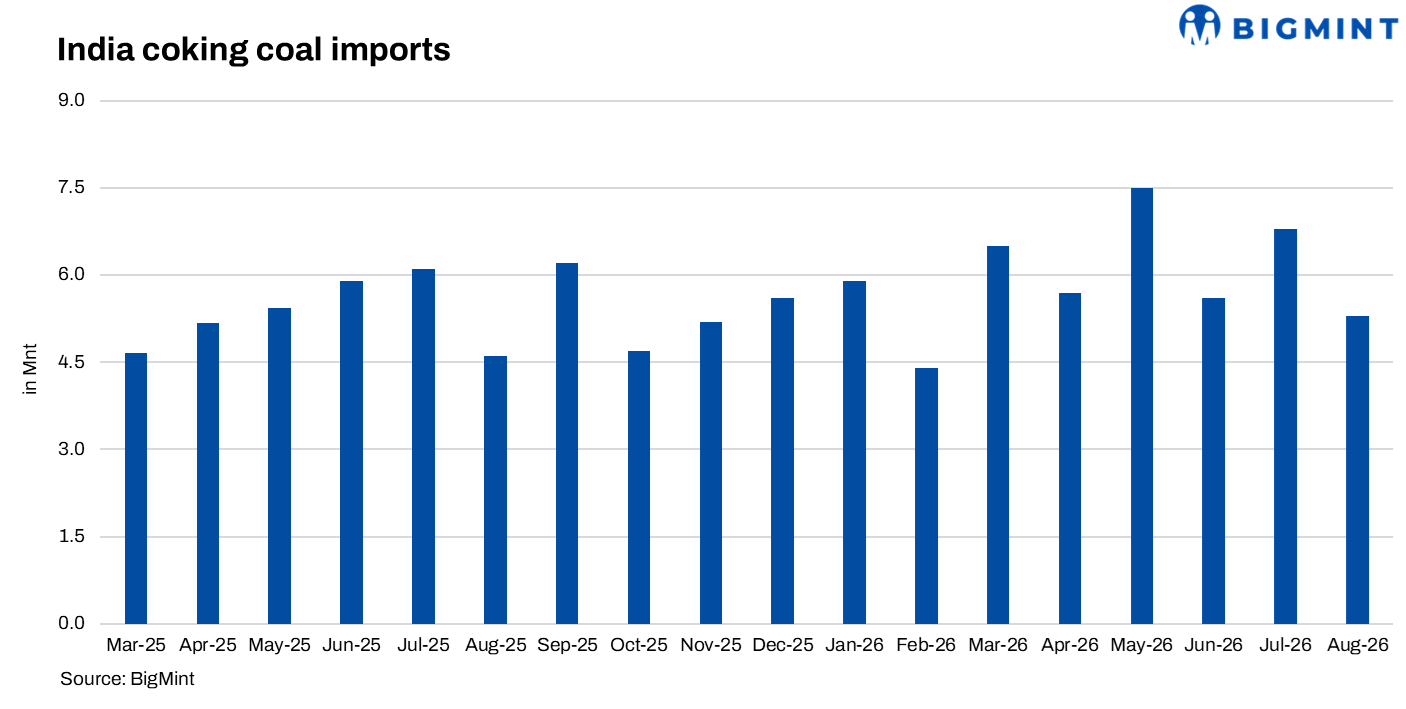
India’s coking coal imports declined 22.1% m-o-m to 5.3 mnt in August 2026, from 6.8 mnt in July, as Indian steel mills remained cautious about fresh purchases amid sharply higher seaborne prices. However, imports were still 15.2% higher y-o-y than the 4.6 mnt recorded in August 2025.
The m-o-m decline was led by a sharp reduction in Australian shipments, while imports from Russia also eased. In contrast, US-origin volumes increased, and Canada emerged as a new supplier in August. Market participants indicated that mills had largely relied on inventories built in previous months and adopted a wait-and-watch approach as global coking coal prices rallied rapidly, driven primarily by stronger Chinese buying and supply disruptions.
Australian shipments lead m-o-m decline
Australia remained India’s largest source of coking coal in August, but shipments fell 37.1% m-o-m to 2.2 mnt, from 3.5 mnt in July. On a y-o-y basis, Australian imports were also down 12% from 2.5 mnt in August 2025.
The decline reflects Indian mills’ continued efforts to diversify sourcing amid elevated Australian premium hard coking coal (PHCC) prices. With the global rally being driven largely by Chinese procurement, Indian buyers have been reluctant to chase sharply higher replacement costs and have instead utilised existing inventories where possible.
Russia remained the second-largest supplier, with imports declining 11.1% m-o-m to 1.6 mnt from 1.8 mnt. However, Russian shipments were substantially higher y-o-y, rising 166.7% from 0.6 mnt in August 2025.
US-origin imports increased 14.3% m-o-m to 0.8 mnt and were up 33.3% y-o-y. Mozambique remained stable at 0.6 mnt m-o-m, while Canada contributed around 0.1 mnt in August.

Chinese buying drives global rally
The decline in Indian imports comes against a sharply strengthening global coking coal market. BigMint’s PHCC index reached $306/t CNF Paradip on 11 September, up $7/t w-o-w, following a sustained rally through late August and early September.
Chinese buying has remained the principal driver of the rally as domestic coking coal production stayed constrained by mine accidents, safety inspections and slower restarts. Weaker Mongolian coal flows further tightened China’s prompt availability, encouraging Chinese mills and traders to secure seaborne Australian cargoes.
The resulting competition for prompt material pushed replacement costs higher for Indian mills. Market participants have indicated that Indian buying has remained relatively quiet compared with Chinese activity, with mills preferring to consume existing inventories rather than aggressively book cargoes at rapidly rising prices.
US and alternative origins gain share
The shift in India’s sourcing pattern was particularly visible in August. Australian coal’s share of total imports declined to around 42%, from approximately 51% in July, while Russia’s share increased to around 30%.
US-origin material accounted for around 15% of August imports, compared with about 10% in July, highlighting the growing importance of alternative origins. Higher Australian prices and the widening price differential between Pacific and Atlantic-origin material have improved the competitiveness of US, Canadian and Mozambican coal for Indian buyers where coal quality and blending requirements permit.
India’s diversification is therefore continuing even as total imports decline. The reduction in Australian volumes should not necessarily be interpreted as a structural fall in India’s coking coal requirement; rather, it reflects a combination of high replacement costs, inventory utilisation and sourcing diversification.
Major Indian buyers reduce August volumes
JSW Steel remained the largest importer among the listed receivers, although its imports fell 30.4% m-o-m to 1.6 mnt, from 2.3 mnt in July. SAIL’s imports declined 23.5% to 1.3 mnt, while Tata Steel’s volumes eased 9% to 1 mnt.
The broad-based decline among major buyers indicates that the lower August import volumes were not limited to a single steelmaker. Instead, mills appear to have adopted a more cautious procurement strategy amid elevated prices.
Firm steel prices offer some support, but margins remain constraint
The Indian steel market has shown improved price sentiment, providing some relief to mills facing higher raw-material costs. However, the pace of the coking coal rally has remained a concern, limiting the willingness of buyers to build inventories aggressively.
Higher coking coal costs have also fed into domestic metallurgical coke prices, which have reached multi-year highs. This has increased the overall raw-material burden on blast-furnace operators even as finished steel prices have strengthened.
Freight has added another layer of cost pressure. India-bound Panamax rates remained firm amid tighter prompt tonnage and steady coal enquiries, keeping delivered replacement costs elevated.
Outlook
India’s August import decline reflects procurement timing and cautious buying rather than a collapse in underlying steelmaking demand. With mills carrying inventories from earlier purchases and global prices rising sharply, buyers have reduced spot procurement and increased reliance on alternative origins.
The key variable for September and the coming months will be the duration of China’s buying-led rally. If Chinese domestic supply and Mongolian flows recover, pressure on seaborne availability could ease and encourage Indian mills to return to the market. Conversely, continued Chinese buying alongside constrained supply could keep replacement costs elevated and delay aggressive Indian restocking.
Leave a Reply