- Inventories remain at 60-65% of normal levels
- Demand recovery remains slower than price increases
India’s coated flat steel trade-level prices increased by around INR 900-2,900/t following major domestic steel mills price hikes of INR 2,000-2,500/t in mid-September. The increase in mill offers has pushed up market enquiries, although actual demand has not strengthened significantly as of 17 September 2026. Buyers remain cautious, with purchases largely restricted to immediate requirements.
Market inventories are currently at medium to slightly lower levels, mainly due to limited material availability from domestic mills. Reduced supplies from mills have kept distributor and trader inventories relatively lean, providing support to trade-level prices despite the limited improvement in underlying demand.
Overall, coated flat steel prices have moved higher, primarily following mill-led price revisions and restricted material availability. While the latest price increases have resulted in higher market enquiries, a sustained improvement in demand remains to be seen. Further price movement will depend on mill offers, material availability and demand in the coming weeks.
Price Update:

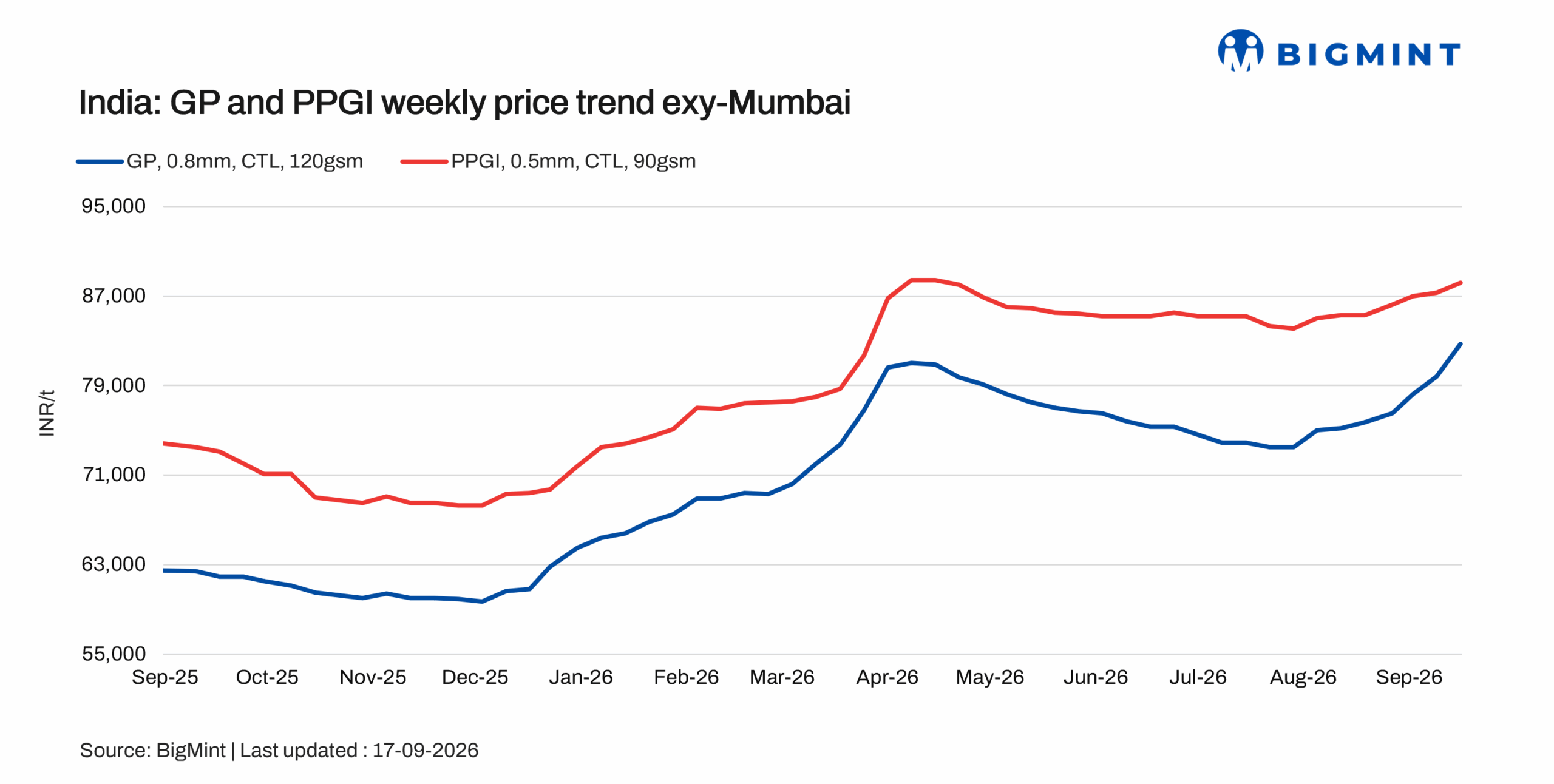
BigMint’s benchmark assessment for Mumbai Galvanized Plain (GP) coil (0.8 mm/CTL, 120 GSM, IS 277) increased by INR 2,900/t w-o-w to INR 82,700/t ex-Mumbai.
Meanwhile, Mumbai Pre-painted galvanized iron (PPGI) (0.5 mm/CTL, 90 GSM, IS 14246) was assessed at INR 88,200/t ex-Mumbai, increasing by INR 900/t w-o-w.
Mumbai Galvalume (BGL) (0.5 mm/CTL, 1220 mm, AZ150) was assessed at INR 91,800/t ex-Mumbai, increasing by INR 1,800/t w-o-w.
Raw material Prices:

India’s zinc ingot (99.995%) prices declined slightly during the latest assessment, with BigMint’s benchmark assessment at INR 435,000/t ex-Delhi, down by INR 1,000/t from INR 436,000/t in the previous week. The marginal correction followed the recent upward movement in zinc prices, while market participants continued to monitor domestic mill pricing and international zinc market trends.

BigMint’s bi-weekly benchmark assessment for Mumbai HRC (IS2062, Grade E250, 2.5-8 mm/CTL) increased by INR 2,000/t w-o-w to INR 63,700/t ex-Mumbai as of 16 September 2026, compared with INR 61,700/t in the previous assessment.
Meanwhile, Mumbai cold-rolled coil (CRC) prices also increased, with trade-level prices rising by around INR 1,500-2,250/t during the period. BigMint’s benchmark assessment for Mumbai CRC (IS513, Grade O, 0.9 mm/CTL) increased by INR 1,400/t to INR 74,700/t ex-Mumbai from the previous assessment.
Market updates
India’s coated flat steel market has turned cautious amid a sharp increase in mill prices, with market participants describing the current trading environment as tense. Demand has improved marginally in recent days, with enquiries and requirement-based purchases picking up; however, major distributors and market participants said the improvement in demand has not been commensurate with the extent of the recent price increase.
Meanwhile, material availability remains relatively tight, with inventory levels estimated at around 60-65% of normal levels across parts of the distribution chain. Limited supplies from major domestic mills have contributed to inventory shortages, adding to uncertainty in the spot market and supporting the recent increase in trade-level prices.
The participant noted that the sharp rise in coal prices has added to cost pressures, although market participants continue to assess the extent to which these increases can be passed on amid relatively subdued demand.
Looking ahead, demand could improve further in the coming weeks, particularly if buying activity picks up from end-users. However, the sustainability of higher coated flat steel prices will depend on the pace of demand recovery, inventory availability and the pricing strategy of domestic mills.
Outlook
Coated flat steel prices are expected to increase further in the coming month, supported by low inventory levels, restricted mill supplies and higher input costs. Demand is likely to improve gradually, which could enable the recent mill price increases to pass through further into the trade market. However, the pace of the increase will depend on the extent of demand recovery and material availability.
Leave a Reply