- US copper tariff plans stall as affordability concerns weigh on policy
- Oil approaches $106/bbl as Middle East supply disruptions intensify
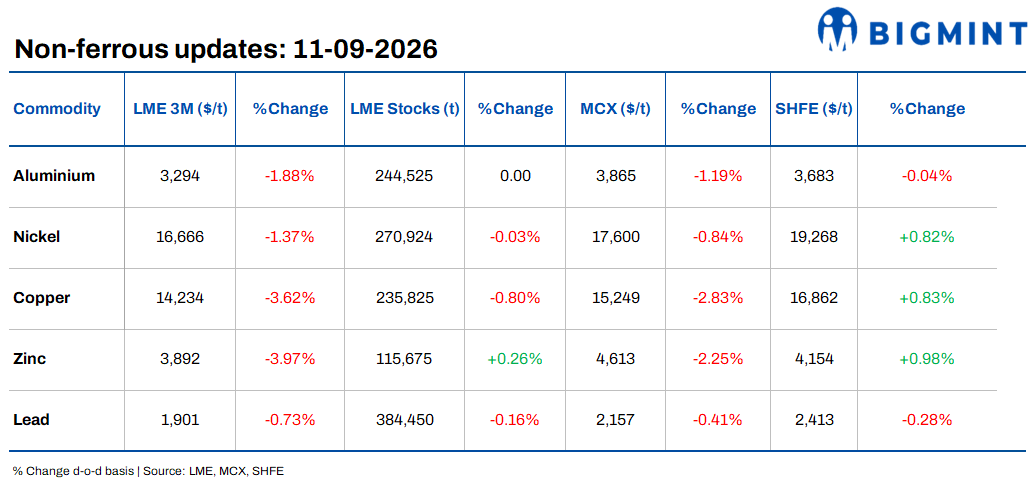
LME base metals traded lower across the board on 10 September. Zinc recorded the sharpest decline, falling 3.97% d-o-d to $3,892/t, followed by copper, down 3.62% to $14,234/t. Aluminium slipped 1.88% to $3,294/t, nickel eased 1.37% to $16,666/t, while lead declined 0.73% to $1,901/t.
The decline came as a stronger US dollar, rising Treasury yields and higher oil prices pressured risk appetite. Copper led the fall after uncertainty over US refined-copper tariffs unwound part of its recent premium, while concerns over higher energy costs and weaker industrial demand weighed on the wider complex.
LME inventories recorded mixed trends d-o-d. Copper stocks posted the sharpest decline, falling 0.80% d-o-d to 235,825 t, while zinc inventories rose 0.26% to 115,675 t. Lead stocks declined 0.16% to 384,450 t, nickel inventories eased 0.03% to 270,924 t, and aluminium stocks remained unchanged at 244,525 t.
Domestic market overview
India’s non-ferrous scrap market witnessed mixed trends on 10 September. Aluminium tense scrap (loose) remained unchanged at INR 253,000/t ex-Delhi and INR 247,000/t ex-Chennai.
Meanwhile, aluminium P1020 ingot, ex-Delhi NCR declined by INR 1,000/t, or 0.3%, to INR 357,000/t from INR 358,000/t. MCX aluminium fell 1.19% d-o-d to INR 3,865/t. However, tense scrap prices remained stable despite weaker international aluminium prices.
Copper armature scrap (Cu 99%), ex-Delhi, rose by INR 20,000/t, or 1.5%, to INR 1,340,000/t from INR 1,320,000/t. Meanwhile, MCX copper declined 2.83% d-o-d to INR 15,249/t. The increase in domestic copper scrap values contrasted with the decline in international and MCX copper prices with correction expected in the coming days.

Other updates
US copper tariff plan stalls as affordability concerns rise
The US administration has yet to decide whether to impose tariffs on refined copper, as officials weigh higher costs for manufacturers against efforts to encourage domestic mining and refining. The White House had considered a 15% tariff from January 2027, rising to 30% in 2028. Meanwhile, copper prices fell more than 4% following the report. The US imports roughly half its annual copper requirements and has only two operating copper smelters. Consequently, weaker tariff prospects could reduce US stockpiling and allow some material to return to international markets.
Oil prices approach $106/bbl as Middle East supply disruptions intensify
Brent crude traded around $105.90/bbl on 11 September, while WTI stood near $102.48/bbl. Both benchmarks were heading for their first weekly close above $100/bbl since mid-May as attacks on shipping routes intensified and oil flows through the Strait of Hormuz remained well below pre-war levels. With the Yemeni Houthis taking control of Mocha port on Thursday, prices are expected to remain elevated in the near term.
Eramet restarts Weda Bay nickel mining after four-month suspension
Eramet has restarted mining at PT Weda Bay Nickel in Indonesia after around four months of care and maintenance. The mine produced 41.9 million wet metric tonnes (Mwmt) of ore in 2025, while Indonesia accounts for around 66% of global nickel production. However, its 2026 quota was initially capped at 12 Mwmt versus 42 Mwmt in 2025. The restart could improve Indonesian ore availability and weigh on nickel prices if production ramps up.
Indian metal stocks fall as oil, yields and dollar rise
Indian metal stocks came under pressure on 11 September amid higher oil prices, a stronger US dollar and rising bond yields. Vedanta fell more than 4%, Vedanta Aluminium around 4%, NALCO 5% and Hindustan Copper more than 4%. Meanwhile, the US 10-year Treasury yield moved above 4.9%, while the 30-year yield reached 5.378%. Higher energy and logistics costs could pressure margins for Indian producers if metal prices fail to offset the increase. However, the equity sell-off does not by itself indicate weaker physical metal supply.
Leave a Reply