- Tight domestic supply, mine safety curbs continue to support prices
- Easing power demand, narrowing import discounts may cap gains
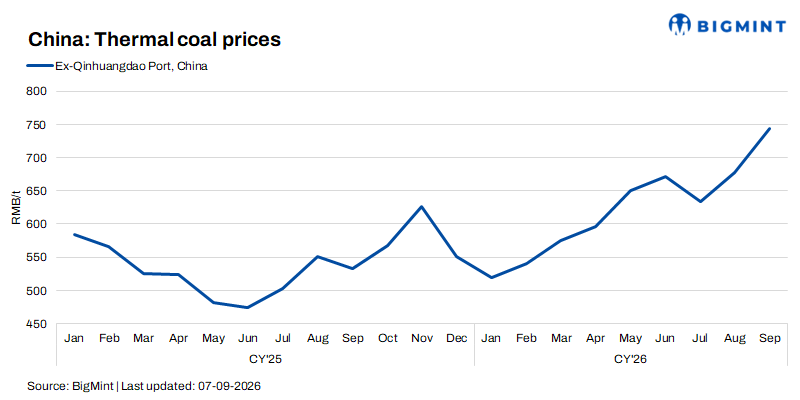
China’s thermal coal market entered September on a firm footing even as the summer peak season for demand faded, with tight domestic supply continuing to provide the main support for prices.
The benchmark 5,500 kcal/kg NAR thermal coal price had maintained a largely upward trend in August, ending the month at Yuan 893/tonne ($132/t), up Yuan 67/t from end-July, FOB northern transfer ports with 13% VAT included, according to Mysteel’s assessment.
The rally in the benchmark’s price accelerated this week, with the price striking above Yuan 900/t on 1 September and reaching Yuan 933/t on 3 September, the highest since 28 February 2024.
Market participants are betting higher odds that the benchmark will break through Yuan 1,000/t as the month progresses, but the prospect of government intervention is also becoming a concern if prices rise much further.
August’s rally was driven largely by a supply shortfall that has persisted since the fatal coal mine accident in Shanxi on 22 May. Mines are required to keep output within approved capacity, while many operations that have resumed after safety-related suspensions are still running below normal levels, as reported. Market participants generally expect the supply gap to persist for the rest of this year.
During July, China’s raw coal output fell 10.1% y-o-y to 343.2 million tonnes, the steepest decline since November 2016 and dragging January-July output down 2.9% on year, National Bureau of Statistics data showed.
Mysteel’s weekly survey of 462 thermal coal mines nationwide showed utilisation falling from 89% at the start of August to 84.3% by month-end, broadly in line with July levels and suggesting that national coal output remains under pressure.
More importantly, the supply constraint is becoming structural rather than safety campaign-driven.
The national mine safety regulator’s Document No. 83, released on 29 July and targeting concealed working faces and falsified production data, remains in force through end-November — meaning that it covers the autumn and pre-winter restocking period. The coal industry’s 15th Five-Year Plan, issued 10 August, also puts greater emphasis on controlling capacity rather than simply expanding output.
The main challenge for prices is now demand. The late-August pickup in steam coal prices, partly caused by typhoon-related reductions in wind and solar generation, has already started to unwind.
Mysteel’s latest survey of 493 power plants showed daily coal burn averaging 4 million tonnes during 28 August-3 September, down 13% from the summer high of 4.59 million t/d averaged a week earlier.
With temperatures easing across much of the country, coal burn is likely to fall further. Utilities can therefore delay or reduce spot coal purchases and rely on contracted coal, particularly while spot prices are rising sharply.
Indonesia adds another variable. The state company Danantara Sumberdaya Indonesia (DSI), now responsible for export sale of key commodities, came into formal operation on September 1, four months earlier than initially planned, as Mysteel Global has reported, but its operating model and impact on coal pricing and supply remain unclear.
At the same time, the El Nino-induced drought has lowered river levels in Indonesia, disrupting barge transport, while domestic supply priorities have kept export availability tight.
Indonesian 3,800 kcal/kg NAR Panamax prices jumped from $73.8/t FOB on 1 September to $77.5/t on 3 September, in contrast to the slower rise from $64/t to $72.5/t during August.
The rally however, has sharply reduced the coal’s price advantage in China. Mysteel estimates that as of September 3, Indonesian 3,800 kcal/kg NAR coal at southern China ports was only Yuan 26/t cheaper than comparable Chinese coal delivered from northern ports, compared with its Yuan 30-50/t advantage during August. After port-related costs, the imported coal offers little price incentive to Chinese buyers.
Note: The article is published as part of a content sharing agreement between Mysteel Global and BigMint.
Leave a Reply