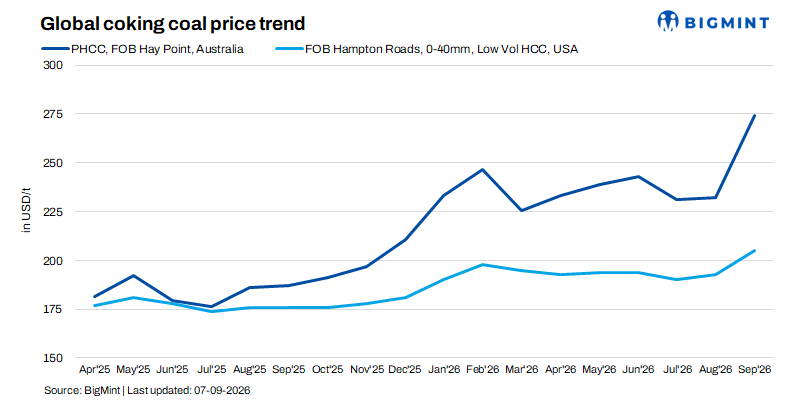
- Chinese supply disruptions lift seaborne coking coal, PCI
- Weak steel margins emerge as principal upside constraint
Global metallurgical coal, PCI, and coke markets strengthened sharply in early September 2026, led by Chinese buying following domestic mine disruptions, lower Mongolian border flows, and constrained coke production.
Australian premium hard coking coal prices rose strongly, while PCI recorded particularly sharp gains as buyers sought alternatives to restricted domestic supply. Higher raw-material costs were transmitted into Chinese and Indian met coke markets, although weakening steel margins and buyer resistance began limiting appetite at elevated prices.

China remained the principal driver of the metallurgical coal rally. Domestic coking coal output stayed constrained following mine accidents, safety inspections and slower-than-expected restarts in Shanxi and other producing regions.
Approvals for mine resumptions increased, including more than 9 mnt of capacity across seven mines in Qinyuan, Changzhi. However, administrative approvals had not yet translated into a meaningful recovery in physical output. Daily clean-coal production remained around 0.63 mnt, leaving the prompt market tight despite expectations of improving supply.
The disruption was compounded by lower Mongolian inflows. Average truck movements through Ganqimaodu declined to 986 trucks/day during 17-23 August, down 7.9% w-o-w and well below the approximately 1,300-1,400 trucks/day recorded during May-July.
Broader cross-border clearance reportedly declined from 170,000-180,000 t/day in early August to 70,000-80,000 t/day by late August. Customs-area inventories consequently fell from more than 3.5 mnt in early August to slightly above 2.3 mnt.
With Mongolia accounting for the majority of China’s metallurgical coal imports, the decline tightened prompt supply and encouraged Chinese mills and traders to secure seaborne Australian cargoes.
Australian PHCC rises but forward buying turns cautious
Australian PHCC FOB prices increased by around $15/t w-o-w to approximately $276/t, while BigMint’s origin-neutral PHCC index reached $299/t CNF India, up $19/t.
An 80,000 t Australian premium mid-vol cargo was concluded at $274.50/t FOB for mid-October loading. A separate 75,000 t cargo was indicated around $288/t CFR China for September arrival, although the transaction could not be fully confirmed.
Chinese buying was concentrated on prompt-arrival and already-floating cargoes. Buyers were less willing to commit to fixed-price forward shipments because of the speed of the rally and expectations that Mongolian supply could recover.
This created a divergence between a firm prompt physical market and softer forward expectations. Australian PHCC derivatives for October-December moved below prevailing spot values, indicating that the market was not pricing the current degree of tightness as permanent.
PCI records sharp gains on substitution demand
PCI prices rose particularly sharply as supply concerns and stronger Chinese demand spread beyond prime coking coal.
Australian low-vol PCI increased $14/t in one day to $217.50/t FOB, while mid-vol PCI rose by the same amount to $207.50/t. Delivered low-vol and mid-vol PCI prices into China climbed to approximately $224/t and $214.50/t, respectively.
Russian low-vol PCI indications ranged from around $205/t to above $220/t CFR China, with offers reaching $225/t for selected November cargoes. Russian mid-tier PCI was indicated around $190-200/t CFR India, while an October offer was reported at $205/t.
Mid-vol PCI delivered to India increased to $196/t. However, rising prices and uncertainty over Russian supply economics limited firm buying interest, particularly among Indian mills already facing pressure on steelmaking margins.
China’s domestic PCI market also remained firm, with Shanxi material indicated around RMB1,500-1,700/t ex-washplant.
Coke prices absorb coal-cost escalation
Higher coking coal costs fed rapidly into metallurgical coke.
Chinese coke producers secured a fourth price increase of RMB 100/t for wet-quenched coke and RMB 110/t for dry-quenched material, effective 3 September. This followed cumulative increases of RMB 250-275/t during three earlier rounds in late August.
Production cuts supported the rally. Average daily output across major Chinese coking plants declined to approximately 445,600 t during 20-26 August, down 13% y-o-y and the lowest level in the available series. Many producers had reduced output by 10-30% after average losses reached RMB 106/t in August.
Chinese export prices increased by $10/t, with 66/65 CSR coke reaching $332/t FOB and 65/63 CSR material rising to $322/t. Domestic 62/60 CSR coke increased RMB 200/t w-o-w to RMB 2,020/t DDP North China.
Indonesian coke availability also tightened. Water-related logistics disruptions and limited vessel movements lifted 65/63 CSR offers to around $330-335/t FOB. Delivered replacement costs into India consequently rose to approximately $357/t.
A 20,000 t Indonesian cargo was concluded at $325/t FOB for 12-18 November loading, providing a firmer physical reference than an isolated $230/t transaction reported elsewhere in the market, which does not reflect current replacement costs.
Indian mills face higher costs but resist imports
India’s coking coal imports declined more than 20% m-o-m to approximately 5.4 mnt in August. Australian shipments fell to 2.2 mnt from 3.5 mnt in July as mills diversified towards Russian, US, Mozambican and Canadian coal.
Despite lower imports, Indian mills remained cautious about new bookings at sharply higher prices. The increase in finished steel prices provided some relief, with BF-route rebar rising INR2,200/t w-o-w to INR57,200/t ex-Mumbai. However, raw-material costs were rising faster than downstream margins could recover.
Domestic met coke prices consequently reached multi-year highs. BF-grade coke rose to INR40,000/t ex-Jajpur and INR35,000/t ex-Gandhidham, while foundry coke reached INR38,000/t ex-Rajkot.
India continued to test alternative supply routes. A proposed 11,000-12,000 t Mongolian coking coal trial through Russia’s Far East could open another sourcing corridor, but its commercial viability will depend on coal quality, rail capacity, transit time and the combined rail-sea freight cost.
Outlook
The near-term market remains supported by Chinese domestic supply constraints, depleted Mongolian border inventories and restricted coke output. PCI and lower-tier coking coal could remain especially sensitive as consumers seek substitutes for expensive premium material.
However, the rally is approaching resistance. Chinese steel-mill profitability has fallen sharply, Indian mills are delaying purchases and Mongolian flows could recover after early-September bilateral discussions. Gradual restarts at Shanxi mines may also improve domestic supply.
The market is therefore entering a tug-of-war between genuine prompt tightness and the prospect of medium-term supply recovery. Prices may remain elevated through the first half of September, but further gains will require continued inventory drawdowns or renewed disruptions. A recovery in Mongolian supply, combined with weak steel margins, could flatten the rally later in the month.
Leave a Reply