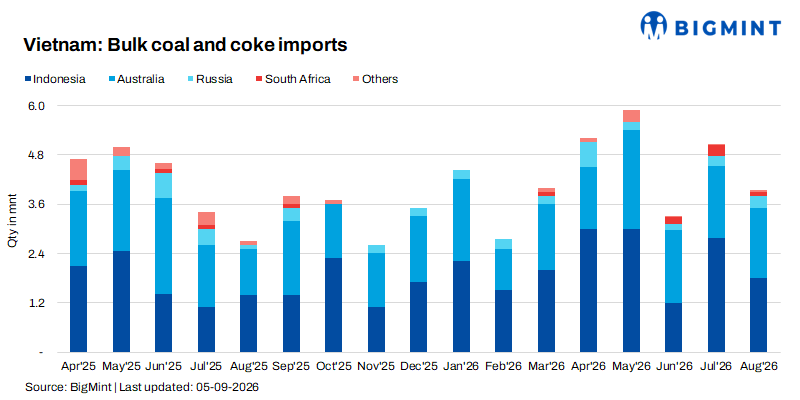
- August imports rise 48% y-o-y despite easing from July
- Australia drives coking coal growth; Indonesia dominates thermal supply
Vietnam’s coal imports reached around 4.0 mnt in August 2026, up nearly 48% y-o-y from a weak 2.7 mnt in August 2025, although volumes declined around 20% from July’s 5.0 mnt.
The headline masks an important divergence. Non-coking coal imports fell sharply month-on-month, while coking coal strengthened to 1.2 mnt and more than doubled from August 2025. The data suggest Vietnam’s 2026 import growth is increasingly being supported by metallurgical coal, while thermal coal remains volatile.
August rebounds strongly y-o-y, but momentum remains volatile
August’s strong y-o-y increase needs to be viewed against the particularly low August 2025 base. On a cumulative basis, January-August 2026 imports were only around 3% higher y-o-y.

The recent monthly pattern is equally revealing. Imports surged to 5.9 mnt in May, fell to 3.3 mnt in June, rebounded to 5.0 mnt in July and eased to 4 mnt in August.
There is therefore no consistent month-on-month acceleration. Rather, Vietnam is maintaining relatively high import requirements with significant fluctuations in cargo timing and coal type.
Coking coal provides stronger August signal
Vietnam’s total coal and met coke imports increased 48% y-o-y to 4 mnt in August 2026, from 2.7 mnt in August 2025, although volumes declined from 5.0 mnt in July 2026. Non-coking coal imports rose 23% y-o-y to 2.7 mnt, while coking coal imports surged 140% y-o-y to 1.2 mnt, reflecting stronger import demand for metallurgical coal. Met coke imports remained minimal during the period.
Non-coking coal remained the largest import category, but volumes fell by roughly one-third from July. Coking coal moved in the opposite direction, rising from 1.0 mnt to 1.2 mnt and reaching more than twice the August 2025 level.
The cumulative numbers reinforce this divergence. Vietnam’s total coal and met coke imports increased around 3% y-o-y to 34.5 mnt during January-August 2026, from around 33.5 mnt a year earlier. Non-coking coal imports rose ~2% to 25.3 mnt, while coking coal imports increased around 10% to 9.1 mnt, indicating comparatively stronger growth in metallurgical coal demand.
Thus, while total imports are only modestly higher in 2026, coking coal is showing substantially stronger growth than thermal coal.
Indonesia remains cornerstone of thermal coal supply
Vietnam’s non-coking coal supply remains heavily concentrated around Indonesia and Australia.

Indonesia supplied around two-thirds of Vietnam’s August thermal coal imports, increasing from approximately 1.4 mnt a year earlier to 1.8 mnt. Australia remained the second-largest source at around 0.7 mnt.
Indonesia’s monthly shipments have nevertheless been highly volatile: 3.0 mnt in April and May, 1.2 mnt in June, 2.8 mnt in July and 1.8 mnt in August.
This helps explain much of the volatility in Vietnam’s overall thermal coal imports.
The strategic importance of imports remains high. Vietnam’s Ministry of Industry and Trade expects 17-19 mnt of imported bituminous and sub-bituminous coal to be required specifically for power generation in 2026, while coal-fired power continues to account for more than half of electricity supply.
Australia strengthens coking coal position
The metallurgical coal market shows a very different supply structure.

Australia supplied around 1.0 mnt, or more than 80%, of Vietnam’s August coking coal imports. This was substantially above the 0.4 mnt supplied in August 2025.
Across January-August, Australia supplied around 6.9 mnt of Vietnam’s 9.1 mnt coking coal imports, with Russia a distant second at 1.8 mnt.
The sourcing structure is consequently becoming clearly segmented: Indonesia dominates Vietnam’s thermal coal supply, while Australia dominates its metallurgical coal requirements.
Import growth increasingly driven by metallurgical coal
August’s 48% y-o-y increase makes Vietnam appear to be undergoing a major coal import surge, but the underlying data suggest a more nuanced trend.
Total January-August imports are only around 3% higher y-o-y, while non-coking coal imports have increased by just around 2%. Coking coal, by contrast, has risen roughly 10%, with August volumes more than doubling y-o-y.
The stronger analytical signal is therefore not simply that Vietnam is importing more coal, but that the composition of incremental demand is changing.
Thermal coal remains essential to Vietnam’s power system and Indonesian supply continues to dominate that market. But metallurgical coal is currently providing the stronger growth impulse, with Australia capturing most of the increase.
Whether that divergence persists through September will determine whether Vietnam’s 2026 import growth remains modest overall or begins to accelerate more meaningfully.
Leave a Reply