- Daytime power abundance contrasts with evening scarcity
- Batteries can shift surplus solar into high-value peak hours
India’s electricity market is developing a pronounced intraday imbalance, with very low prices during solar-rich daytime hours increasingly giving way to severe supply tightness after sunset.
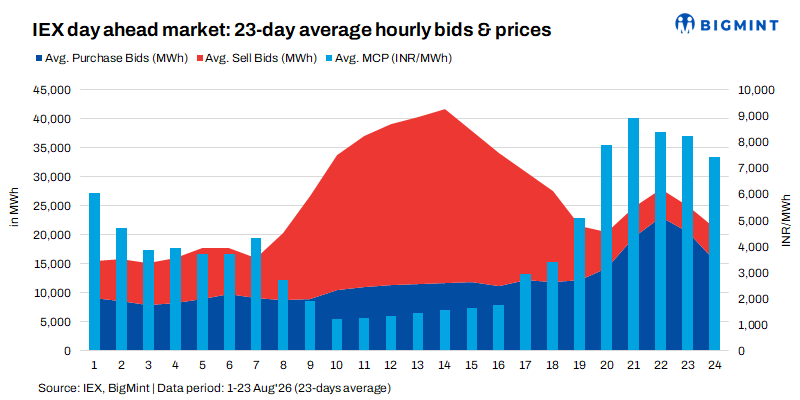
An analysis of hourly Indian Energy Exchange (IEX) Day-Ahead Market data for 1-23 August 2026 shows average prices of only around INR 1.60/kWh between 10:00 am and 3:00 pm, compared with approximately INR 7.54/kWh between 6:00 pm and midnight.
More strikingly, the market hit the INR 10/kWh price ceiling during 87 hourly blocks in the first 23 days of August. Around 68 of those ceiling-price hours occurred between 6:00 pm and midnight.
At the other extreme, prices fell below INR 1/kWh during 49 hours, overwhelmingly during periods of strong daytime supply.
The result is an increasingly visible electricity-market version of the renewable-energy “duck curve”: abundant solar generation depresses prices during the day, but available supply contracts rapidly as solar output falls while electricity demand remains high.

The contrast between supply and demand is even more revealing than the prices themselves.
Solar hours increasingly resemble an electricity surplus
Between 10:00 am and 3:00 pm, average sell bids were almost 27 GWh/hour, more than twice average purchase bids of around 11.3 GWh/hour.
Prices consequently collapsed.
On 8 August, for example, the market-clearing price fell to just INR 0.00081/kWh at 1:00 pm, after dropping to INR 0.0158/kWh at noon.
On 9 August, prices remained around INR 0.03/kWh at noon and 1:00 pm as sell bids approached 39 GWh against purchase bids of only around 10-11 GWh.
Similar conditions appeared repeatedly. On 7 August, prices fell to INR 0.069/kWh at 2:00 pm as sell bids exceeded 30 GWh against purchase bids below 9.5 GWh.
The signal is clear: India increasingly has periods when electricity itself is abundant but its timing is wrong.
This reinforces the conclusion from our earlier storage analysis. India’s next renewable-energy challenge is increasingly not simply installing more solar capacity, but moving part of that electricity into hours when the system actually needs it.
Sunset reverses the market within hours
The transformation after sunset is dramatic.
Average sell bids fall from almost 27 GWh/hour during 10:00-15:00 to barely 6.2 GWh/hour during 18:00-23:00. Purchase bids move in the opposite direction, rising to more than 24 GWh/hour. By 8:00-10:00 pm, average purchase bids are around six times available sell bids. This produces extraordinarily strong prices.
On 12 August, the MCP reached INR 8.84/kWh by 6:00 pm and then hit the INR 10/kWh ceiling for every hour between 7:00 pm and midnight. Purchase bids at 8:00 pm exceeded 43.9 GWh while sell bids were below 4 GWh.
On 18 August, prices moved from just INR 0.20/kWh at 1:00 pm to INR 10/kWh from 7:00 pm onwards.
On 21 August, the imbalance became extreme. From 7:00 pm through midnight, the market remained continuously at the INR 10/kWh ceiling. At 9:00 pm, purchase bids reached almost 81.9 GWh against just 3.05 GWh of sell bids.
These are not isolated price spikes. The price ceiling was reached during 87 hours over 16 of the first 23 days of August. That indicates structural scarcity during particular hours rather than a generally undersupplied electricity system.
Weak hydro is making the evening problem worse
This intraday imbalance must be viewed alongside the generation data analysed earlier.
During 1-23 August, total electricity generation increased 9.5% y-o-y, while average peak demand rose 11.3%. Renewable generation surged 38.4%, but hydro output fell 17.2%.
Coal therefore still had to increase generation by 9.2%.
This matters because hydro normally provides precisely the flexibility that the market currently needs: generation can be increased quickly during morning and evening peaks and reduced when solar supply is abundant.
Weak reservoir levels mean there is less hydro available to perform that balancing role.
Coal can provide the energy, but thermal plants are less suited to repeatedly ramping down during very low-priced solar hours and rapidly increasing generation after sunset. Maintaining coal generation for reliability also means burning additional fuel, contributing to the more than 6 mnt decline in thermal power-plant coal inventories during the first 23 days of August.
The hourly IEX data therefore expose a problem that daily averages obscure. India does not necessarily lack electricity across the entire day.
It increasingly lacks electricity at the right time. This is exactly where BESS becomes economically valuable
Battery energy storage can arbitrage this increasingly large intraday spread.
Conceptually, a battery can charge when electricity is available at INR 0-2/kWh during solar hours and discharge when prices rise towards INR 8-10/kWh after sunset.
The average market price differential in August highlights a significant opportunity, with the Market Clearing Price (MCP) averaging INR 1.60/kWh during the 10:00-15:00 window compared with INR 7.54/kWh during the 18:00-23:00 peak period. This represents a gross price differential of INR 5.94/kWh, underscoring the substantial value potential associated with shifting electricity consumption or generation toward higher-priced evening hours.
That is not equivalent to a BESS profit margin. Battery round-trip losses, degradation, charging constraints, network charges, market-access rules and capital costs must all be considered.
But a nearly INR 6/kWh average gross price differential is economically meaningful.
On individual days, the theoretical spread was considerably larger — from almost zero during midday to INR 10/kWh after sunset.
This is why the rise of standalone BESS procurement identified in our earlier analysis is important. During April-July FY27, standalone batteries accounted for around 4.3 GW, or 51%, of project-development storage capacity tendered, while two-hour systems remained the dominant duration.
The IEX price curve helps explain why.
Two-hour batteries address the peak, four-hour systems address the curve. A two-hour battery can target the most expensive portion of the evening peak. But the August data suggest that India’s scarcity window frequently lasts four to six hours, beginning around 6:00-7:00 pm and extending towards midnight.
This strengthens the case for longer-duration systems.
Four-hour BESS can absorb more of the daytime solar surplus and carry it deeper into the evening peak. Pumped hydro remains even better suited to longer-duration shifting, but new pumped-storage projects require considerably longer development periods.
Battery deployment can happen much faster. There is also a broader system benefit.
Every unit of daytime solar stored and released during the evening potentially reduces the need to ramp coal generation, limits exposure to INR 10/kWh exchange prices and preserves coal inventories.
Storage therefore does not simply compete with coal.
It can allow coal plants to operate more efficiently and with less extreme cycling, while batteries handle the steep transition between daytime solar abundance and evening scarcity.
BigMint assessment
The most important insight from August’s hourly electricity data is the extraordinary coexistence of surplus and scarcity within the same day.
At midday, sell bids can exceed purchase bids by more than two-to-one and electricity prices can approach zero.
Six hours later, purchase bids can exceed sell bids by five or six times and the market repeatedly hits its INR 10/kWh ceiling.
That is not fundamentally a generation-capacity problem.
It is increasingly a flexibility and storage problem.
And the weak 2026 monsoon has made it more visible because hydro — traditionally one of India’s most valuable flexible generation resources — is contributing less just as electricity demand is rising rapidly.
Coal is presently filling much of that gap, but the resulting increase in coal burn is drawing down inventories at a time when the power system may need elevated thermal generation through the coming dry season.
BESS therefore offers something increasingly valuable: the ability to transform very cheap midday electricity into scarce evening electricity.
The August IEX curve may consequently provide one of the clearest economic arguments yet for India’s emerging storage market.
India increasingly does not need only more electricity. It needs the ability to move electricity from the hours when it is abundant to the hours when it is valuable.
Leave a Reply