- Stable ore costs help producers defend SiMn offers
- Overseas buyers remain selective amid elevated freight costs
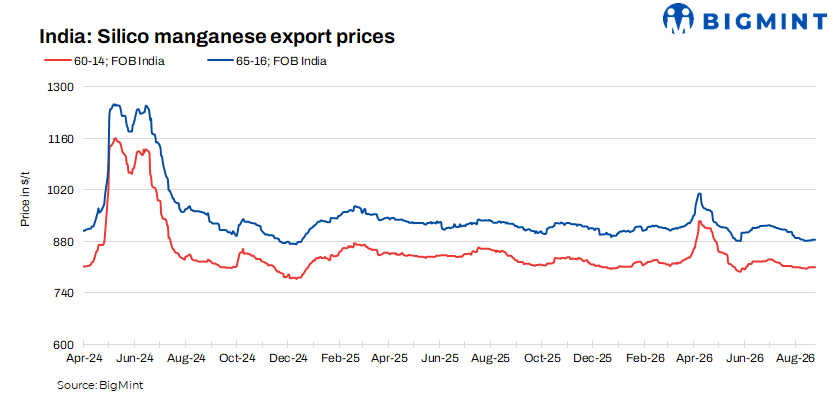
Indian silico manganese export prices remained broadly stable in the week ended 24 August, with the 65-16 grade rising $2/t w-o-w to $886/t FOB, while 60-14 remained unchanged at $810/t FOB Haldia/Vizag. Despite softer spot enquiries, prices have held firm as smelters remain largely covered through advance ore bookings, while firm replacement costs and limited prompt availability are preventing producers from conceding aggressively on offers.
Additionally, domestic demand had shown signs of improvement, with better alloy buying and strengthening downstream steel activity expected to support fresh manganese ore procurement, while ample buyer coverage and cautious spot purchasing could keep prices rangebound in the near term.
Market overview
Imported manganese ore prices remain rangebound amid cautious buying: India’s imported manganese ore market remained largely stable, as smelters had already covered near-term requirements through bulk bookings, reducing spot demand. Limited prompt availability and firm seller resistance prevented a sharper correction, while volatile freight rates kept buyers cautious on fresh cargoes.
- Australian high-grade ore (Mn 46%) remained unchanged w-o-w at $5.28/dmtu CNF Haldia/Vizag, supported by limited spot availability despite subdued buying interest.
- Gabonese high-grade ore (Mn 44%) held steady at $5.00/dmtu CNF Haldia/Vizag, as bulk cargo bookings reduced spot activity and buyers remained cautious.
- South African manganese lumps (Mn 37%) remained stable at $4.28/dmtu CNF Haldia/Vizag, with weaker enquiries offsetting support from limited prompt availability.
Cautious overseas buying kept export enquiries subdued: Indian exporters reported limited fresh enquiries from overseas buyers, as customers remained focused on need-based procurement rather than building inventories. Earlier price declines had already encouraged some buyers to cover requirements, leaving fewer immediate spot opportunities in the market. Exporters consequently maintained offers rather than chasing volumes, particularly as lower realisations would have put pressure on margins. The market therefore saw limited fresh trade, with buyers and sellers largely remaining on the sidelines.
Higher freight costs cloud landed costs for Indian smelters: Rising ocean freight costs had added uncertainty to landed ore economics, making buyers more cautious about fresh import bookings. Freight-rate fluctuations had made it difficult for smelters to accurately assess final delivered costs, particularly for longer-haul cargoes. As a result, buyers had preferred to delay spot purchases or rely on previously booked bulk shipments, while sellers had limited scope to pass higher logistics costs through to alloy prices amid subdued SiMn export demand.
Outlook
SiMn export prices are likely to consolidate in the near term, with downside limited by producer cost pressure, while a sustained recovery will depend on stronger overseas buying and improved steel mill demand.

Leave a Reply