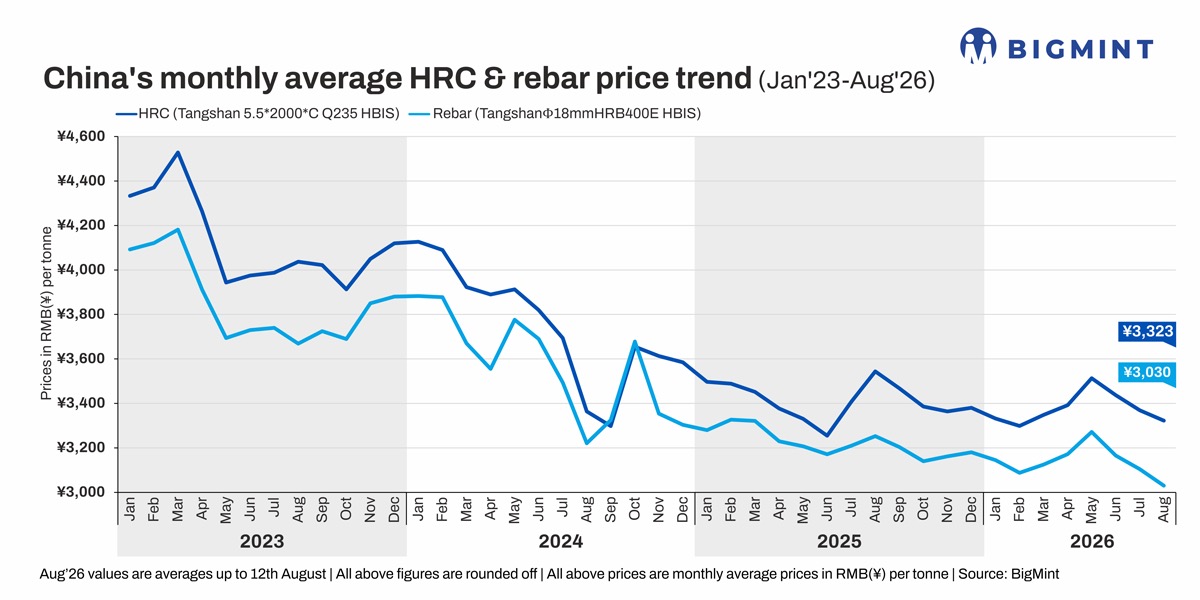
- HRC outperforms rebar as manufacturing demand remains firmer than construction
- Mill losses trigger production cuts but weaker demand limits price recovery
- Slower exports and rising trade barriers increase reliance on domestic market rebalancing
Morning Brief: China’s steel market remained under pressure in July as mills accelerated production cuts in response to widening losses, but weaker domestic demand and slowing export momentum prevented the supply adjustment from stabilising prices. Average Tangshan HRC prices declined 2.0% m-o-m to RMB 3,369/t in July from RMB 3,437/t in June, while average rebar prices fell 2.0% to RMB 3,104/t from RMB 3,166/t over the same period. HRC continued to outperform rebar as manufacturing demand remained relatively resilient while construction activity weakened further.
Mill losses force production cuts
Mill margins deteriorated for a second consecutive month. After turning negative in June as finished steel prices fell below production costs, losses widened further in July to around RMB 260/t for HRC and RMB 200/t for rebar, prompting more mills to advance maintenance schedules and reduce output. Unlike previous production curbs, the adjustment was driven by commercial considerations rather than administrative controls, with producers responding to persistent negative margins.
The reduction in output became increasingly evident during the month. According to the China Iron and Steel Association, average daily pig iron production at key steel enterprises declined 4.0% m-o-m to 1.82 million tonnes, while crude steel production fell 4.9% to 1.97 million tonnes/day and finished steel output dropped 6.7% to 1.93 million tonnes/day. Production cuts became more pronounced towards the end of the month as blast furnace maintenance increased and mills continued to respond to deteriorating profitability.
Manufacturing remains more resilient than construction
Manufacturing sectors including shipbuilding, construction machinery, pressure vessels and new energy equipment continued to provide relatively stronger support for HRC, although traditional manufacturing and export-oriented industries remained subdued. Construction demand weakened further as high temperatures, heavy rainfall and typhoons disrupted project execution, while the prolonged downturn in the property sector continued to suppress procurement of rebar and other long products. Infrastructure investment provided only partial support, leaving purchases largely limited to immediate requirements.
Inventories continue to build despite lower production
Combined output of the five major steel products declined 2.3% w-o-w to 8.18 million tonnes during July 23-29, while apparent consumption fell 1.5% to 8.12 million tonnes as heavy rainfall and Typhoon Noul disrupted downstream construction activity. Stocks of the five major steel products held by traders across 132 cities increased for a second consecutive week to 19.39 million tonnes by July 30, with rebar inventories rising to 7.94 million tonnes and HRC inventories increasing to 4.76 million tonnes. Inventories tracked across Mysteel’s 35-city survey also rose 1% w-o-w to 11.91 million tonnes.
Lange Steel data showed social steel inventories across 29 major cities increasing 1.7% m-o-m to 11.09 million tonnes at the end of July, remaining 28.9% above year-earlier levels. Building-material inventories rose 2.8% m-o-m to 5.26 million tonnes, compared with a 0.7% increase in flat steel inventories to 5.83 million tonnes, reflecting weaker construction demand than manufacturing-linked steel consumption.
Exports remain resilient but face growing headwinds
Steel exports continued to provide an outlet for surplus domestic production, although momentum softened. China exported 10.12 million tonnes of steel in July, down 1.9% m-o-m from 10.32 million tonnes in June but up 2.9% y-o-y. Cumulative exports during January-July reached 64.99 million tonnes, down 4.4% from a year earlier.
Although China’s HRC export prices remained below those of India, Japan and Turkiye, preserving its price competitiveness, expanding trade remedy investigations across major importing markets and weaker overseas manufacturing increasingly constrained export demand, reducing the ability of overseas markets to absorb surplus Chinese steel.
Outlook
Production cuts are expected to continue through August as mills respond to sustained losses, but any recovery in steel prices will depend on whether supply contracts faster than demand. Seasonal restocking ahead of September may improve market sentiment, although persistent weakness in the property sector, elevated inventories and slowing export growth are expected to limit the pace of recovery.
Manufacturing demand is likely to remain more resilient than construction, allowing HRC to continue outperforming rebar. Seasonal demand typically improves during late August and September, although elevated inventories, continued weakness in the property sector and slower export growth are likely to determine whether current production cuts translate into tighter market balances. However, elevated inventories, weaker export orders and expanding trade barriers indicate the market will continue to rely on commercially driven production cuts rather than stronger demand to restore balance. Until inventories begin to decline consistently, any recovery in HRC and rebar prices is likely to remain gradual.
Leave a Reply