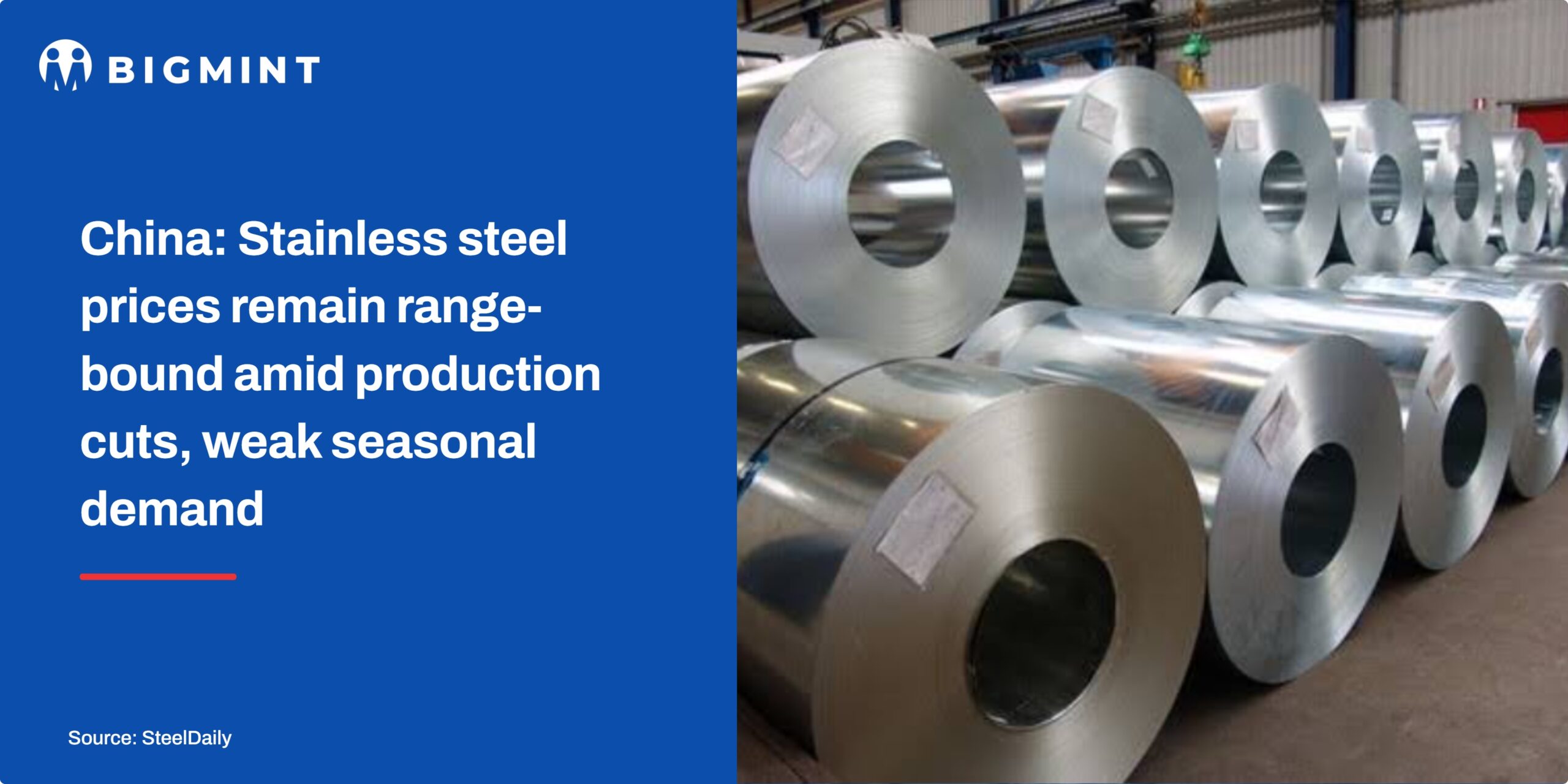
- June stainless steel output estimated to decline 5.6% m-o-m
- Weak nickel and ferro chrome prices reduce cost support for mills
Steel Daily: China’s stainless steel market remained under pressure in June as seasonal demand weakness continued to offset support from production cuts and inventory adjustments. While steelmakers have implemented maintenance shutdowns and output reductions to curb supply, market participants expect prices to remain range-bound through early July amid subdued buying activity and persistent oversupply concerns.
According to market sources, 304-grade cold-rolled stainless steel prices in Wuxi were assessed at RMB 14,650-14,800/t as of 23 June. Trading activity remained largely demand-driven, with buyers limiting purchases to immediate requirements amid uncertain market direction.
Cost support weakens as nickel, ferro chrome prices soften
Raw material support for stainless steel prices weakened during June following corrections in nickel and ferrochrome markets. Sentiment in the nickel market softened after Indonesia signalled flexibility in nickel ore mining quotas depending on international price movements, raising expectations of improved ore availability.
Meanwhile, Chinese mills reduced July high-carbon ferrochrome procurement prices by RMB 200/t m-o-m. Benchmark procurement prices were settled at RMB 8,095/t and RMB 8,295/t, respectively, on a 50% chromium basis, reflecting easing alloy costs.
Despite the recent correction, nickel prices remain historically elevated, preventing a sharper decline in stainless steel prices and providing some downside protection for mill margins.
Production cuts slow supply growth, but oversupply concerns persist
On the supply side, maintenance shutdowns and output reductions gained momentum across Chinese stainless steel mills during June. Stainless steel crude steel production is estimated at 3.60 million tonnes (mnt), down 5.6% from May levels.
Among product categories, 200-series production is expected to record the sharpest decline, falling 13.2% m-o-m to 937,800 t. Production of 300-series stainless steel is projected at 2.00 mnt, down 2.6%, while 400-series output is estimated at 662,800 t, down 2.3%.
However, despite the monthly decline, June production remains 9.5% higher than the corresponding month last year. Market participants noted that current production cuts are slowing supply growth rather than fundamentally tightening market availability, leaving overall supply pressure elevated.
Demand remains constrained by seasonal slowdown
Demand conditions remained weak across major downstream sectors as China’s traditional summer off-season impacted purchasing activity. High temperatures and rainfall affected consumption from construction, interior decoration, and pipe manufacturing segments, while demand from appliances, kitchenware, and hardware sectors remained below expectations.
Most transactions were reported on a need-based basis, with buyers avoiding large-scale inventory replenishment due to uncertain pricing trends and adequate material availability.
Export performance showed some improvement during May, with stainless steel shipments increasing 5.4% m-o-m to approximately 415,700 t. However, exports remained 4.7% below year-ago levels, indicating that overseas demand has yet to fully compensate for domestic weakness.
Inventories decline gradually
Inventory levels continued to trend lower during June, supported by reduced mill output. Stainless steel inventories across major Chinese markets stood at 1.118 mnt as of 18 June, down 0.7% from the previous week.
Cold-rolled inventories remained stable at 662,700 t, while hot-rolled inventories declined 1.8% to 455,100 t. However, market participants noted that inventories of 300-series stainless steel remain relatively high, limiting the potential for a sustained price rebound.
Market implications and outlook
China’s stainless steel market is expected to remain largely range-bound through early July as opposing market forces continue to balance each other. Production cuts, easing inventories, and still-elevated raw material costs are likely to provide support against sharp price declines.
However, weak seasonal demand, cautious procurement activity, and abundant supply availability are expected to cap any meaningful price recovery. Market sentiment will also remain sensitive to developments in nickel prices, Indonesian ore policy, macroeconomic conditions, and export demand trends.
As a result, market participants are expected to continue adopting a wait-and-watch approach until clearer signals emerge on demand recovery and inventory tightening.
Leave a Reply