- US coal exports gain importance
- Global competition likely to intensify
The United States coal market continues to be shaped by diverging domestic and international trends.
While overall electricity generation has remained resilient, coal-fired power generation is steadily losing market share to natural gas and renewable energy, resulting in lower domestic coal consumption and increasing exportable supply.
For international markets, this is an important development. Greater availability of US thermal coal is likely to intensify competition in Atlantic and Asian markets, particularly as Indian and Chinese buyers continue to adopt cautious procurement strategies.
Although export opportunities remain favourable, weaker global demand and abundant supply suggest that US producers will increasingly compete on quality, logistics and delivered cost rather than price alone.

Coal continues to lose market share
The US electricity market continues to undergo a structural transformation.
During the first quarter of 2026, total electricity generation increased by approximately 2% year-on-year, supported by economic activity and seasonal demand. However, coal-fired generation declined 10%, continuing a long-term trend as utilities increasingly favour lower-cost natural gas and expanding renewable capacity.
This shift reflects both economic considerations and the continuing decarbonisation of the US power sector.
Despite stable electricity demand, coal’s share of generation continues to contract.
Domestic coal consumption continues to decline
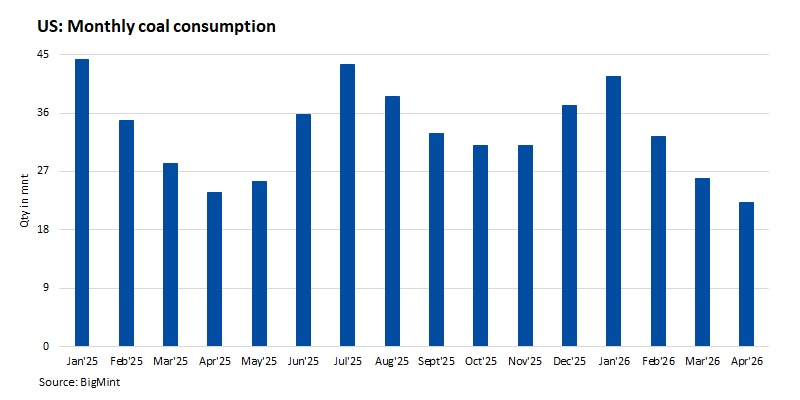
The impact on coal demand has become increasingly evident.
Coal consumption during March 2026 declined to approximately 22.8 million tonnes, while cumulative coal consumption during the first quarter (January-March) totalled 87 million tonnes, representing a 12% year-on-year decline.
The decline continues a multi-year trend that has fundamentally reshaped the US coal industry.
While domestic demand weakens, production capacity and mining infrastructure remain substantial, increasing the amount of coal potentially available for export markets.
Export markets become increasingly important
Lower domestic consumption is strengthening the importance of exports for US coal producers.
Thermal coal suppliers are increasingly targeting markets including:
- Europe
- India
- Morocco
- Egypt
- Southeast Asia
At the same time, metallurgical coal exports continue to benefit from relatively healthy global steel production and steady demand from Asia and Europe.
For many producers, export markets are becoming the principal source of incremental growth.
India remains a strategic long-term destination
India continues to represent one of the most attractive long-term markets for US coal.
Although utilities have remained cautious buyers in recent weeks, high-calorific-value US thermal coal continues to compete effectively against South African and Colombian material.
Indian cement producers have also demonstrated increasing flexibility in fuel procurement, switching between petroleum coke, domestic coal and US Northern Appalachian (NAPP) coal depending on relative economics.
This flexibility provides continuing opportunities for US exporters despite subdued spot demand.
Competition in global markets intensifying
Greater export availability is likely to increase competition across both Atlantic and Asian markets.
US suppliers will increasingly compete with:
- Colombian thermal coal into Europe,
- Russian coal into India and China,
- South African coal into the Indian market,
- Indonesian lower-calorific-value coal across Southeast Asia.
As procurement strategies become more sophisticated, buyers are placing greater emphasis on delivered energy costs, freight economics and fuel quality rather than headline prices alone.
This trend favours suppliers capable of consistently delivering high-quality coal with competitive logistics.
Natural gas continues to reshape the US market
The continued expansion of natural gas generation remains the single biggest driver of declining domestic coal demand.
Abundant shale gas production, competitive fuel pricing and operational flexibility continue to encourage utilities to favour gas-fired generation over coal.
At the same time, renewable energy additions are further reducing coal’s share of the electricity mix.
These structural changes are expected to continue, reinforcing the export orientation of the US coal industry.
Implications for global coal trade
The increase in exportable US coal supply could provide additional liquidity to international markets during the second half of 2026.
However, its impact on prices is likely to be moderated by several countervailing factors:
- Indonesian export availability remains below historical averages.
- Chinese mine production growth has slowed due to safety inspections.
- European energy security concerns continue to support high-calorific-value coal demand.
- Indian buyers remain disciplined but continue to require high-quality imported coal for specific applications.
Consequently, additional US exports are more likely to intensify competition than trigger a significant decline in international coal prices.
What to watch for
Market participants should closely monitor:
- US natural gas prices
- Coal export volumes from East Coast terminals
- Indian utility and cement sector procurement
- European thermal coal demand
- Atlantic freight ratesAsian spot market buying activity
BigMint’s take
The US coal market is increasingly transitioning from a domestically driven industry to an export-oriented business.
As natural gas and renewable energy continue to capture a larger share of US electricity generation, domestic coal consumption is steadily declining, creating additional exportable supply for international markets.
For Asian buyers, this presents an opportunity to access reliable high-calorific-value coal from an increasingly competitive supplier base.
However, abundant US supply alone is unlikely to fundamentally alter global market dynamics. Indonesian export constraints, slower Chinese production growth and continued energy security concerns across Europe are expected to provide ongoing support to international coal prices.
The result is a market where quality, freight economics and delivered energy value-not simply price-will increasingly determine competitiveness, reinforcing the growing importance of value-in-use across the global coal trade.

Leave a Reply