- Drop in Iranian exports to create 5-5.5 mnt supply gap in long products
- China may capture 30-40% of that billet supply gap – around 2 mnt/year
Horizon Insights: On the afternoon of 27 March, US and Israeli warplanes struck Iran’s core steel plants: Mubarak, Khuzestan, and Isfahan. These facilities account for 50%-70% of Iran’s crude steel capacity, using natural gas-based direct reduction and EAF routes that rely heavily on power and natural gas. The strikes also destroyed supporting power plants, making short-term resumption difficult.
Iran is the world’s second-largest producer of direct reduced iron (DRI), holding about one-fourth of global share. Targets expanded beyond military and nuclear sites to include power plants, warehouses, and steel furnaces.
Supply gap impact
Iran is a major net steel exporter, ranking first in the Middle East and among the top 10 globally. 2025 crude steel output was 31.8 mnt (over 58% of Middle East total). Iran’s steel capacity is nearly 58 mnt and annual exports were over 10 mnt in 2024, with export value at $6.48 billion. Product mix was billets/slabs 50%, rebar 25%, HRC and sheet 15%.
Iran accounts for about 2% of global crude steel output. The conflict is unlikely to trigger a global price surge but will lift regional steel prices and shipping costs.

Short term: Monthly exports fall from 900,000 t to 350,000-450,000 t, a 50%-60% drop. Medium term: Full-year exports may fall from 10.8 mnt, creating a supply gap of 5-5.5 mnt. Sheet gap: 3-3.5 mnt/year and billet/long product gap: 2-2.5 mnt/year.
Impact on China’s steel prices
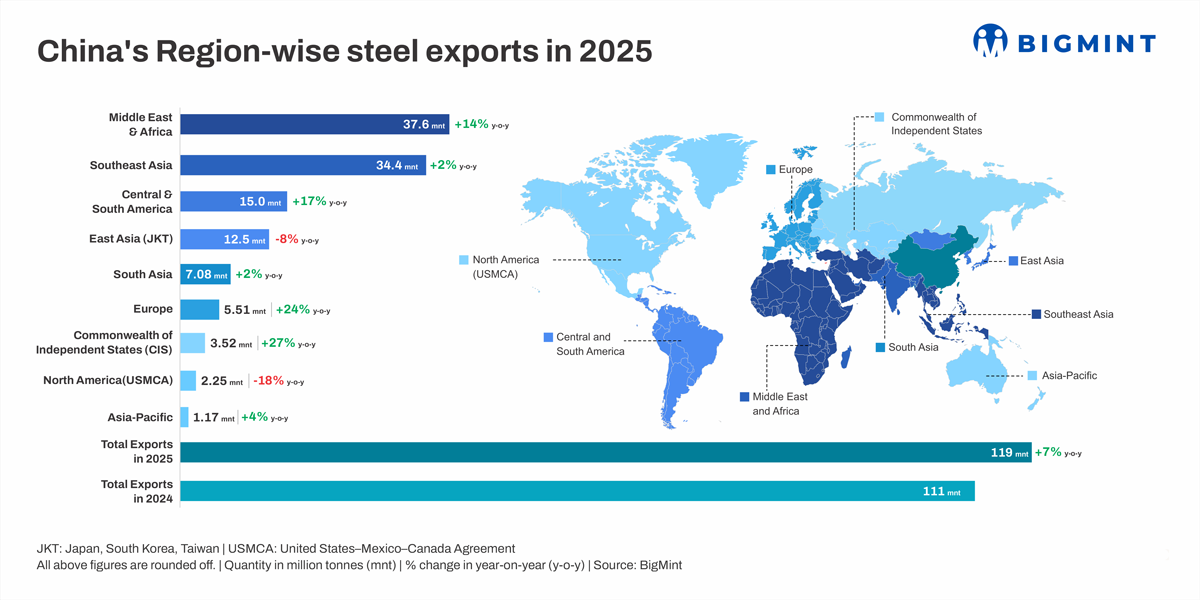
China’s product mix aligns with Iran’s export structure. China is expected to fill part of the supply gap, increasing exports to the Middle East and Southeast Asia, especially HRC, cold-rolled sheet, and long products. Export increments are likely in Q2.
China may capture 30%-40% of the gap, or about 1.5-2 mnt annually, with billet exports benefiting most.
Key drivers:
- Higher energy and shipping costs raise global steel prices
- Supply gaps boost China’s direct exports
Geopolitical tensions increase oil and gas prices, raising EAF steel costs globally. Longer shipping routes replace short-haul Iranian exports, increasing freight costs and supporting export margins. Absolute steel prices in China remain range-bound in the short term but are likely to see a rising bottom. A sharp increase in export costs has formed a solid floor, while improving domestic macro data keeps steel in a bottom-forming phase.
Export profits have risen amid strong overseas prices driven mainly by energy costs, with robust new export orders. As long as supply growth remains restrained, a steady steel price recovery this year is likely.
This piece is published as part of an article sharing agreement between Horizon Insights and BigMint
Leave a Reply