- Govt seeks to boost output to maximise revenue amid higher coal prices
- Indian portside prices of Indonesian coal up INR 1,100/t since end-Feb
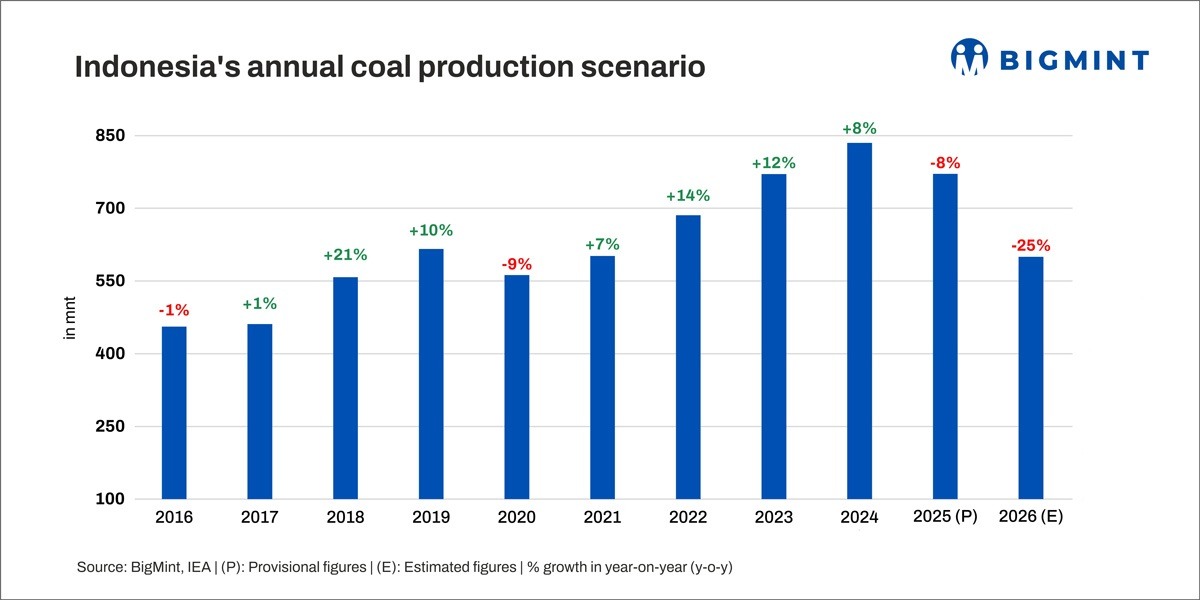
Indonesia’s Ministry of Energy and Mineral Resources has so far approved coal production work plans (RKAB) amounting to 580 million tonnes (mnt) for 2026, according to Director General of Coal and Minerals Tri Winarno. Additional approvals are expected to be finalised soon, indicating that the final national production quota could exceed the currently approved level. The early approvals suggest a shift towards supporting higher output as market conditions improve.
Earlier, the government had indicated plans to reduce coal production targets to around 600 mnt in 2026, down from 790 mnt in 2025, to address global oversupply that had pressured coal prices. However, the current pace of RKAB approvals and policy signals indicate that authorities are reconsidering the earlier supply restraint strategy.
“Mixed signals on 2026 output — 580 mt is being talked about as approved, but there is chatter of higher volumes. Export tax is on hold for now, and many of us are still waiting for final quota allocations,” said an Indonesian miner.
Temporary extraction provision supported early-year mining activity
To ensure operational continuity, the ministry had issued a circular on 31 December 2025 allowing mining companies to extract up to 25% of the production volume outlined in their three-year RKAB plans even before receiving formal approvals for 2026. This provision allowed miners to continue production until 31 March, preventing disruptions in supply while regulatory approvals were pending.
Rising energy prices drive strategic output increase
Indonesia’s policy stance appears to have shifted amid rising global energy prices following the US-Israeli attacks on Iran, which prompted Iran to threaten the closure of the Strait of Hormuz, a crucial global oil shipping route. The resulting supply concerns have pushed oil prices to around $100/bbl, encouraging several countries to increase reliance on alternative fuels such as coal. Consequently, Newcastle coal futures have climbed to about $135/t, roughly 16% higher than pre-conflict levels.
Government seeks to capture windfall revenue
In response to stronger coal prices, Coordinating Economic Affairs Minister Airlangga Hartarto stated that President Prabowo Subianto has instructed the government to increase coal output to maximise state revenue. The government is also evaluating the possibility of introducing a coal export tax to capture windfall gains and stabilise fiscal revenues during periods of energy price volatility. However, no further updates have been received yet on this.
Expected impact on India
India typically imports around 160-170 mnt of thermal coal each year, with roughly 100 mnt sourced from Indonesia, making it the dominant supplier of the low-calorific coal used by Indian coastal power plants. Indonesia is now moving toward tighter control of coal production, exports and pricing.
For India, which relies heavily on Indonesian low-CV material, the shift has direct implications for supply availability and price formation. Players may shift to other origins of thermal coal or domestic sources in order to make up for the deficit of Indonesian supplies.
Indian portside prices for Indonesian-origin thermal coal increased sharply w-o-w on 03 March 2026, supported by tight supply and geopolitical tensions between the United States and Iran, which injected uncertainty into global energy markets. However, prices have stabilised in the past week owing to fiscal year end limiting trades and less aggressive buying at high price levels. According to BigMint’s latest assessment on 27 March, 4,200 GAR prices were higher by INR 1,100/t since the end of February 2026, at INR 7,700/t at Kandla and INR 7,600/t at Vizag.

Leave a Reply