- South African coal prices surge sharply amid freight rise, Middle East war
- Indonesian coal prices climb up as export policy uncertainty tightens supply
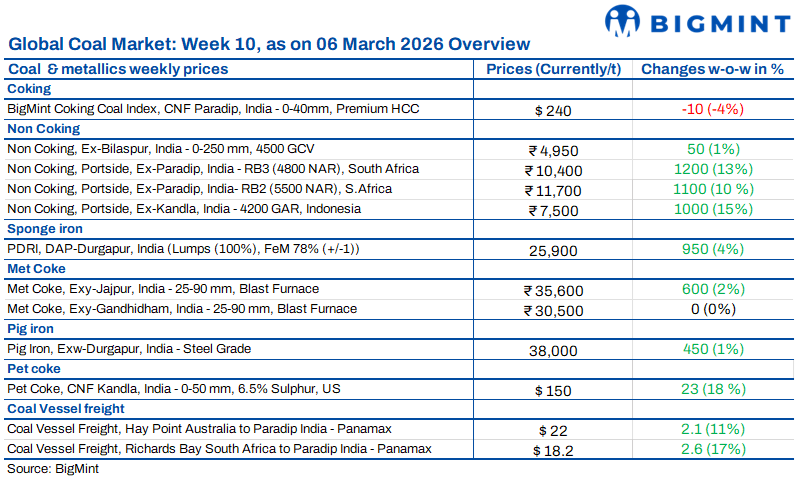
Global coal prices increased across most segments in the week ending 07 March 2026, as geopolitical tensions and supply uncertainties continued to support sentiment. Export offers stayed elevated across key origins, while freight costs and energy market volatility added pressure to delivered prices. However, buying activity remained selective as many consumers maintained adequate inventories and preferred to monitor market developments. Overall sentiment stayed cautious, with participants adopting a wait-and-watch approach amid widening bid-offer gaps and uncertain supply signals.
Portside Indonesian thermal coal prices near 3-year high
Indian portside prices of Indonesian thermal coal rose sharply w-o-w as of 6 March, nearing a three-year high, driven by Indonesian export policy uncertainty and geopolitical tensions. 5,000 GAR increased INR 950/t to INR 9,300/t at Kandla and INR 9,200/t at Vizag. 4,200 GAR rose INR 1,000/t to INR 7,500/t at Kandla and INR 7,400/t at Vizag, while 3,400 GAR increased INR 1,000/t to INR 5,900/t at Navlakhi.
Indonesian benchmarks also strengthened, with 5,800 GAR up $2.35-2.4/t, 4,200 GAR up $4-4.5/t, and 3,400 GAR up $0.8-0.9/t. Freights from East Kalimantan to Navlakhi rose $2.7/t to $17/t, increasing import costs. Despite the rally, buyers remained cautious, and some shifted towards domestic coal and lignite.
Portside South African thermal coal hits 3-year high
South African thermal coal prices at Indian ports surged w-o-w amid rising export offers, higher freights, and Middle East geopolitical tensions. As per BigMint’s assessment, exw-Paradip RB2 (5,500 NAR) increased to INR 11,700/t and RB3 (4,800 NAR) to INR 10,400/t, up INR 1,100-1,200/t w-o-w. At Vizag, RB2 rose to INR 11,600/t and RB3 to INR 10,300/t, marking a three-year high.
FOB RBCT offers were heard near $100-110/t for 5,500 NAR and around $80/t for 4,800 NAR, implying roughly $116-120/t and $95-100/t CFR India. Freights increased by $4-5/t amid higher oil prices. Buying activity remained limited as consumers held 1-2 months of stock, widening the bid-offer gap. Port inventories declined 3.6% w-o-w to 13.14 mnt, while sponge iron prices, exw-Durgapur, rose INR 600/t to INR 25,700/t.
Domestic coal prices edge up
Indian domestic non-coking coal prices increased INR 50/t w-o-w, as per BigMint’s assessment. 4,500 GCV rose to INR 4,950/t and 5,000 GCV to INR 6,000/t exw Bilaspur. Sellers raised offers slightly amid stronger sponge iron prices and the sharp rise in imported coal prices. However, the domestic market largely remained stable, with procurement continuing at steady levels across industrial users.
Coking coal index drops in recent deal
BigMint’s premium hard coking coal (PHCC) index was assessed at $240/t CNF Paradip on 6 March, down $10/t w-o-w, marking a two-month low amid cautious buyer sentiment and lower bids. Australian PHCC offers softened, with an eastern India mill booking 75,000 t Goonyella coal at $220/t FOB Australia for April shipment. Freight costs increased, with Panamax Haypoint-Paradip rates rising by over $2/t to $22/t. India’s coking coal imports declined 14% m-o-m to 4.4 mnt in February, with Australian volumes falling to 1.9 mnt from 2.7 mnt due to weather disruptions.
Indian met coke prices edge higher
Indian blast furnace (BF)-grade metallurgical coke prices increased marginally w-o-w on 3 March, supported by firm import parity despite mixed global signals. In eastern India, BF coke (25-90 mm) rose by INR 600/t to INR 35,600/t ex-Jajpur, with a 22,500 t spot trade concluded at INR 36,000/t. Prices in western India remained stable at INR 30,500/t ex-Gandhidham, while foundry coke (+90 mm) held at INR 36,100/t ex-Rajkot.
Indonesian BF coke was indicated at $270-275/t CFR India, implying landed costs of INR 34,000-34,500/t, supporting domestic prices. Meanwhile, Australian PHCC declined by $20/t w-o-w to $221/t FOB, easing raw material costs. Weak pig iron auction results and potential coke price cuts in China signalled cautious downstream sentiment.
Petcoke market disrupted by war
The global petroleum coke market turned volatile after the US-Israel-Iran conflict, which disrupted Middle East supply routes and lifted freight and crude prices. Shipping through the Strait of Hormuz became risky, tightening exports from Saudi Arabia and Oman to Asian markets. Freights from the US Gulf to India climbed to around $53-54/t, raising landed costs.
US Gulf high-sulphur pet coke traded around $89-94/t FOB, while 4.5% sulphur cargoes were heard near $88-94/t and 6%+ sulphur at $79-85/t. In India, offers rose from $124-130/t CNF in late February to $145-150/t, with some indications near $152-155/t by early March. Many cement buyers paused purchases amid the rapid price surge and uncertain supply outlook.
Nayara pet coke price rises
Nayara Energy raised its pet coke price by INR 670/t ($7/t) m-o-m to INR 16,040/t, effective 1 March, from INR 15,370/t earlier. The revised level was 7% higher y-o-y. The increase followed tight domestic availability after operational disruptions at Nayara’s refinery during July-October 2025, when US sanctions affected crude sourcing linked to Russia and Rosneft backing. Although crude procurement improved from November, allowing refinery operations to normalise, the overall supply of pet coke in the domestic market remained constrained. Limited availability supported the latest price revision, while buyers continued to monitor supply recovery and downstream fuel demand conditions across cement and industrial sectors.
Coal freights extend weekly gains
Dry bulk coal freights to India increased w-o-w as of 6 March, supported by rising bunker prices and geopolitical tensions linked to the Iran-Israel-US conflict. The South Africa-Paradip route hovered near a five-month high, while Pacific routes also strengthened. Freights from East Kalimantan to Navlakhi also rose earlier to $17/t, reflecting firm Pacific sentiment. Despite higher rates, fixtures remained limited as cargo enquiries stayed muted.
Leave a Reply