- Fed signals cautious stance, limiting expectations of rate cuts
- Canada Nickel’s Crawford Project secures federal fast-track
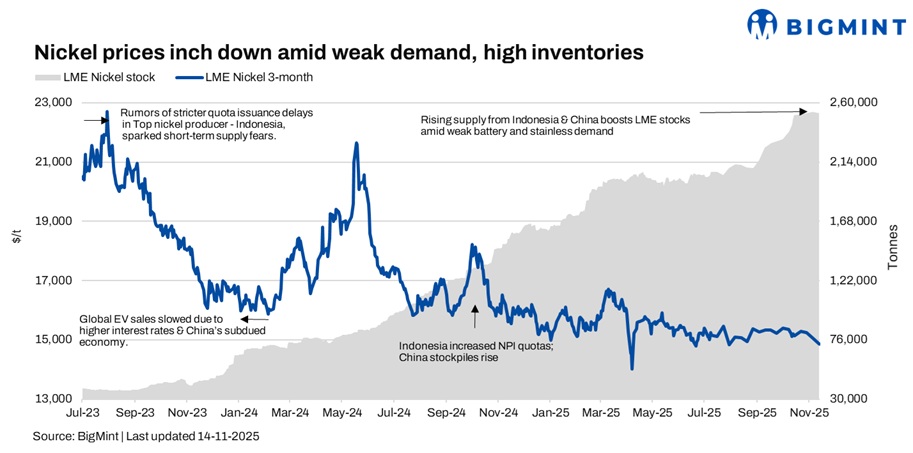
Nickel prices on the London Metal Exchange (LME) declined by 1.5% w-o-w, with three-month contracts settling at $14,870/t on 14 November, against $15,070/t in the previous week. LME nickel inventories stood at around 252,090 t, marginally down from last week’s 253,104 t, indicating stable yet elevated stocks.
Despite short-term fluctuations, the overall trend remains subdued due to ongoing oversupply concerns and mixed demand signals. Price volatility was constrained by persistent bearish sentiment amid resilient Indonesian production, despite government restrictions aimed at curbing output.
The Indonesian government continued to enforce quota controls, limiting new nickel mining permits without downstream processing plans, adding some long-term support amid the current oversupply.
Macro factors influencing nickel this week
US Federal adopts reserved stance: The US Federal Reserve signalled a cautious approach toward further rate cuts, introducing uncertainty that impacts industrial metals demand. While markets priced in potential easing, several Fed officials expressed concerns over inflation persistently exceeding targets and economic resilience, suggesting limited near-term cuts. This stance tempers optimism for stronger commodity demand and reflects ongoing macroeconomic risks such as labour market conditions, inflation trends, and geopolitical tensions shaping monetary policy decisions.
Crawford Nickel project secures federal fast-track: Canada Nickel’s Crawford Project in northern Ontario has been referred to the Canadian Major Projects Office (MPO) for federal fast-tracking as of November 2025. The project, located in the world’s second-largest nickel reserve, aims to produce low-carbon, high-quality nickel essential for batteries and green steel, with emissions estimated at nearly 90% below global averages. Development of this project is expected to attract $5 billion in investment, and this designation aligns with Canada’s broader strategy to accelerate nation-building infrastructure projects that support clean energy and critical minerals supply chains.
Brazil’s strategic minerals policy boosts nickel industry: Brazil’s government has introduced rules to finance lithium, nickel, and cobalt projects, positioning the country as a key player in battery production and clean energy. Up to 49% of funds raised through incentivised debentures can support mining and development, while the majority targets processing and high-value manufacturing. This policy aims to attract billions of reais in investment, fostering innovation and industrial growth in strategic minerals essential for the energy transition.
Outlook
The nickel market faces structural adjustments with oversupply, keeping prices depressed in the near term. However, market participants look for a potential rebalancing driven by supply shutdowns at unprofitable levels, tightening of Indonesian quotas, and improving demand fundamentals later in 2026 and beyond.
Leave a Reply