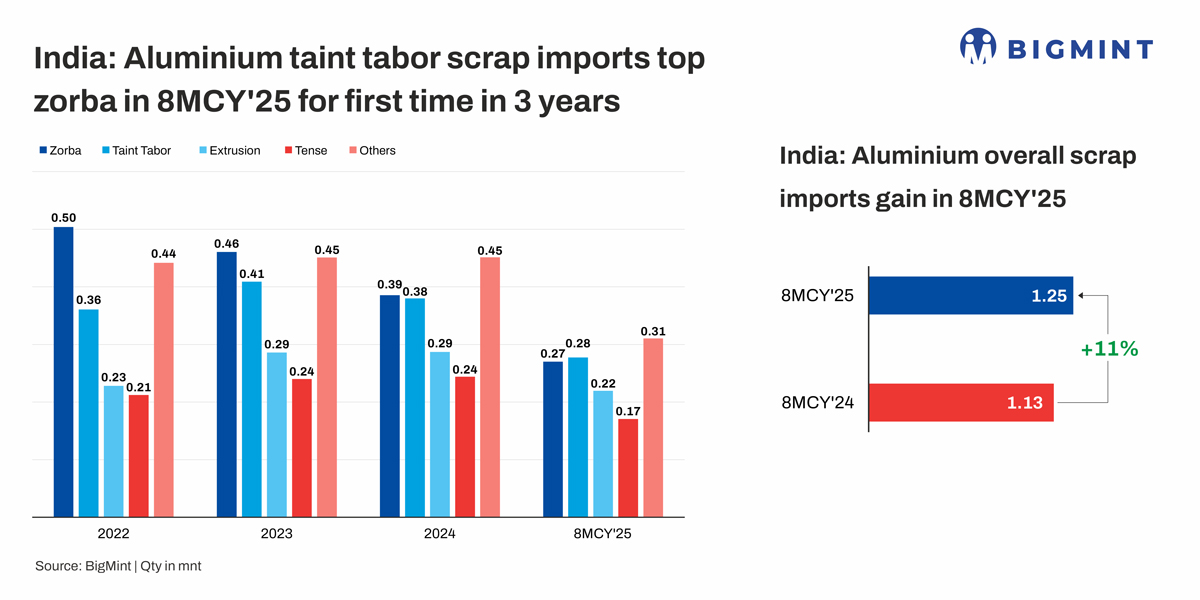
- Taint Tabor imports overtake Zorba for 1st time in 3 years
- Importers diversify sourcing patterns as exports from US fall
- Imported Taint Tabor more competitive than domestic scrap
Morning Brief: India’s aluminium scrap imports have witnessed an incremental shift in terms of grade-wise sourcing. In January-August 2025 (8MCY’25), for the first time in the past three years, Taint Tabor scrap imports surpassed Zorba arrivals to become the most-imported grade into India. Imports of Taint Tabor stood at 0.28 million tonnes (mnt) in 8MCY’25, an 11% increase from 0.24 mnt in 8MCY’24.
Notably, Zorba has always remained the top grade imported into India by secondary aluminium makers, used primarily for producing alloy ingots. A major portion is also imported by traders who sort out the copper impurities and then put up the processed material for sale.
India’s aluminium scrap imports rise 10% in 8MCY’25
India’s overall aluminium scrap imports increased by 10% to 1.25 mnt in 8MCY’25 from 1.13 mnt in 8MCY’24. Major importers also scaled up procurement amid a shortage of aluminium scrap during the initial months of the year, particularly following the imposition of US tariffs.
Grade-wise aluminium scrap imports
Most grades, except for Talk, witnessed an increase in arrivals in 8MCY’25 despite intense price volatility.
While Taint Tabor was the most imported grade in 8MCY’25, the gap between it and Zorba was a slim 1,800 t. Zorba imports totalled around 276,000 t, up 9% from 253,000 t in 8MCY’24.
Among other grades, Extrusion (Tread) witnessed the highest percentage growth of 16% to 220,000 t. Meanwhile, Tense was also up 10% to 171,000 t.
Country-wise imports

The US, the leading exporter to India, witnessed a 12% y-o-y decline in shipments to 244,510 t in 8MCY’25. Saudi Arabia overtook the UK as the second-largest source, with exports up 7% to 115,000 t. The UK’s volumes inched up by 2% to 113,000 t, while the UAE witnessed the strongest growth of 41% to 111,000 t.
Why did India’s scrap import mix shift in 8MCY’25?
Importers source from alternative regions amid fall in US exports: The increase in Taint Tabor imports ultimately stems from a drop in US export shipments of the same. Resultant supply concerns prompted Indian importers to modify their sourcing strategies and source Taint Tabor from alternative regions.
Overall, scrap supply from the US shrank by 12% in 8MCY’25 to 244,510 t from 278,027 t in 8MCY’24. The contraction follows the Trump administration’s imposition and subsequent doubling of tariffs on steel and aluminium imports, initially set at 25% in March and later raised to 50% in early June.

Taint Tabor shipments from the US, the second-largest exporter of this grade to India after the UK, declined by a steep 29%. Conversely, Zorba imports from the US witnessed a 3% dip.
The US began to consume more domestic scrap due to a 13% drop in finished aluminium imports, to 1.06 mnt from 1.22 mnt in 8MCY’24. As a result, US markets absorbed more domestic scrap, reducing export volumes.
Particularly, demand for Taint Tabor scrap remained strong in the US domestic market, as many new re-rolling mills commenced, contributing to the decline in exports of the same grade.
Additionally, it was also seen that the US was actively importing aluminium scrap from Canada and the EU, as scrap was exempted from tariffs amid strong demand.
The combination of rising local demand and more attractive domestic pricing significantly limited scrap availability for key export destinations, including India. This also increased the prices and the transit time of Taint Tabor to India, which led to an increase in sourcing from other near by countries like the Middle East region.
Amid lower volumes of Taint Tabor from the US, India raised its intake from the Netherlands (+13%), UAE (+36%), and Saudi Arabia (+11%) in 8MCY’25 to compensate for the supply shortfall.
Imported material offers cost advantages: As per BigMint’s assessments, domestic prices were higher than those of imported material by around INR 4,000-6,000/t.
As per BigMint’s assessments, US-origin Taint Tabor HRB 3% average scrap prices stood at $2,120/t, CFR west coast, India, in 8MCY’25, increasing by a notable 12% from $1,900/t in 8MCY’24. The average price of UK-origin Taint Tabor (C/S 9–10%) stood at $1,961/t in 8MCY’25, up 12% from $1,751/t a year ago. Despite the y-o-y increase, the landed cost of imported scrap remained lower than domestic Taint Tabor, making it a cost-effective option for Indian buyers.
Meanwhile, domestic Taint Tabor averaged INR 187,837/t, reflecting an increase of 6% y-o-y.

During the same period, average LME aluminium prices were also up by 6% to $2,555/t compared to $2,400/t in 8MCY’24. The rise followed uncertainty in the global market, driven by geopolitical tensions, such as in the Middle East and US tariffs, and supply concerns. The rise in LME aluminium prices aligned with a decline in inventories at LME-registered warehouses.
Stocks at LME-registered warehouses dropped by 39% in 8MCY’25 to 466,365 t from the previous year’s 767,530 t, further supporting the price rise.
Rolled product, ingot units raise Taint Tabor intake: Most rolled product companies increased their scrap procurement during this period, as compared with 8MCY’24. Small-to-medium scale alloy ingot makers also boosted their procurement volumes of Taint Tabor, as it can also be used as an alternative for making ADC12 ingots.
Outlook
Looking ahead, in the remaining months of 2025, India is expected to raise its scrap imports to offset the drop from the largest supplier, the US. To this end, importers might increase procurement from the UK, EU, and Middle East. Additionally, going by current trends, scrap imports could reach around 1.8-1.9 mnt in CY’25.
Leave a Reply