- Steel imports reach 3.68 mnt in Jan-May’25, down 20% y-o-y
- Competitive prices boosting Russia’s HRC export prospects
- Regulatory tightening to further curb inflow of steel imports
Morning Brief: India’s total steel imports, including stainless steel, increased m-o-m in May 2025 to 0.82 million tonnes (mnt), as per provisional data gathered by BigMint.
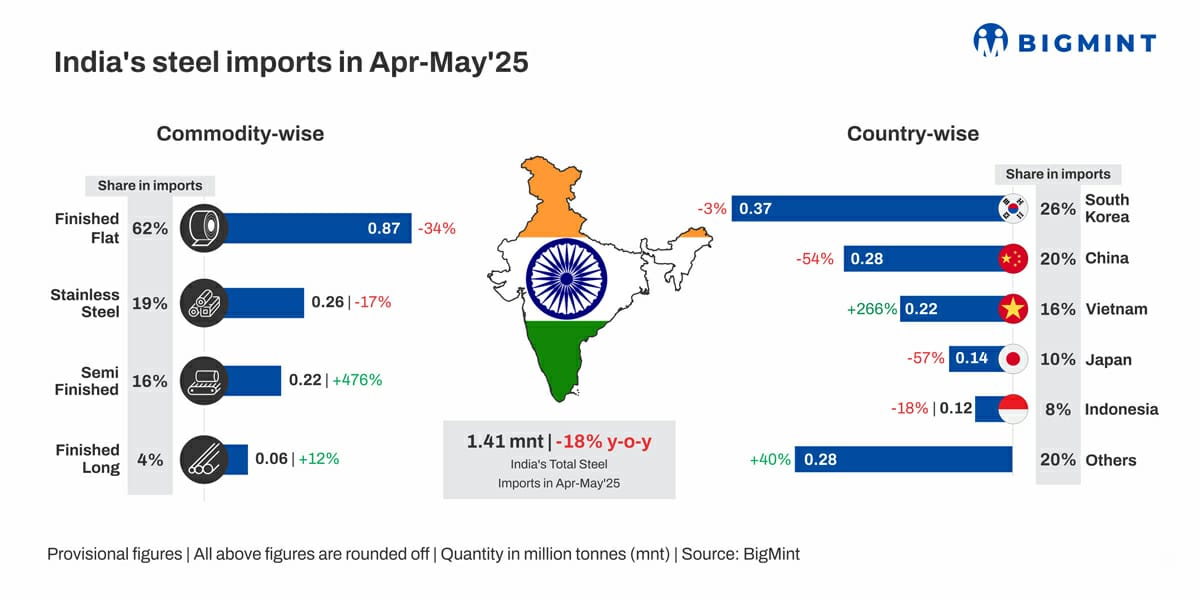
Steel imports increased over 40% m-o-m mainly due to the surge in imports of semis (slabs) in May by a major steel producer from its own overseas unit. Other than that there has been no noticeable change. Steel imports in April-May 2025 stood at 1.41 mnt (provisional figure), a decline from 1.71 mnt in the same period of 2024.
Likewise, total steel imports in January-May of the current year stood at 3.68 mnt, a decline of nearly 20% from 4.37 mnt in the corresponding period of CY’24. Of course, India’s steel imports in CY’24 increased sharply to around 11 mnt, edging up by over 20% y-o-y.
But the 12% provisional safeguard duty on imports, mooted earlier but taking effect from mid-April, has successfully stemmed the tide of imports seen in CY’24.
Product-wise imports: Finished flat products, mainly HRC, pipes and tubes, galvanized and coated strips and sheets and electrical steel comprised 62% of total imports in April-May, as per data, with the shares of semis and finished longs at 19% and 16%, respectively. Stainless steel imports had a share of 4% of total imports during the period.

Country-wise steel imports: South Korea was the leading steel exporter to India during April-May with a share of 26%, followed by China at 20%, Vietnam (16%) and Japan (10%).
Interestingly, Vietnam displaced Japan from the position of the third-highest steel exporting country to India during the period under review after leading Vietnamese mills received renewals of their BIS licences, thereby allowing them to export certain products and grades to India.

Steel import market dynamics
High safeguard threshold & deteriorating global prices: The 12% provisional safeguard mechanism mentions a price threshold for all forms of imported products from HRCs to coated plates and sheets beyond which the duty doesn’t apply. Considering HRC as a reference point, the threshold is $675/t CIF which is actually much higher than the prevailing export prices in key countries.
So, imports have been affected because lower import prices of steel beyond the recommended threshold would attract a 12% tariff. This is borne out by the sharp fall in imports from the FTA countries and China.
The consistent decline in global steel prices would have led to steel imports retaining some of their attractiveness for Indian buyers only if the duty was not in place. In addition, domestic prices have weakened considerably and so the urge for imports is absent.
HRC offer prices by major Vietnamese mills or from South Korea are in the $475-485/t FOB range – far lower than the threshold under the safeguard duty even after adding freight, insurance and other charges. Moreover, HRC export prices of all the key suppliers have declined by $20-25/t on FOB basis over the last three months.
Resumption of Russian HRC exports: Russia has re-entered the Indian HRC market after a significant gap, with bookings of 35,000-40,000 t for June shipment heard. This marks a notable increase in imports from a source which happens to be re-emerging on the trade scene.
Incidentally, much like all Russian exports, extremely attractive and competitive pricing is giving the country an edge in steel exports at a time of declining domestic demand in the construction and manufacturing sectors in Russia amid the crippling impact of wide-ranging sanctions on the war economy.
Russian HRC was heard booked at $460-470/t CFR, indicating that competitive prices attracted Indian buyers as deals seemed viable despite the 12% tariff.
Another crucial factor enabling Russian exports is that the major mills have secured BIS certification. Russian producers such as Novolipetsk Steel and PAO Severstal hold operative BIS licences for relevant steel grades such as coils, sheets and strips (IS 2062 and IS 1079).
Outlook
Effective 16 June, the Ministry of Steel mandates that input materials used in imported steel and steel products requiring SIMS registration must comply with specified Indian standards. This reinforces the existing Quality Control Order (QCO), 2024. This will effectively end the re-routing of steel through third countries via further processing of vanilla grades from certain leading exporting countries.
Extending the BIS mandate across the product and supply chains, or a regulatory tightening of imports, is likely to further restrict shipments from certain suppliers.
Again, attractive and super competitive prices may attract buyers despite the existing duty. Therefore, there is speculation that the government may consider doubling the prevailing provisional duty to 24%.
Leave a Reply