- Embedded ferro alloy emissions counted twice — as product and as steelmaking input
- Use of carbonaceous reductants, fragmented industry structure emerge as key challenges
- Ability to provide product-level emissions data may become key competitive advantage
Morning Brief: The discussion around the European Union’s Carbon Border Adjustment Mechanism (CBAM) has largely centred on steel, aluminium and cement. However, for the ferro alloys industry, the implications may be equally profound – if not more complex.
Embedded ferro alloys emissions are counted twice – as a directly covered product as well as a precursor to steel – leading to a bigger exposure to CBAM than steel.
Given that Indian ferro alloy manufacturing is characterised by high electricity intensity, dependence on carbon-based reductants, and a fragmented industry structure, exports have faced increasing scrutiny from both direct buyers and downstream steelmakers.
While ferro alloys are a relatively small source of total industrial emissions because of their lower production volumes, they are a significant emissions-intensive input for steelmakers.
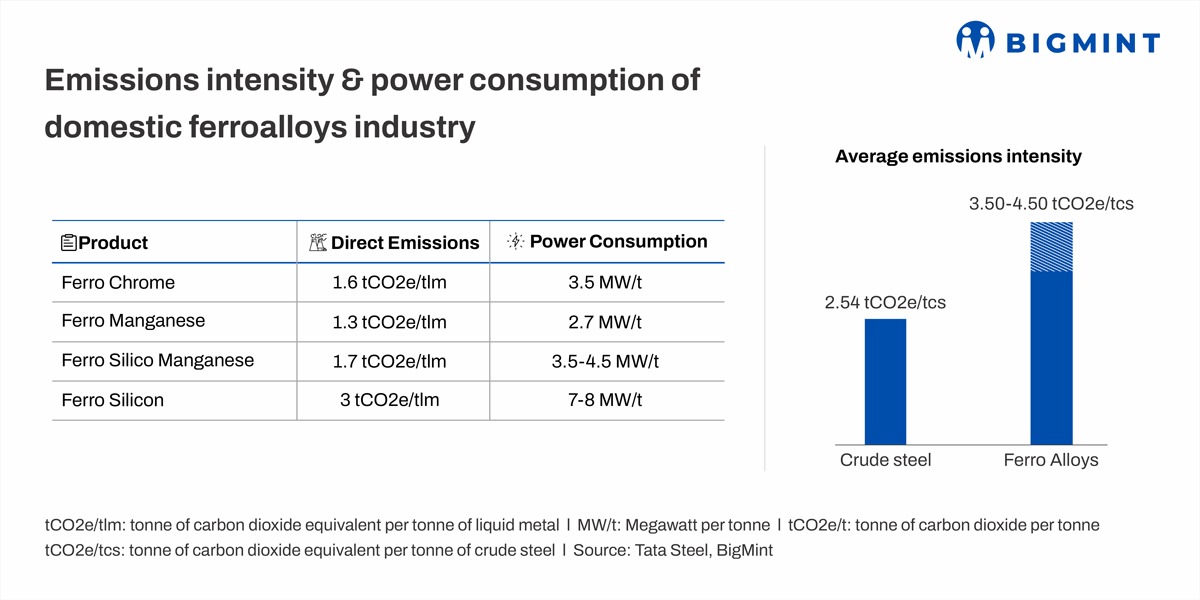
According to BigMint estimates, the direct emissions intensity of ferro chrome production is around 1.6 tonnes of CO2 emissions per tonne (tCO2e/t) of liquid metal, compared with 1.3 tCO2e/t for ferro manganese and 1.7 tCO2e/t for silico manganese. Ferro silicon is higher at around 3 tCO2e/t. Overall, the emissions intensity of India’s ferro alloy sector is estimated at nearly twice that of the steel sector.
As such, the real significance of CBAM for Indian ferro alloys is not the immediate carbon cost – it is the possibility that carbon intensity becomes a decisive factor in global sourcing decisions.
Ferro alloys: Hidden carbon link in steel Ferro alloys occupy a strategic position in the steel value chain. Every tonne of stainless steel, special steel, automotive steel or high-strength steel requires alloying elements such as chromium, manganese, and silicon. As a result, the carbon footprint of ferro alloys becomes embedded within the carbon footprint of finished steel.
Historically, ferro alloy producers have competed on three variables: raw material access, power costs, and conversion efficiency. CBAM introduces a fourth variable: the embedded carbon intensity per tonne of alloy produced.
This shift is important because European steelmakers, traders and OEMs are increasingly evaluating emissions across the entire supply chain rather than only at the steelmaking stage. A steel producer may reduce emissions within its own operations but still face a high embedded-carbon footprint if its alloy inputs are carbon intensive.
Consequently, ferro alloy producers are moving from being commodity suppliers to becoming carbon-accountable suppliers. Why Indian producers are more exposed than competitors. India possesses significant strengths in ferro alloy production. It has abundant manganese ore resources, a large ferro chrome industry, a growing stainless steel sector, and a strong export orientation.
However, these advantages are accompanied by structural carbon challenges.
The first challenge is electricity. Although CBAM currently does not take into account indirect emissions from electricity consumption, power accounts for a substantial share of ferro alloy production costs and emissions. Many Indian ferro alloy plants remain dependent on coal-based grid electricity or captive thermal power. Since India’s grid emission factor remains significantly higher than many developed economies, electricity-related emissions become a major contributor to overall product carbon intensity.
The second challenge is reductant usage. Ferro alloy production relies heavily on metallurgical coke, coal and carbonaceous reductants. These materials are not only energy sources but also participate directly in the reduction process, making complete decarbonisation far more difficult than simply switching to renewable electricity.
The third challenge is industry fragmentation. Unlike integrated steel producers, the ferro alloy sector comprises numerous medium-sized producers operating with varying levels of technological sophistication. While some leading producers have already begun implementing renewable power, waste heat recovery, and advanced monitoring systems, a significant portion of the industry still lacks detailed emissions measurement capabilities. This creates a critical vulnerability under CBAM.
Real risk not carbon cost, it’s carbon visibility Much of the industry’s current focus is on estimating future CBAM costs. While this is important, it may not be the most immediate threat.
The more significant challenge is emissions transparency. Until recently, buyers rarely asked ferro alloy suppliers for verified carbon data. Product specifications, chemical composition and delivery schedules were the primary concerns.
This is changing rapidly. European importers increasingly require supplier-level emissions information. Steelmakers exporting to Europe are beginning to examine emissions across their upstream supply chains. Sustainability reporting frameworks are creating pressure for greater disclosure throughout industrial value chains.
In this environment, producers who cannot quantify emissions accurately may face disadvantages even before carbon costs become material. A supplier with lower actual emissions but poor data could be treated less favourably than a supplier with higher emissions but robust reporting systems.
This is why measurement may become more important than mitigation in the near term. The industry’s first competitive divide is likely to emerge not between high-carbon and low-carbon producers, but between producers who can provide emissions-related data and those who cannot.

Emergence of two-tier market CBAM may gradually create a two-tier ferro alloy market. The first tier will consist of suppliers capable of providing product-level emissions data, third-party verification, transparent monitoring systems, and traceable production records.
The second tier will consist of suppliers that cannot. The distinction matters because global buyers are increasingly willing to pay a premium — or at least provide preferred supplier status — to producers capable of supporting sustainability reporting requirements.
In such a scenario, carbon transparency becomes a market-access tool rather than merely a compliance exercise. This trend is already visible in steel, aluminium and automotive supply chains and is likely to extend further into ferro alloys.
Decarbonisation economics are changing Traditionally, decarbonisation was viewed as an additional cost burden. However, CBAM alters this calculation.
Measures such as waste heat recovery, furnace optimisation, ore beneficiation, renewable energy integration, improved raw material quality, and reduction in specific power consumption not only reduce emissions but also lower operating costs.
Historically, these investments were justified primarily through energy savings. Under a carbon-regulated trade environment, they generate an additional return through reduced carbon exposure and improved customer acceptance.
This fundamentally changes investment economics. Projects that previously delivered only operational benefits may now deliver both operational and commercial benefits.
Strategic importance of data Perhaps the most overlooked implication of CBAM is that the industry is entering the age of carbon data. For decades, ferro alloy producers focused on metallurgical performance: recovery rates, specific power consumption, electrode consumption, and yield optimisation.
While these metrics remain important, future competitiveness may increasingly depend on another set of metrics: Scope 1 emissions, Scope 2 emissions, product carbon intensity, verified emissions factors, and lifecycle emissions accounting.
The companies that master these metrics earliest are likely to gain an advantage in export markets. In many cases, the ability to prove low emissions may become as valuable as actually achieving them.
Beyond Europe: Preview of future trade Perhaps the biggest mistake would be to view CBAM as solely a European issue. CBAM is effectively a pilot project for incorporating carbon considerations into international trade.
If it proves successful, similar mechanisms could emerge in other major markets. Even where formal border carbon adjustments do not appear, multinational corporations are increasingly imposing carbon-related requirements on suppliers.
The direction of travel is clear. Carbon is becoming a tradable attribute of industrial products. Just as buyers today compare alloy chemistry, physical quality and delivery performance, tomorrow they may compare carbon intensity with equal scrutiny.
Competitiveness vs. compliance The ferro alloys industry often frames CBAM as an environmental regulation imposed by Europe. That interpretation is too narrow.
CBAM is fundamentally a competitiveness challenge. The industry’s future will not be determined solely by who produces the cheapest alloy. It will increasingly depend on who can produce, measure and demonstrate lower-carbon alloys.
For Indian producers, the next few years present a critical window. Companies that invest in emissions measurement, verification systems, energy efficiency and cleaner production routes are likely to strengthen their position in global markets. Those that delay may discover that the challenge is not paying for carbon — it is finding buyers willing to accept products whose carbon footprint cannot be demonstrated.
In that sense, CBAM represents more than a new trade regulation. It signals the beginning of a structural shift in how industrial competitiveness is defined, measured and rewarded in global markets.
Leave a Reply