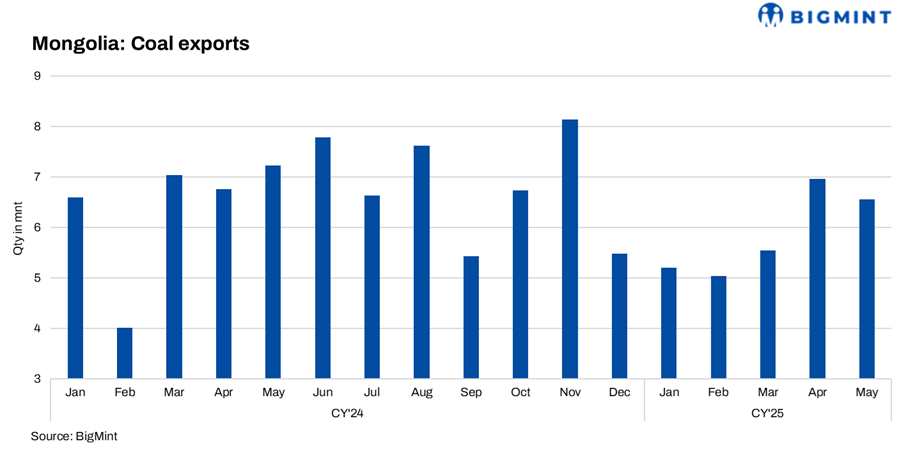
- Mongolia’s coal e-auction failures surge amid weak demand
- Chinese traders resist high prices, cite delivery delays
Mysteel Global: Mongolia’s e-auctions for metallurgical coal have failed frequently, a phenomenon that is prompting concern among industry participants on both sides of the Sino-Mongolian border. China buys almost all the coal that Mongolia exports, as reported.
In the week of June 2-6, met coal auctions held on the Mongolian Stock Exchange (MSE) were mostly unsuccessful. Mysteel data show that four Mongolian mining companies – Erdenes Tavan Tolgoi (ETT), Energy Resources LLC (ER), Khangad Exploration LLC, and Tavan Tolgoi JSC – listed a combined 428,800 tonnes of coal. However, only 44,800 tonnes were sold, resulting in a staggering failure rate of 89.55%.
So far this year, a total of 306 e-auctions had been held up to June 6 where a total of 11.53 million tonnes of coal had been offered. Yet only 51 sessions concluded with successful deals, amounting to just 2.1 million tonnes transacted. The remaining 255 sessions (involving 9.43 million tonnes of coal) saw no deals stuck, which brought the overall failure rate to 81.8%, Mysteel data showed.
In May alone, the situation worsened. Out of the 61 auctions held by the MSE where 1.69 million tonnes were offered, 57 sessions failed, accounting for 1.64 million tonnes – a failure rate of 96.97%, the data revealed.
A new system, but market resistance
The current e-auction model was introduced by the Mongolian government in early 2023 to address the fallout from coal theft scandals. Aiming to improve transparency and curb corruption, the Ulaanbaatar government replaced the traditional pithead sales with an online auction system overseen by the MSE.
However, the transition hasn’t been smooth. While a few Chinese traders retained direct supply contracts with the Tavan Tolgoi mine, Mongolia’s largest, most traders were required to participate in e-auctions to secure supply, Mysteel Global has learned.
Possibly to recover past financial losses, major miners like ETT often set high reserve prices in the auctions. However, Chinese buyers, wary of price risks and market uncertainty, have been reluctant to meet the reserve, leading to frequent auction failures.
Price pressure and delivery delays
Another key reason for the lack of participation is the downward trend in Chinese domestic met coal prices since December 2023. Compounding the issue is the long delivery time from Mongolian mine to Chinese border port. For example, after it is auctioned a consignment of 3# washed coking coal from ER takes up to 90 days to reach the Ganqimaodu border crossing. By the time the coal arrives, its market value often falls below the auction price, resulting in substantial losses for Chinese traders.
To hedge against these risks, traders have tried several strategies: using spot-futures arbitrage, partnering with third-party companies to share risk, or pre-locking contracts with end-users. However, the effectiveness of these methods is limited, and uncertainty continues to deter active participation in auctions.
Inventory pressure and weak demand
High coal inventories at border crossings are further worsening the situation. As of June 11, total coal stockpiles in Customs-bonded yards at Ganqimaodu had risen to 4.18 million tonnes, up by 610,000 tonnes from a month ago and by 1.05 million tonnes year-on-year, according to Mysteel data.
These mounting inventories reflect weak demand and slow sales, leaving Chinese traders – who have invested heavily in warehouses, washing plants, trucks, and staff – stuck with coal that’s increasingly hard to sell. Under such financial strain, few are willing to commit to new purchases.
Adding to the woes are the weak fundamentals in the Chinese domestic coking coal market, which seem set to remain weak in the near term. Amid the seasonal lull in summer, Chinese steel mills have been under mounting pressure to boost steel sales, driving them to push harder for lower prices of both coking coal and coke.
Since early May, the steelmakers have won three coke-price cuts from domestic independent met coke producers, and a fourth reduction is on the horizon. As a result, coking enterprises have seen their profit margins squeezed and have become increasingly cautious about procuring feedstock coal, Mysteel analysts observed.
Given these headwinds, demand for Mongolian metallurgical coal is unlikely to recover in the near term, which in turn presages ongoing failures in the country’s e-auctions.
As of June 11, Mongolian 5# raw coal (A<18%, VM 25-30%, S<0.6%, G 80-85, MT<5%) at Ganqimaodu was priced at Yuan 718/t ($100.1/t), on an ex-stock basis with VAT, down 13.5% from the start of May, according to Mysteel’s assessment.
Note: This article has been written in accordance with a content exchange agreement between Mysteel Global and BigMint.

Leave a Reply