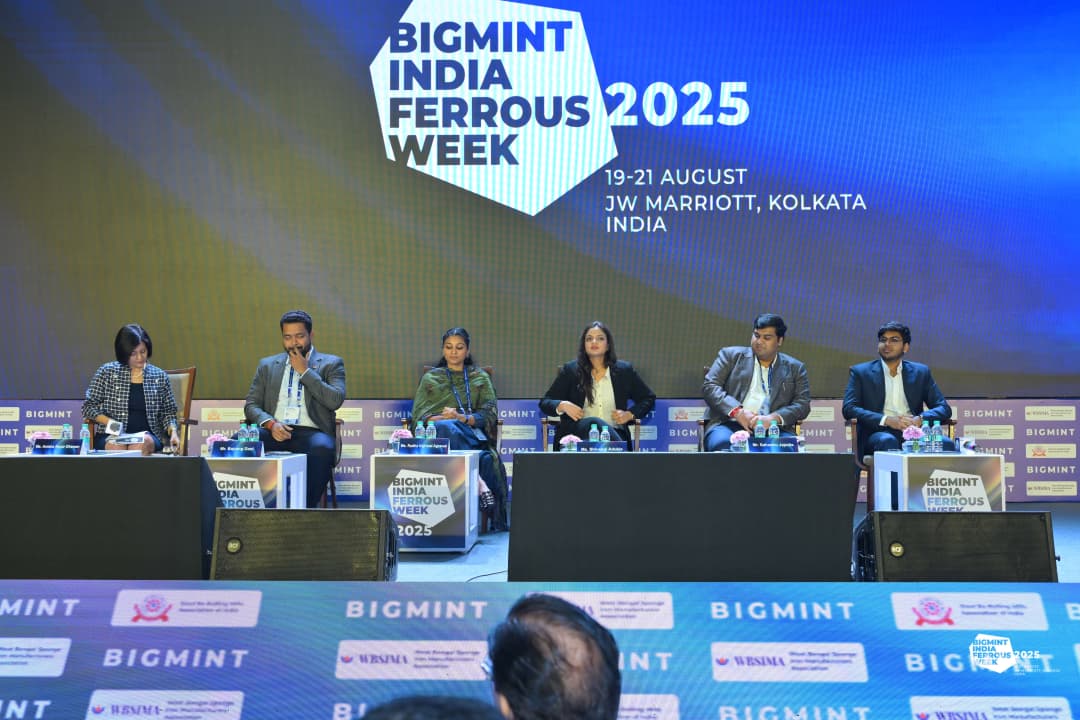
On Day 2 of BigMint’s India Ferrous Week the session titled “Young Leaders: Driving Change in the Industry” brought together a dynamic panel of next-generation leaders who are at the forefront of transforming India’s steel and metals sector. With industries often defined by legacy business models and family-owned structures, the session illuminated how young leaders are bringing in new ideas, technologies, and people-centric approaches while continuing to honour tradition.
Innovation & industry transformation
Bajrang Goel, Director, Shri Bajrang Power and Ispat Ltd., narrated his experience of pioneering hot charging technology in India. After being introduced to the concept during his travels to China, he implemented it at his company, setting in motion what is today a standard industry practice. This breakthrough has helped the Indian steel sector collectively save an estimated INR 10,000 crore annually in furnace oil consumption.
Divyansh Agarwal, Director, Giridhan Metal Pvt. Ltd., shared how he reshaped supply chain management by integrating cross-functional teams into decision-making. His initiative, branded internally as Inventory on Wheels, helped reduce raw material inventory holding from 90 to 60 days, easing working capital pressure while building vendor reliability. Agarwal emphasised that innovation is also about fostering data-driven collaboration and agility across the val
Unlocking human capital
Radha Kejriwal Agrawal, Whole-time Director, Electrosteel Castings Ltd., focused on how human capital can be the biggest driver of transformation. She spoke about launching business excellence initiatives that invited employees across levels to contribute improvement ideas. Over 890 such projects were implemented, contributing savings of almost INR 100 crore in a single year. Agrawal underlined that true leadership requires creating an environment where employees feel heard and trusted, enabling bottom-up innovation within legacy structures.
Sustainability as competitiveness
Sahastra Jajodia, Director, Jai Balaji Industries Ltd., highlighted the urgency of decarbonisation. He pointed out that steel production contributes nearly 7% of global emissions, and sustainability has become unavoidable for competitiveness. Jai Balaji’s investments in efficient furnaces, cleaner fuels, and better power systems have not only reduced the company’s carbon footprint but also enhanced credibility with international buyers. Notably, the company today exports ferro alloys to over 40 countries, backed by a reputation for responsible practices.
Overcoming resistance, driving adoption
Shivangi Adukia Bagaria, Director, Adukia Industries Pvt. Ltd., spoke of the cultural challenges in deploying new technology and how she won buy-in from teams. The introduction of simulation software to detect casting defects was initially resisted by employees who saw it as unnecessary. However, after a successful pilot saved significant time and effort, adoption spread quickly across operations. Bagaria emphasised that the role of future leaders lies not in replacing experienced employees but in educating and enabling them to embrace tools that improve efficiency.
Evolving leadership styles
The discussion also touched upon personal leadership journeys. Jajodia reflected on how his style transformed from “an aggressive, top-down micromanager” into a facilitator who now empowers teams to solve problems collaboratively. Divyansh Agarwal stressed the importance of patience and listening when balancing family legacy with fresh perspectives.
Kejriwal Agrawal explained how Electrosteel launched its first structured leadership development program, Pragati, in partnership with Mercer, to systematically identify and groom future leaders from within. She described it as a long-gestation but high-return investment designed to secure succession in key positions.
Shared vision
Across the panel, several points of consensus emerged:
- Growth must be ambitious but not reckless, recognising both opportunity and cyclical risks in the steel sector.
- Family legacy should be honored and built upon, rather than disrupted, blending tradition with transformation.
- Future leadership requires resilience, agility, openness to technology, and a people-centric approach.
- Diversification into allied industries such as cement, renewables, and power is emerging as a critical strategy for long-term resilience.
Closing thought
As the discussion closed, one sentiment resonated strongly among the panellists: young leaders must “keep their eyes on the sky but their feet firmly in the soil”. Amid rapid technological change and rising global sustainability standards, India’s next-generation steel leaders are finding ways to modernise without losing sight of legacy and cultural continuity.
The session offered a compelling snapshot of how India’s industrial families are empowering the next guard—equipping them to not just sustain the businesses they inherit, but to expand their horizons boldly into the future.
Leave a Reply