- Anti-dumping, QCO developments remain key watchpoints
- Domestic demand remains resilient despite fall in JSL’s sales
India’s largest stainless steel producer, Jindal Stainless Limited, used its Q1FY’27 earnings call to offer more than a quarterly business update. Management’s commentary pointed to the key themes likely to shape India’s stainless steel industry over the coming year, including resilient domestic demand, greater focus on value-added products, deeper raw material integration through Indonesia, and a regulatory environment that could become more supportive for domestic producers. While temporary gas supply disruptions affected production during the quarter, the company’s longer-term strategy suggests confidence that demand growth remains intact and that competitive advantages will increasingly come from downstream processing, supply chain security, and favourable trade policy.
Domestic demand remains resilient
Management stated that demand across key end-use sectors remained healthy despite temporary production disruptions during the quarter.
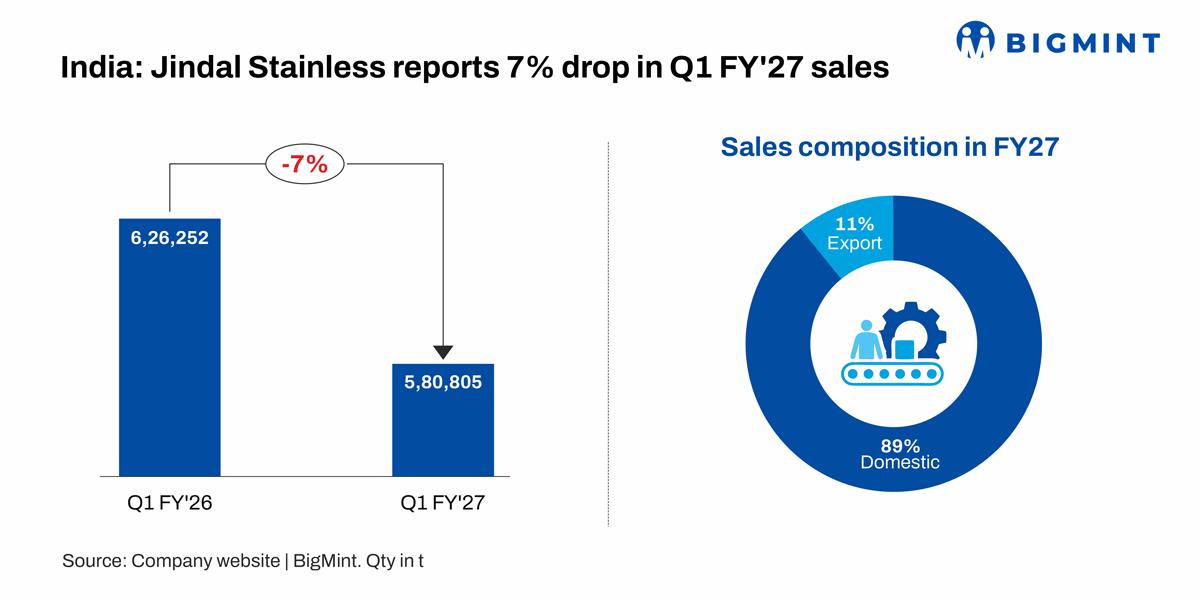
Automotive, railways and metro projects, infrastructure, white goods, manufacturing and consumer sectors continued to support domestic stainless steel consumption. The company clarified that lower sales volumes during Q1 were primarily due to operational constraints arising from industrial gas shortages rather than any slowdown in underlying demand.
Higher-value product mix supports profitability
JSL continued to prioritise value-added products to improve margins.
During Q1FY’27, the company’s sales mix comprised 47% 300 series, 35% 200 series, and 18% 400 series stainless steel products.
Domestic sales accounted for 89% of total volumes, while exports contributed the remaining 11%.
Export strategy focuses on premium markets
Management reiterated that the domestic market will remain JSL’s primary focus, while exports continue to be an important part of its long-term strategy.
The company is expanding its presence in Japan, South Korea, Brazil and Colombia, targeting premium, higher-margin products. Management also clarified that EU import quota restrictions, rather than the Carbon Border Adjustment Mechanism (CBAM), currently remain the key constraint for stainless steel exports to Europe.
Raw material strategy strengthens resilience
Following supply disruptions caused by shortages of propane and LPG during the Middle East conflict, JSL has diversified its fuel mix by increasing the use of piped natural gas (PNG).
Management said fuel costs have already declined 40-50% from Q1 peak levels, while the adoption of multiple fuel sources has improved operational flexibility and reduced dependence on imported industrial gases.
The company also noted that nearly 90-95% of its stainless steel scrap requirements are sourced from India and Southeast Asia, limiting its exposure to European scrap markets.
Capacity expansion remains on track
JSL maintained its FY’27 capital expenditure guidance of INR 2,700-2,800 crore, with investments primarily focused on downstream value-added facilities.
The company aims to increase its cold rolling capacity from 2.0 million tonnes (mnt)/year to 2.67 mnt/year by FY’28.
Meanwhile, the 1.1 mnt/year Hot Rolled Annealed & Pickled (HRAP) facility is expected to be mechanically completed by the end of Q3FY’27, followed by phased commissioning.
Indonesian operations continue ramp-up
Management said the Indonesia stainless steel melt shop has entered its ramp-up phase and is expected to achieve 70-80% capacity utilisation during FY27.
The company reiterated that the investment is strategically aimed at securing long-term nickel raw material availability and strengthening supply-chain integration rather than serving solely as a profit centre.
No additional stainless steel capacity expansion in Indonesia is currently planned.
PT GMI reclassified as associate
Effective 1 July 2026, PT Glory Metal Indonesia (PT GMI) has been reclassified from a subsidiary to an associate.
Management clarified that the change is purely accounting-related and will not affect slab availability, operational strategy or previously announced business guidance. Going forward, the company will account for PT GMI under the equity method.
Subsidiaries continue improving utilisation
Chromeni continued to perform strongly during the quarter, operating at 80-85% capacity utilisation. Management said the facility played a key role in supporting production during Q1 as it was fully connected to PNG when industrial gas supplies were disrupted.
Rabirun is currently operating at around 70% utilisation, while Chromeni’s cold rolling mill and bright annealing (BA) line expansion projects remain on schedule for commissioning in FY’28.
Regulatory developments remain key watchpoints
Management expects progress in India’s ongoing anti-dumping investigation (into 300 and 400 series cold-rolled flat stainless steel imports from China, Indonesia, and Vietnam) following the 9 September public hearing, after which verification and recommendation processes will continue.
Regarding the Quality Control Order (QCO), JSL expects the present exemption to continue until March 2027, while expressing hope that it is not extended further, which would strengthen quality standards and support domestic stainless steel manufacturers against sub-standard imports.
Outlook
JSL expects production to remain stable following the normalisation of industrial gas supplies, while downstream capacity expansion, premium product offerings, export diversification and Indonesia’s nickel integration remain central to its long-term growth strategy. The company will also closely monitor developments related to anti-dumping measures and the QCO, which are expected to shape the domestic stainless steel industry’s competitive landscape.
Leave a Reply