- Capacity seen reaching 25 mnt by FY’30 from 21 mnt in FY’26
- Long products dominate, with limited flat steel footprint
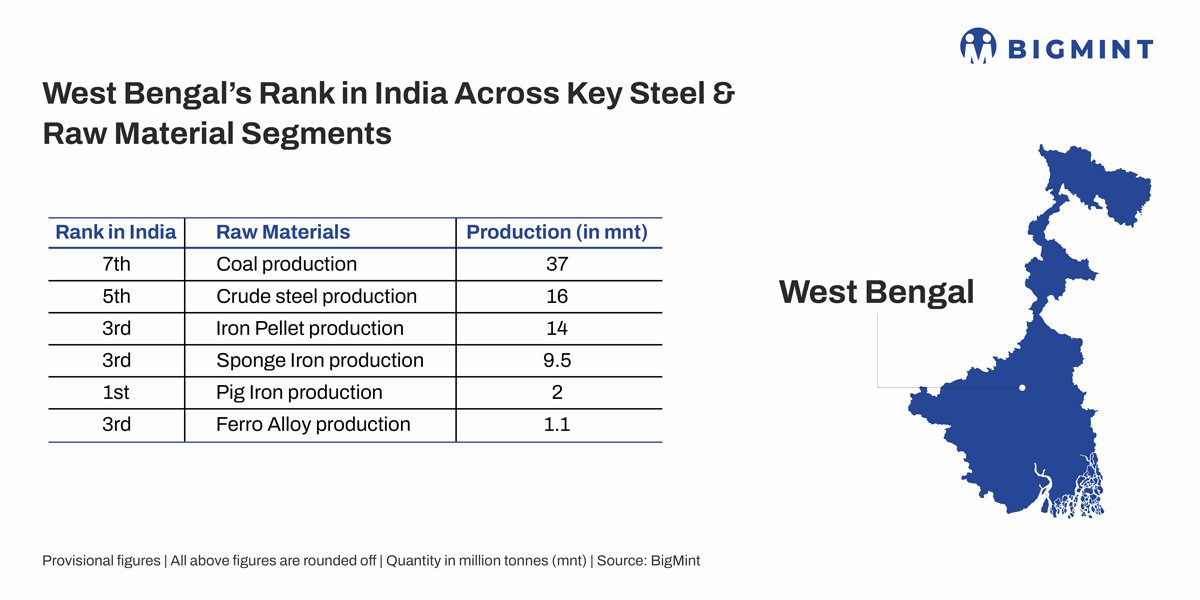
West Bengal has entered FY’27 as one of India’s most structurally diversified steel states, with a production base spanning blast furnaces, induction furnaces, electric arc furnaces, sponge iron, pellets, long products, and ferro alloys. Crude steel capacity stood at 21.08 million tonnes (mnt) in FY’26, according to BigMint data, expanding 13% from 18.67 mnt in FY’25 and accounting for 9% of the national total. Meanwhile, crude steel production reached 16.36 mnt — around 9.7% of India’s total crude steel output of 169.23 mnt — positioning West Bengal as a mid-tier but strategically important producer.
The defining feature of the state’s steel identity is its substantial secondary steel ecosystem, with 14.67 mnt of induction furnace (IF) capacity against 9.74 mnt of blast furnace (BF), 4.77 mnt of basic oxygen furnace (BOF), and 1.64 mnt of electric arc furnace (EAF) capacity. This wide IF base is supplemented by the state’s growing sponge iron, pig iron, and pellet production capacity.
Installed capacity expands faster than production
Between FY’25 and FY’26, West Bengal’s installed crude steel capacity rose faster, by 13% from 18.67 mnt to 21.08 mnt, while production increased by 9% from 15.05 mnt to 16.36 mnt. As capacity additions outpaced production growth, utilisation moderated from around 80.6% to around 77.6%.

In FY’30, BigMint expects capacity to reach 25.20 mnt with output rising to 21.4 mnt, translating to utilisation of around 85%. By route, we see blast furnace capacity rising sharply to 15.21 mnt from 9.74 mnt, IF reaching 16.91 mnt from 14.67 mnt, and EAF more than doubling to 3.52 mnt from 1.64 mnt, while BOF remains unchanged at 4.77 mnt. The combination signals a more diversified production structure by FY’30 — with growth coming from both BF and IF and EAF routes simultaneously.
Raw material, cost advantage
West Bengal is deepening its raw material preparation base in parallel with its steelmaking capacity — a structure that could strengthen self-sufficiency for secondary steelmakers, particularly the induction furnace units that depend on sponge iron and pellets.

Coal-based sponge iron capacity rose to 12.37 mnt in FY’26 from 9.96 mnt in FY’25 — up nearly 24% — and is projected to reach 16.48 mnt by FY’30. Pellet capacity increased to 20.6 mnt from 18.8 mnt and is expected to reach 30.9 mnt. Iron ore beneficiation capacity rose to 7.8 mnt from 5.4 mnt, sinter capacity to 10.91 mnt from 10.46 mnt, and coke oven capacity to 5.98 mnt from 5.71 mnt. Pig iron capacity increased to 2.06 mnt from 1.73 mnt.
Demand, downstream steel ecosystem
West Bengal’s location provides access to established raw-material corridors and large consuming markets across the eastern and northern regions. The location also enables proximity to raw-material sources on the input side and to eastern and northern demand centres on the output side.

West Bengal’s downstream capacity is decisively oriented toward construction. Long-product capacity stood at 19.11 mnt in FY’26 — up from 16.87 mnt in FY’25 — comprising 11.61 mnt of rebar, 4.16 mnt of structural steel, and 3.34 mnt of wire rod. Rebar alone rose from 9.54 mnt in FY’25, cementing its dominance of the product mix.
Flat-product capacity, at 2.74 mnt, is far smaller. CRC capacity increased to 0.95 mnt from 0.83 mnt, colour-coated to 0.84 mnt, and GP/GC held at 0.94 mnt (projected to reach 1.61 mnt by FY’30). Critically, the dataset records no HRC capacity in the state and only negligible plate capacity at 0.0025 mnt.
The structural implication is that West Bengal remains a commodity-oriented, construction-linked steel market rather than a high-value flat-steel ecosystem. The concentration in rebar, structural steel, and wire rod positions the state to capture infrastructure and construction-led demand but ties its fortunes to the construction cycle. The absence of HRC means the flat-steel value chain — and the higher-margin automotive and appliance segments it typically feeds — is not yet a meaningful part of the state’s profile. Value addition is visible mainly in coated flat products and ferro alloys, not in a broad transition away from long products.
Industrial clusters, regional value chain
The investment pipeline is concentrating new capacity into identifiable clusters, chiefly across Bankura and Purulia. Shyam Steel Group’s reported INR 15,000-crore expansion at Mejia includes 2 mnt/year steelmaking capacity along with DRI, pellet and rolling facilities. SFAL Metallics is planning an INR 755-crore greenfield ferro-alloy and EAF project at Basudebpur.

In Purulia, Shakambhari Group, and Adukia Industries are pursuing investments of around INR 5,000 crore and INR 3,000 crore, respectively, spanning integrated steel, wire rod, rolling, and sponge iron capacities. Amit Metaliks has announced a proposed INR 4,000-crore integrated steel project at Raghunathpur.
The pattern is meaningful: these projects bundle steelmaking with DRI, pellet, rolling and ferro alloy capacity, pointing to cluster formation along a steel rather than standalone crude steel additions.
Ferro alloys capacity
On value addition, the strongest position is ferro alloys. Capacity rose to 2.73 mnt in FY’26 from 2.34 mnt and is projected to reach 2.82 mnt by FY’30 — around 25.8% of India’s total ferro alloy capacity of 10.57 mnt, the state’s single strongest national share. Within this, silico manganese leads at 1.23 mnt, followed by ferro manganese at 1.15 mnt, ferro chrome at 0.25 mnt and ferro silicon at 0.09 mnt.
West Bengal’s clearest value-addition opportunities lie in ferro alloys and coated flat products (colour-coated, GP/GC), not in a transition to HRC or speciality flat steel, which are absent from the state’s profile. The pathway to higher value runs through alloys and coatings rather than flats.
West Bengal vs India
Positioned against the national base, West Bengal’s contribution varies sharply by segment. The state holds 25.8% of India’s ferro alloy capacity, 17.7% of coal-based sponge iron, 16.1% of both IF and wire rod, 12.9% of rebar and 11.7% of pellet capacity. Its shares are markedly lower in primary and flat segments: 9.0% of crude steel, 7.5% of blast furnace, 5.0% of BOF, 3.6% of EAF and just 2.5% of CRC.

The story these shares tell is clear: Its advantage lies in the secondary-steel and ferro-alloy ends of the value chain, supported by a rising pellet and sponge iron base and an eastern-India location. Its structural gap is in flat products — no HRC, minimal CRC share — which limits participation in higher-value downstream industries.
Key challenges
Power and input cost exposure: Strong dependence on induction furnace steelmaking leaves a significant part of the market exposed to fluctuations in scrap, sponge iron, and power costs. As EAF and IF capacity expands, electricity availability and tariff competitiveness become increasingly decisive.
Absorbing new capacity: With crude steel capacity projected at 25.20 mnt by FY’30 and utilisation already having slipped to 77.6% in FY’26, sustained growth in regional consumption, inter-state movement, and exports is essential to lift operating rates back toward the projected 85%. The construction-heavy product mix compounds this, tying absorption closely to the infrastructure cycle.
Outlook
The state’s structural advantages are concrete: a dominant 25.8% national share in ferro alloys, a leading position in induction-furnace and sponge iron capacity, a deep long-product base led by rebar, and an eastern India location with access to raw-material corridors and large consuming markets. Its structural disadvantages are equally clear: near-total absence of HRC, a thin flat steel base, heavy exposure to scrap, sponge iron and power costs through its IF dependence, and utilisation that has already softened as capacity ran ahead of production.
The key opportunity is to convert an expanding metallics and long-product base into higher utilisation by securing regional and inter-state demand, while extending the ferro-alloy and coated-product value chains that are already national strengths. The key risk is that capacity outpaces demand and raw-material or power economics deteriorate, leaving utilisation stranded below target.
Whether West Bengal strengthens its role as a major eastern steelmaking hub will ultimately hinge on the commissioning pace of new capacity, the availability and cost of raw materials, power economics, and the ability of downstream markets to absorb additional long-product and metallics supply.
Leave a Reply