- Japan’s export offers soften amid weak demand from Vietnam
- Offers to Pakistan rise on higher freights despite cautious buying
Global ferrous scrap markets remained largely subdued during the week ended 18 July as weak finished steel demand, cautious mill procurement, and wide bid-offer gaps continued to limit trading activity across key importing regions. While higher freight costs and geopolitical tensions offered some support to export offers, most mills maintained need-based buying, keeping overall market sentiment cautious despite isolated price firmness in selected markets.
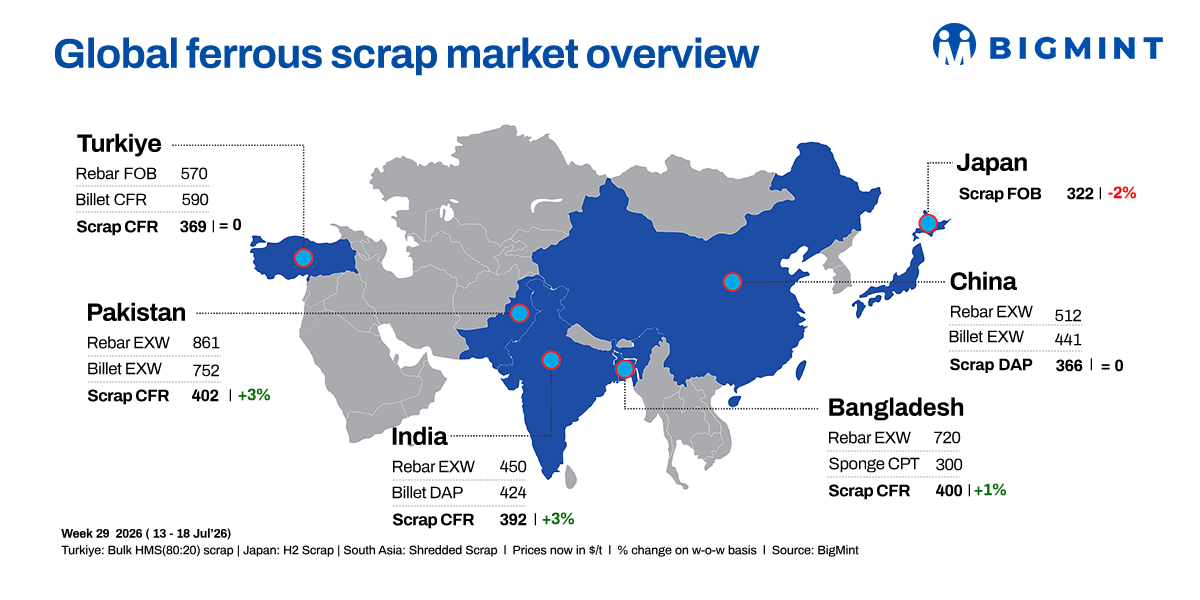
Turkiye’s imported deep-sea ferrous scrap market remained largely stable during the week ended 18 July as weak finished steel demand, sluggish rebar sales, and cautious mill procurement continued to limit trading activity. US-origin HMS 80:20 was assessed at $369/t CFR, down $1/t w-o-w and a 7-month low so far, while US East Coast HMS 80:20 eased to $334/t FOB. European/Baltic-origin material was heard at $362-368/t CFR, with only one Poland-origin cargo concluded at $363/t CFR.
Despite subdued buying interest, higher freights from the US and Europe continued to support offers, limiting further downside. Turkish mills maintained hand-to-mouth procurement, favouring domestic and short-sea scrap over deep-sea cargoes. Domestic rebar offers remained at $565-575/t exw, while export offers stood at $568-570/t FOB, keeping the scrap-to-rebar spread at around $200-202/t. Market participants expect scrap prices to remain broadly stable unless finished steel demand shows a meaningful recovery.
India’s imported ferrous scrap market remained subdued during the week ended 18 July as poor import viability, weak steel demand, and rising freight costs continued to discourage buying. Mills largely preferred domestic scrap and sponge iron over imported material, while renewed Middle East tensions tightened vessel availability and supported freights.
Trading activity remained extremely limited, with around six containerised deals totaling around 3,000-3,500 t concluded during the week, including Costa Rica-origin HMS 60:40 at $298/t CFR Chennai, HMS 80:20 at $333/t CFR, and Europe-origin turnings/borings at $291/t CFR Mundra.
EU/UK-origin HMS 80:20 was offered at $330-335/t CFR, Chile-origin HMS 80:20 at around $330/t CFR, West Africa-origin HMS at $340-345/t CFR, and Australia-origin HMS at $335-340/t CFR. UK-origin shredded scrap offers stood at $395-400/t CFR West Coast India against buyer indications of $365-370/t CFR, while containerised HMS was offered at $325-335/t CFR versus bids of $310-320/t CFR.
Market participants expect import prices to remain under pressure in the coming weeks as limited procurement and weak steel demand continue to weigh on market sentiment.
Pakistan’s imported ferrous scrap market remained subdued during the week ended 18 July, with higher freight costs and firmer global sentiment lifting offer prices but failing to revive buying interest. UK/EU-origin shredded scrap offers increased to $405-410/t CFR Qasim, while buyers maintained workable levels at $395-396/t CFR, keeping the bid-offer gap wide. Despite cautious sentiment, around 7-8 containerised deals totalling 10,000-11,000 t were concluded, including a 9,000 t UK/EU-origin shredded scrap cargo at $395-405/t CFR Qasim and 2,500 t of blue steel, short steel and NTP at $415-421/t CFR as mills selectively replenished inventories.
Domestic market fundamentals remained weak, with local scrap quoted at PKR 148,000-150,000/t ($532-540/t), Bala billet at PKR 196,000-200,000/t ($704-718/t), CC billet at PKR 208,000-210,000/t ($747-754/t), and Grade-60 rebar at PKR 238,000-240,000/t ($855-862/t). Weak construction activity and mill operating rates of around 30-35% continued to limit raw material procurement to immediate production requirements despite firmer imported scrap offers.
Bangladesh’s imported ferrous scrap market remained subdued during the week ended 18 July as weak long steel demand, monsoon disruptions, and higher production costs continued to curb buying interest. Mills maintained need-based procurement, while wide bid-offer gaps limited fresh bookings.
US-origin HMS 80:20 was offered at $398-400/t CFR Chattogram against buyer bids below $390/t CFR, while Singapore-origin PNS was heard at $390-420/t CFR with workable levels around $385/t CFR. Australia-origin HMS 90:10 was offered at $365-370/t CFR, Chile-origin PNS-HMS 1 drew bids at $370/t CFR, and UK-origin shredded scrap remained at $398-400/t CFR. European shredded scrap was assessed at $396/t CFR, with overall trading activity remaining limited.
Only a few containerised trades were reported, including 500 t of Malaysia-origin GI bundles at $325-330/t CFR and 1,000 t of Brazil-origin HMS 80:20 at $345/t CFR. Domestic ship scrap remained at BDT 52,000-53,000/t ($422-430/t), billet at BDT 67,000-70,000/t ($544-568/t), and rebar at BDT 88,000-90,000/t ($714-730/t) in Chattogram, reflecting subdued downstream demand and cautious mill buying.
Japan’s H2 scrap export market remained under pressure during the week ended 18 July as weak demand from Vietnam, competitive offers, and seasonal rains continued to curb buying activity. H2 offers eased to $365-370/t CFR Vietnam against buyer bids of $360-365/t CFR, limiting transactions.
FOB Tokyo Bay H2 declined to JPY 52,250/t ($322/t), down JPY 650/t ($4/t) w-o-w, following lower Kanto tender prices and domestic purchase price cuts. Although the weaker yen improved export competitiveness, sluggish Southeast Asian steel demand continued to weigh on exports.
The UAE ferrous scrap market softened during the week ended 18 July as mills shifted to need-based procurement amid weak long steel demand and tightening liquidity in the construction sector. Although BigMint’s processed HMS (80:20) assessment increased by AED 12/t ($3/t) w-o-w to AED 1,000/t ($272/t) DAP Abu Dhabi, buying sentiment weakened toward the end of the week, with mills indicating workable levels at AED 975-980/t ($265-267/t) DAP. Shredded scrap was workable at AED 1,025-1,050/t ($279-286/t) DAP.
Despite ample domestic scrap availability following the export ban, mills limited purchases to immediate requirements. Stable rebar prices and imported billet offers at $570-610/t CPT Jebel Ali failed to improve raw material demand. Market participants expect UAE scrap prices to decline by a further AED 20-30/t ($5-8/t) if subdued steel demand and cautious procurement persist.

Leave a Reply