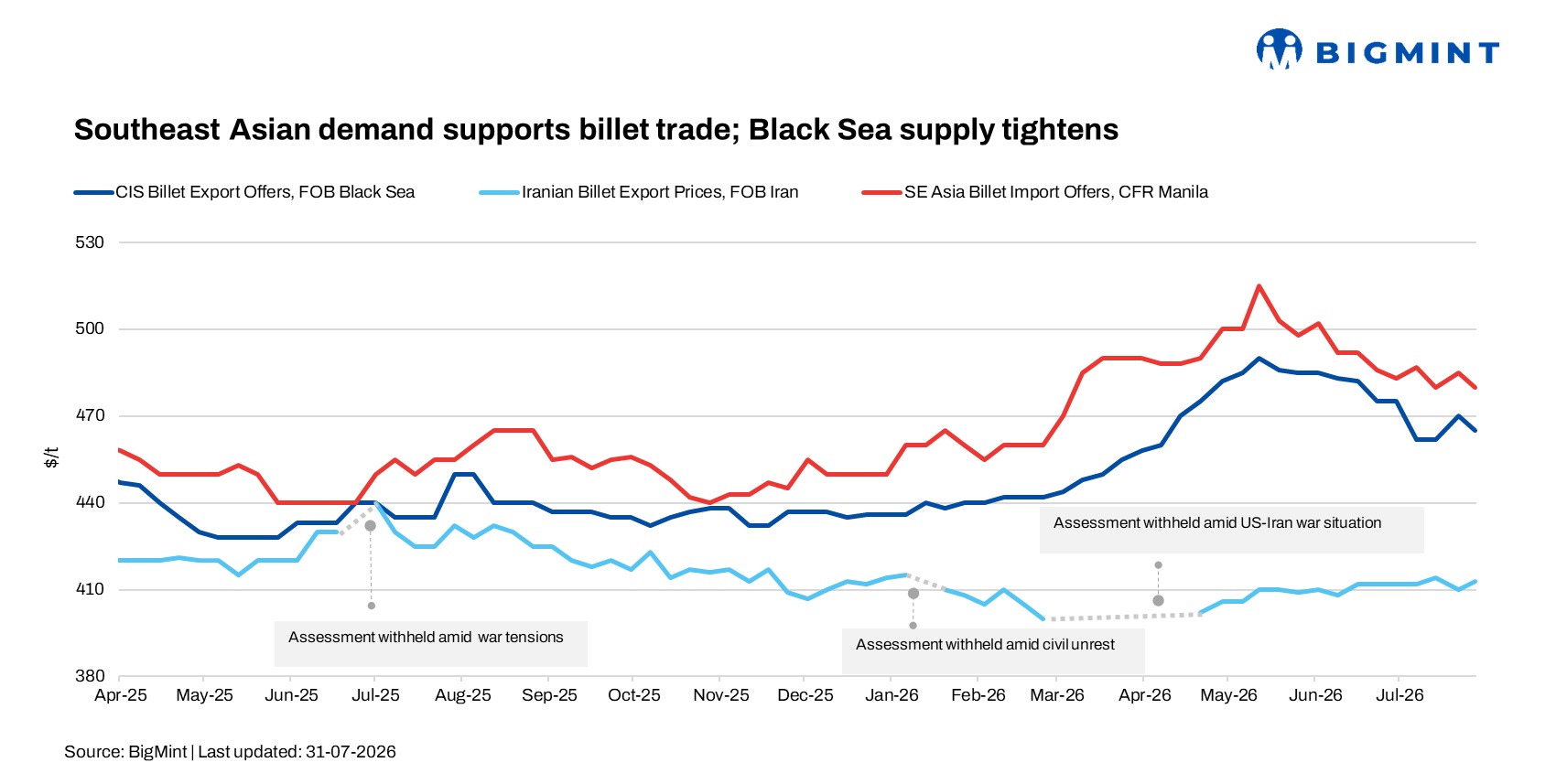
- Chinese export offers soften on cautious overseas buying
- Iranian exports remain subdued amid geopolitical uncertainties
Global billet markets remained mixed during the week ended 1 August, as stronger buying from Southeast Asia supported Indonesian billet exports, while weak Chinese steel demand and subdued export activity continued to pressure prices. At the same time, tight Russian billet availability, rising Black Sea freight costs, and ongoing geopolitical tensions in the Black Sea and Middle East reshaped regional trade flows and provided support to billet prices.
Turkiye’s imported deep-sea scrap market also remained firm, with US-origin HMS 80:20 rising to $376-378/t CFR. Higher domestic billet prices of $525-535/t exw and export rebar at $575-578/t FOB narrowed the scrap-to-rebar spread to around $196-198/t, reflecting a stable steelmaking margin. However, mills continued need-based procurement amid weak rebar demand and the seasonal summer slowdown.
Asian billet market
Asian billet markets remained mixed during the week, with improving demand from Southeast Asia contrasting with subdued conditions in China.
Demand for Indonesian billets strengthened due to stronger buying from Malaysia and Vietnam. Export offers eased by $5/t to $460/t FOB to remain competitive with Chinese suppliers, while around 100,000 t were reportedly booked at $455-460/t FOB for September-October shipment. Strong construction activity in Malaysia and firmer domestic scrap prices in Vietnam supported billet purchases.
A Southeast Asia-based trader said the regional billet market remained largely stable compared with last week, although buying interest had improved in parts of Southeast Asia. “Chinese billet offers are workable around $455/t FOB, while Dexin is still offering at around $460/t FOB. Overall, prices across most Asian markets have changed little week on week,” the trader said
BigMint expects Southeast Asian demand to continue supporting Indonesian exports, although weak Chinese steel consumption and subdued export demand are likely to keep regional billet prices under pressure.
Chinese billet export offers softened to around $454/t FOB, down from $460/t FOB a week earlier, as cautious overseas buying continued to weigh on export activity.
In China, domestic billet prices declined RMB 40/t ($5/t) w-o-w to RMB 2,920/t ($433/t), while SHFE rebar futures fell to RMB 3,004/t ($446/t) amid weak seasonal steel demand, rising inventories, and softer iron ore and coke prices. Mills reduced billet prices by RMB 10-30/t to stimulate sales, but spot demand remained sluggish.
Buyers in the Philippines remained inactive after securing sufficient billet volumes last week, when around 40,000 t of China-origin 5sp billet was booked at approximately $478/t CFR, with some market participants indicating slightly higher prices.
CIS billet market
The CIS billet export market strengthened during the week as limited Russian billet availability, rising freight costs, and higher war-risk premiums supported prices.
Russian billet export offers stood in the $465-475/t range FOB Black Sea, with only limited September-shipment volumes available and larger cargoes unlikely before late September. Suppliers remained focused on domestic orders, while tightening availability supported export sentiment.
Freight from Novorossiysk increased to around $30-35/t to Marmara and $40-45/t to more distant destinations, alongside higher war-risk insurance premiums. Consequently, Russian billet offers into Turkiye strengthened to around $500-510/t CFR.
Meanwhile, Kardemir raised domestic billet prices by $10/t to $520-530/t Exw, selling around 100,000 t shortly after opening bookings. Limited Russian and Iranian billet availability also lifted indicative domestic billet offers to $540-550/t Exw, although weak domestic rebar demand continued to constrain finished steel activity.
Middle East billet market
Middle East billet markets remained mixed as Egypt advanced plans to expand domestic billet production, while geopolitical uncertainty continued to constrain Iranian exports and disrupt Gulf trade flows.
Egypt unveiled a broad industrial reform programme aimed at attracting investment and expanding domestic manufacturing, with billet production identified as a strategic priority. The government plans to launch its first industrial investment fund in September and issue licences for around 2.8 million tpa of new steelmaking capacity to reduce import dependence and strengthen domestic billet output.
Iran’s billet export market remained subdued, with nominal offers at $413-415/t FOB. Buyer interest from Iraq and Africa stayed cautious as the continued closure of the Strait of Hormuz, shipping uncertainties, and geopolitical tensions disrupted exports. Operational constraints and exchange-rate volatility further limited trading activity.
Across the Gulf Cooperation Council (GCC), logistics remained the dominant market driver. Shipping disruptions through the Strait of Hormuz and renewed Houthi attacks in the Red Sea continued to increase freight costs, insurance premiums, and transit uncertainty.
Despite around 150,000 t of Chinese and Indonesian billet bound for the UAE and 80,000 t for Saudi Arabia already in transit, buyers increasingly explored North African suppliers such as Egypt, Algeria, and Libya to diversify sourcing and reduce logistics risks. Indicative billet prices were heard at around $520-525/t CFR UAE and $560-565/t CFR Saudi Arabia, with the Saudi premium reflecting elevated freight and war-risk costs rather than tighter billet supply.


Leave a Reply