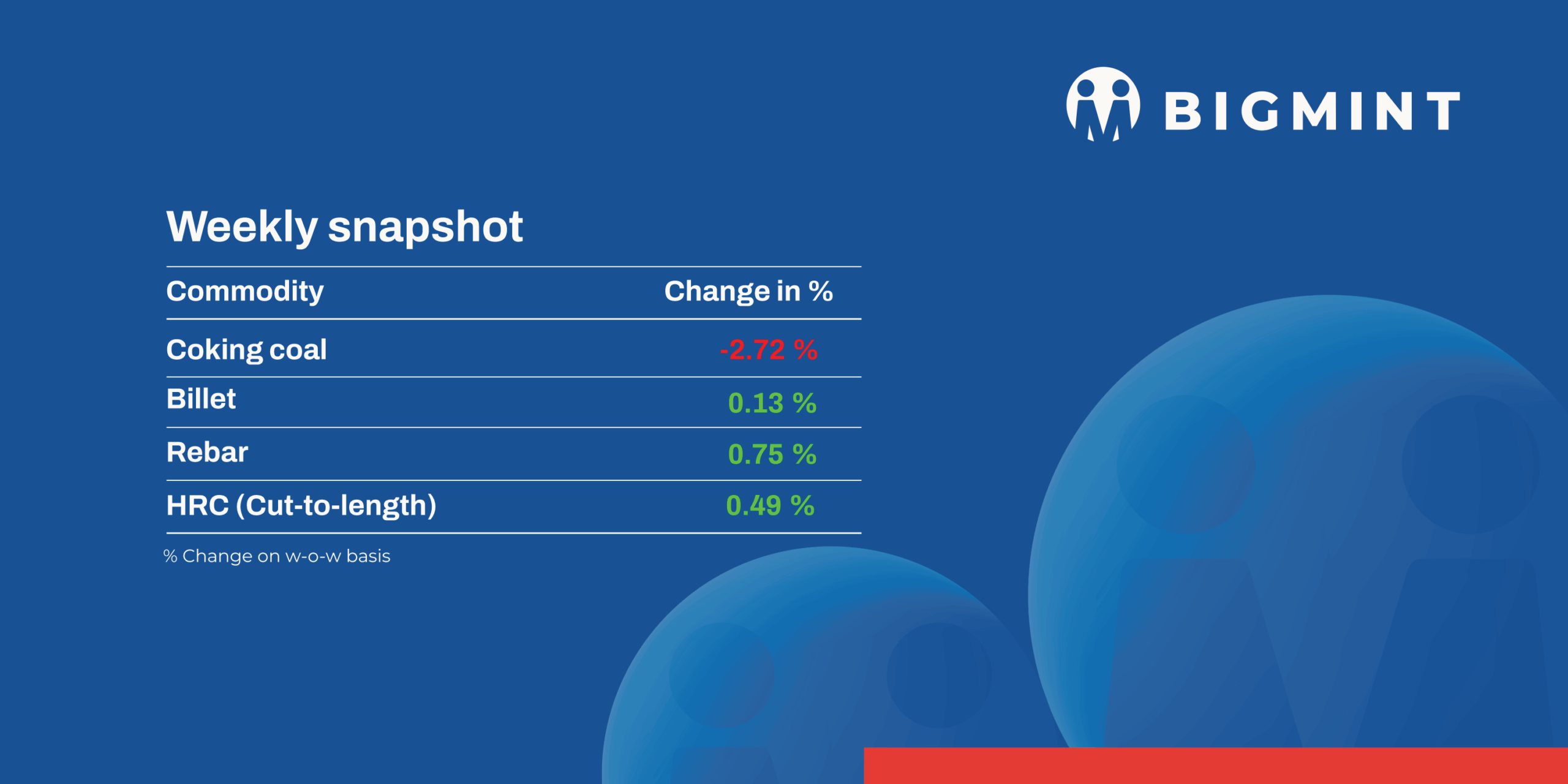
- Supply constraints and monsoon disruptions support higher domestic raw material prices
- Rebar prices rise on maintenance-led tightness
Commodity markets turned firmer this week as monsoon disruptions, maintenance-led supply tightness and higher input costs supported iron ore, coal, billet and rebar prices, while ferro alloys and exports remained under pressure.
Iron ore and pellet
- India’s largest merchant iron ore mining company, NMDC, has reduced its list prices of iron ore CLO (calibrated lump ore) and fines on 8 August 2026, BigMint learnt from sources. The miner has fixed prices of DR CLO (10-40 mm, Fe 67%) at INR 5,750/tonne (t) ($60/t) and of iron ore fines (-10 mm, Fe 64%) at INR 4,500/t ($47/t). Prices are on FOR basis from the miner’s Bacheli complex and exclude royalty, DMF, and NMEDT. Prices of all grades have decreased in the range of INR 100-200/t.
- PELLEX, BigMint’s bi-weekly domestic pellet (Fe 63%) index for Raipur, increased by INR 50/t ($0.5/t) w-o-w to INR 10,200/t ($107/t) DAP on 7 August 2026, supported by constrained spot availability and firm producer offers. Producers maintained offer levels amid healthy order books, while buyers continued cautious procurement at prevailing prices. Limited availability prevented downward pressure on prices, keeping trading activity thin and the market largely stable.
- BigMint’s India pellet (Fe 63%, 3-3.5% AlO) export index declined by $4.5/t w-o-w to $96.5/t FOB east coast on 5 August 2026, the lowest level since end-February, as persistent weakness in the global iron ore market weighed on sentiment. Export activity remained subdued, with no fresh deals concluded during the assessment period. Chinese buying interest remained limited and selective across pellet grades, while Indian exporters refrained from offering fresh cargoes amid better realisations in the domestic market.
Ferrous Scrap
- India: Imported ferrous scrap buying remained subdued through the week as weak steel demand, poor import economics and cheaper domestic scrap kept mills cautious. HMS 80:20 bids stayed below offers, with the gap limiting fresh bulk bookings.
- Lower-priced containerised cargoes continued to attract selective interest, while premium grades remained under pressure. Africa-origin HMS was heard around $340/t CFR, EU-origin near $325/t, and Australia/New Zealand HMS 80:20 at $315-320/t CFR Chennai. UK shredded offers stayed high at $395-400/t CFR against limited southern mill interest.
- Over the last seven days, around 3,000-3,500 t of ferrous scrap was booked for India, including 750-1,000 t of Chile-origin HMS 90:10, 1,000-1,5000 t of Southeast Asia-origin turnings and 1,000-1,500 t of Central America-origin light HMS.
Coal
- South African thermal coal prices at Indian ports strengthened this week, supported by firmer international offers, higher replacement costs and steady freight. As on 7 August, RB2 (5,500 NAR) ex-Paradip rose INR 150/t w-o-w to INR 11,150/t, while RB3 increased INR 50/t to INR 9,200/t. At Vizag, RB2 increased INR 50/t to INR 10,700/t, while RB3 rose INR 150/t to INR 9,200/t. Buying remained largely requirement-based despite higher offers.
- Domestic non-coking coal prices rose sharply amid tight availability, monsoon-related supply disruptions and firmer trader expectations. As on 7 August, 4,500 GCV coal increased INR 550/t w-o-w to INR 5,150/t, while 5,000 GCV coal rose INR 250/t to INR 6,700/t. Market participants said monsoon conditions continued affecting coal grades and supply consistency, while constrained availability and expectations of further price gains supported aggressive procurement and firmer offers.
- Washed coal prices edged higher as washeries continued to face difficulty securing suitable ROM coal during the monsoon. BigMint assessed 38% FC (5,000 GCV) washed coal at INR 6,800/t FOR Raipur, up INR 50/t from the previous assessment. Market participants said inconsistent coal grades due to rainfall, limited availability of preferred ROM coal and higher domestic coal replacement costs continued to constrain production and support prices.
- India’s metallurgical coke market remained broadly stable, with firm production costs and restricted spot availability offsetting weak steel demand. BF-grade coke in eastern India increased INR 150/t w-o-w to INR 35,300/t ex-Jajpur, while western India remained unchanged at INR 33,500/t ex-Gandhidham. Foundry-grade coke also held around INR 36,400/t ex-Rajkot. The anti-dumping duty provided additional support, although subdued steelmaking activity and cautious buying limited further price gains.
Ferro alloys
- Silico Manganese:Indian silico manganese (60-14) prices were mostly steady with slight decline by INR 375/t ($4/t) w-o-w to INR 73,300-73,900/t ($768-774/t) across key markets. Despite MOIL reducing manganese ore prices for August deliveries, silico manganese prices remained mostly stable as balanced market fundamentals, ample spot availability and cautious buying limited price movement.
- Meanwhile, HC 65-16 silico manganese export prices also dipped by $4/t to $887/t FOB Vizag/Haldia.
- Ferro Manganese:Indian ferro manganese (70%) prices remained unchanged at INR 78,400/t ($822/t) in Raipur and Durgapur. However, export prices of the 75% grade also dropped by $11/t w-o-w to $902/t FOB Vizag/Haldia.Domestic prices remained stable on balanced supply-demand conditions, while export prices declined as subdued overseas demand and competitive offers from major suppliers pressured Indian quotations.
- Ferro Silicon:India ferro silicon (Si 70%) prices dropped w-o-w by INR 400/t ($4/t) at INR 87,500/t ($917/t) ex-works Guwahati, while Bhutan prices fell by INR 500/t ($5/t) to INR 87,200/t ($914/t).The price correction was mainly attributed to sufficient inventories in the market and weak export inquiries, which continued to weigh on sentiment.
- Ferro Chrome:Indian high-carbon ferro chrome (HC 60%, Si: 4%) prices eased by INR 1,400/t ($15/t) w-o-w to INR 119,600/t ($1,253/t) exw-Jajpur.Prices fell as earlier higher offers failed to gain acceptance, prompting sellers to lower quotations to secure orders and maintain production operations amid weak buying interest.
Semi finished
Billet
- India’s semi-finished steel market experienced an upward trend during the week ended 8 August 2026, with billet and sponge iron prices increased across the major producing regions. As per BigMint’s assessment, domestic billet prices increased by INR 50-900/t ($0.5-9/t) w-o-w across major regions. Jalna was the exception, recording a INR 300/t ($3/t) decline. Market activity was moderate to low as the week progressed. Buyers increasingly adopted a cautious approach amid weakening finished steel demand, while spot corrections failed to generate a sustained improvement in procurement.
Sponge iron
- Sponge iron prices across the major regions increased by INR 100-650/t ($1-7/t) w-o-w. Producers maintained elevated spot offers, citing limited availability of quality raw materials and supply disruptions associated with the ongoing monsoon season across the country. Buying remained need-based as market participants indicated that material booked in the earlier sessions was still available in inventory, reducing the requirement for fresh procurement.
- India’s DRI export market witnessed another increase in offer levels, tracking the rise in domestic sponge iron prices. However, overseas buying interest remained limited. Pellet-based sponge iron offers to Nepal increased by $5/t w-o-w to $278/t CPT Raxaul, while CDRI/mix sponge iron offers rose by $5/t to $305/t CPT Raxaul. Offers to Bangladesh increased by $2/t to $311/t CPT Benapole.
Pig iron
- The SAIL-RSP pig iron auction held on 5 August 2026 reflected firmer price levels despite moderate buying interest. Out of the 5,000-t quantity offered, 1,700 t was booked at a base price of INR 37,530/t, up INR 280/t from the previous auction on 27 July, when 6,100 t was booked out of 10,500 t offered.
Finished long steel
- IF-rebar:IF-route rebar prices increased by INR 100-1,100/t across most major markets during the week, with Jalna being the only exception, where prices declined by INR 200/t. The steepest increase was recorded in the Delhi market, primarily due to limited material availability from nearby markets such as Muzaffarnagar and Ghaziabad, where operations remained affected by local festival-related closures. The supply tightness enabled Delhi-based mills to raise their offer prices. Buying activity remained moderate during the early part of the week; however, demand weakened in the latter half, leading to subdued market sentiment and lower enquiry and booking levels. Despite slower buying, mills largely maintained the revised price levels, supported by restricted supply. Mill inventories remained at around 10-15 days, while order booking visibility stayed limited to 3-5 days, reflecting continued need-based procurement.
- On a week-on-week basis, rebar prices showed mixed trends in the range of INR 100-1,100/t across key regions, except in Jalna where the prices declined by INR 200/t according to BigMint’s assessment.
- Trade reference prices of Fe 500 grade rebars manufactured via the IF route (10-25 mm size) were assessed at INR 40,100-40,500/t exw Raipur and INR 44,400-45,000/t exw Jalna.
- Trade reference prices of heavy structural steel for the base size 150 mm channel stood at INR 43,800-44,200/t exw Raipur.
- Trade reference prices of wire rod stood at INR 42,000-42,500/t exw Raipur.
- BF-rebar:BF-route rebar prices rose INR 1,000/t w-o-w to INR 52,000/t ex-Mumbai, supported by maintenance-led supply tightness, improved procurement and restocking.
- The BF-IF spread in Mumbai widened to around INR 5,600/t.
- Project rebar: INR 52,000-53,000/t landed, with booking activity improving.
Flat steel
- BigMint’s bi-weekly benchmark assessment for HRC (IS2062, Grade E250, 2.5-8 mm/CTL) in Mumbai increased by INR 300/t ($3/t) to INR 58,000/t ($610/t) w-o-w from INR 57,700/t ($607/t) as on 7 August from the previous assessment.
- Likewise, the benchmark assessment for CRC (IS513, Grade O, 0.9 mm/CTL) increased by INR 100/t ($1/t) w-o-w to INR 65,000 ($683/t) from INR 64,900/t ($682/t) as on 7 August from the previous assessment.
- India’s trade-level HRC prices turned marginally firm after leading mills withdrew rebates of around INR 750-800/t offered last month, prompting a corresponding increase in spot offers. The price revision initially encouraged some early buying, but the momentum faded towards the end of the assessment week. Demand remained moderate and largely need-based, with buyers continuing to procure only against immediate requirements. Market activity therefore remained steady, with no significant improvement in fresh order bookings.
- Import volumes: India’s bulk HRC imports stood at 345,015 t as of 28 July and with an additional 235,611 tonnes to be recorded by the end of August
- Export volumes: India’s bulk HRC exports stood at 260,157 t as of 28 July, with an additional 249,631 tonnes expected to be added by the end of August.
- Indian HRC export offers stayed mixed w-o-w, with EU offers gaining on strong quota-led bookings, even as buying activity has now stalled with the October-December quota fully booked. In contrast, sentiment towards the Middle East and Southeast Asia remained cautious, weighed down by geopolitical uncertainty, unworkable bid levels, and weak demand, particularly in Vietnam.

Leave a Reply