- Domestic coal shortages support imported coal enquiries
- Sponge iron recovery improves coal buying sentiment
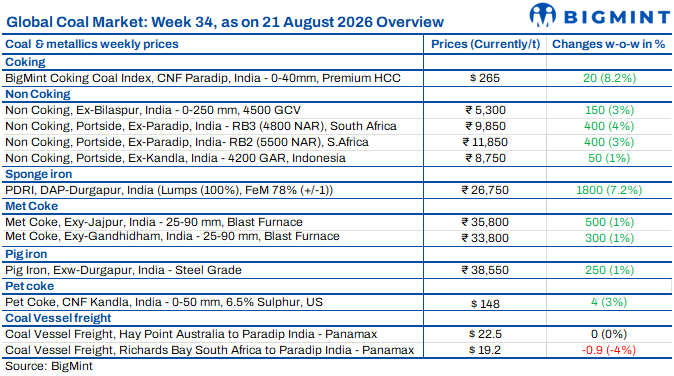
Indian coal market sentiment turned firmer in the week ended 21 August as monsoon-related domestic supply disruptions, tighter preferred-grade availability and stronger sponge iron prices supported the market. However, Indian buyers remained cautious, with imported coal purchases largely restricted to immediate requirements. Firmer international offers and supply concerns supported seller confidence, while high replacement costs and soft freight sentiment limited broader import activity.
Indonesian coal prices edge higher
Indian portside Indonesian thermal coal prices increased slightly in the week ended 21 August 2026, supported by tighter supply signals, weather disruptions and improving Chinese buying interest. 5,000 GAR coal remained at INR 10,500/t at Kandla and INR 10,400/t at Vizag, while 4,200 GAR rose INR 50/t to INR 8,750/t and INR 8,650/t, respectively. At Navlakhi, 3,400 GAR increased INR 100/t to INR 6,950/t. Supply concerns were linked to production plan (RKAB) quota restrictions, which limited fresh 4,200 GAR allocations, while high-GAR availability remained tight. Indian power-plant stocks fell 6% w-o-w to 33.2 mnt as of 20 August, supporting selective restocking.
South African coal prices strengthen
South African thermal coal prices at Indian ports strengthened on 21 August 2026 as firmer international offers, higher sponge iron prices and monsoon-related domestic coal supply constraints supported sentiment. RB2 (5,500 NAR) ex-Paradip rose INR 400/t w-o-w to INR 11,850/t, while ex-Vizag increased INR 300/t to INR 11,700/t. RB3 (4,800 NAR) ex-Paradip rose INR 400/t to INR 9,850/t and ex-Vizag increased INR 250/t to INR 9,700/t. Sponge iron prices also strengthened, with PDRI DAP-Durgapur rising INR 1,800/t to INR 26,750/t and ex-Raipur increasing INR 1,700/t to INR 27,750/t. However, high FOB offers, freight costs and a wide bid-offer gap kept imports requirement-based.
Domestic coal prices rise
India’s domestic non-coking coal prices strengthened further, with 5,000 GCV coal ex-Bilaspur rising INR 150/t w-o-w to INR 6,900/t on 21 August 2026. The 4,500 GCV grade also increased INR 150/t to INR 5,300/t. Recent SECL auctions supported replacement costs, with firm premiums indicating continued competition for selected grades. G8 coal attracted a 112.7% premium in the 10 August auction, while its premium increased to 119.5% in the 17 August auction. However, allocated G8 volumes declined from 72,000 t to 43,000 t, suggesting tighter availability. The higher premiums supported domestic coal prices despite subdued spot-market activity and monsoon-related supply constraints.
Washed coal prices stay firm
Washed coal prices remained firm as monsoon-related disruptions continued to restrict ROM coal availability and washery production. BigMint assessed 38-39% FC (5,000 GCV) washed coal FOR Raipur at INR 7,050/t on 19 August, up INR 50/t w-o-w. Slower SECL dispatches and reduced auction frequency by CIL subsidiaries further constrained feedstock availability. Several sellers had reportedly held back offers until monsoon conditions eased, while consumer enquiries remained active. This created a supply-demand gap and strengthened sellers’ negotiating positions. Higher domestic coal replacement costs and stronger sponge iron demand also supported washed coal prices, although actual buying remained largely requirement-based.
Met coke prices rose on tighter supply
India’s domestic met coke prices strengthened in the week ended 20 August 2026 as tighter availability and higher import costs supported the market. BF-grade coke rose INR 500/t w-o-w to INR 35,800/t ex-Jajpur, while western prices increased INR 300/t to INR 33,800/t ex-Gandhidham. Foundry-grade coke also rose INR 200/t to INR 36,600/t ex-Rajkot. Imported Indonesian BF-grade coke increased $5/t to $313/t CFR India, while Australian PHCC rose $21/t to $245/t FOB Australia. Higher raw material and freight costs lifted domestic replacement costs. Pig iron prices also increased INR 250/t w-o-w to INR 38,550/t ex-Durgapur, although higher coke prices could face buying resistance.
US NAPP coal stocks tighten
US NAPP coal availability in India tightened further as retail stocks fell below 0.15 mnt, limiting cement buyers’ fuel-switching options. By 17 August, Kandla and Tuna stocks had declined to 147,695 t, while weekly lifting stood at 36,379 t. Retail NAPP indications had risen to INR 14,600-14,850/t by 18 August, with existing cargoes traded around INR 14,200-14,300/t and replacement cargoes indicated at INR 14,700-14,800/t. NAPP offers stood at $91-92/t FOB, while USEC-India freight was $49-50/t. The tighter availability came despite subdued monsoon demand, with buyers increasingly relying on NAPP as imported petcoke became expensive.
Imported petcoke faces buyer resistance
Imported petcoke prices in India remained elevated, with 6.5% sulphur USGC petcoke assessed at $83.50/t FOB and CFR India at around $144/t on 19 August. Physical offers subsequently reached $145-150/t CFR India, while buyers remained resistant. Cement-sector petcoke imports fell 82% y-o-y to 0.21 mnt in July, while January-July imports declined 59% to 2.66 mnt. Domestic petcoke prices also increased, with RIL rising to INR 18,090/t and Nayara to INR 18,200/t in August. High imported petcoke costs had encouraged cement producers to shift towards domestic coal and NAPP, although tightening NAPP availability had reduced the benefit of fuel switching.
India-bound coal freights soften
India-bound coal freight rates softened in the week ended 21 August 2026 as ample vessel availability kept pressure on Panamax and Supramax markets. Australia-Paradip Panamax freight remained unchanged at $22.5/t, while RBCT-Paradip fell $0.9/t to $19.2/t. East Kalimantan-Navlakhi Supramax declined $0.4/t to $20.8/t, and South Kalimantan-Navlakhi fell $0.2/t to $20/t. Softer Atlantic sentiment and limited fresh Indonesia-India enquiries weighed on rates, although steady Australia-India coal activity provided support. The BDI declined 1.9% w-o-w to 2,791, while Singapore VLSFO increased $7/t to $828/t. Higher bunker costs provided some cost support, but comfortable tonnage remained the main factor limiting freight gains.
Leave a Reply