- Turkish mills cautious as steel market weakness continues
- Japanese currency appreciation piles pressure on H2 scrap
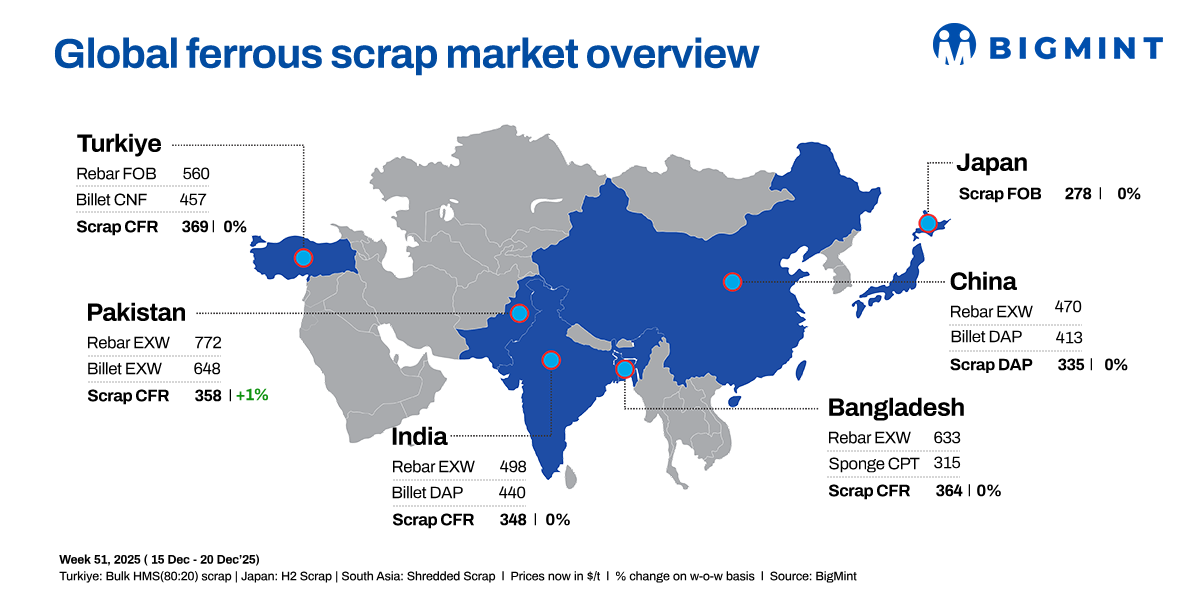
Global ferrous scrap markets remained subdued, with India, Pakistan, Bangladesh, and Turkiye facing weak demand and cautious buying, Japan pressured by a stronger yen, UAE stable, and Lebanon banning Syrian scrap imports, while supply tightness and high costs provided limited support.
Turkiye: Deep-sea imported scrap market remained rangebound through the week, pressured by weak downstream rebar demand and softening finished steel prices, which kept mills cautious despite low yard inventories. Bids for HMS 80:20 hovered near $365/t CFR against offers around $370/t, limiting deal closures as mills focused on protecting margins.
At the same time, seasonal supply tightness, high Eurozone collection costs of EURO 265-270/t, and slower scrap inflows provided downside support. Although mills were said to need five to seven cargoes for January loading, strategic buying delays and falling rebar offers of about $5/t d-o-d restrained overall trading activity.
India: Imported scrap demand in India stayed subdued through the week as the rupee weakened to record lows near 91 against the dollar, pushing up import costs. Weak steel demand, year-end holidays, and cheaper domestic scrap restricted buying to urgent requirements.
Falling steel prices, higher sponge iron usage in southern India, and ample scrap inventories in the north kept the market largely at a standstill.
Prices remained rangebound despite weak sentiment, with EU-origin shredded at $345-350/t CFR west coast India and HMS 80:20 at $315-318/t CFR. Buyers capped shredded bids near $340/t, maintaining a wide bid-offer gap with western suppliers.
Around 3,000-4,000 t of imported ferrous scrap was booked last week, comprising HMS 80:20 and HMS 90:10 from Somalia, Israel, and Mozambique.
Pakistan: The imported scrap market remained largely subdued through the week, with quiet sentiment and mills limiting purchases on weak domestic demand and margin pressure. Offers firmed slightly as cargo availability tightened, but overall activity stayed thin. Some improvement in buyer enquiries was seen ahead of the holiday period, though volumes remained limited. Europe/UK shredded scrap was offered at $354-359/t CFR Qasim, while South African shredded traded around $353-355/t CFR.
Bangladesh: Bangladesh’s imported scrap market stayed subdued through the week amid weak steel demand and cautious buying. Prices were largely steady, with HMS 80:20 around $335-340/t CFR, shredded at $358-365/t CFR, and PNS near $364-368/t CFR, while trading volumes remained limited.
Political uncertainty ahead of elections, forcing several Dhaka-based mills to shut. Hong Kong shredded and PNS were heard at lower levels, reinforcing the dull market tone.
Japan: H2 export prices fell in the week, pressured by a stronger JPY against the US dollar, even as offer levels remained largely unchanged. BigMint assessed H2 scrap at JPY 43,850/t ($283/t) FOB Tokyo Bay, down JPY 150/t ($1/t) from last week, while offers to Vietnam stayed at $325-328/t CFR with bids at $320/t CFR.
The largest H2 scrap buyer, Vietnam, had already secured volumes through the Kanto tender, limiting current demand and favoring containerized or domestic scrap.
UAE: Domestic scrap prices eased slightly, with HMS at AED 1,139/t ($310/t) on subdued buying. Processed grades and fabrication scrap remained stable as mills limited purchases ahead of year-end. Rebar offers stayed steady at AED 2,648/t ($721/t) exw, with moderate market activity and near-term stability expected.
Lebanon banned Syrian ferrous scrap imports and re-exports from 12 December to curb illicit trade and money laundering. About 100 trucks per month previously entered Lebanon, with over 2 mnt shipped to Turkiye since 2013. Syrian scrap prices rose from $40/t to $100/t, while Lebanon exports 25,000-30,000 t monthly.
Leave a Reply