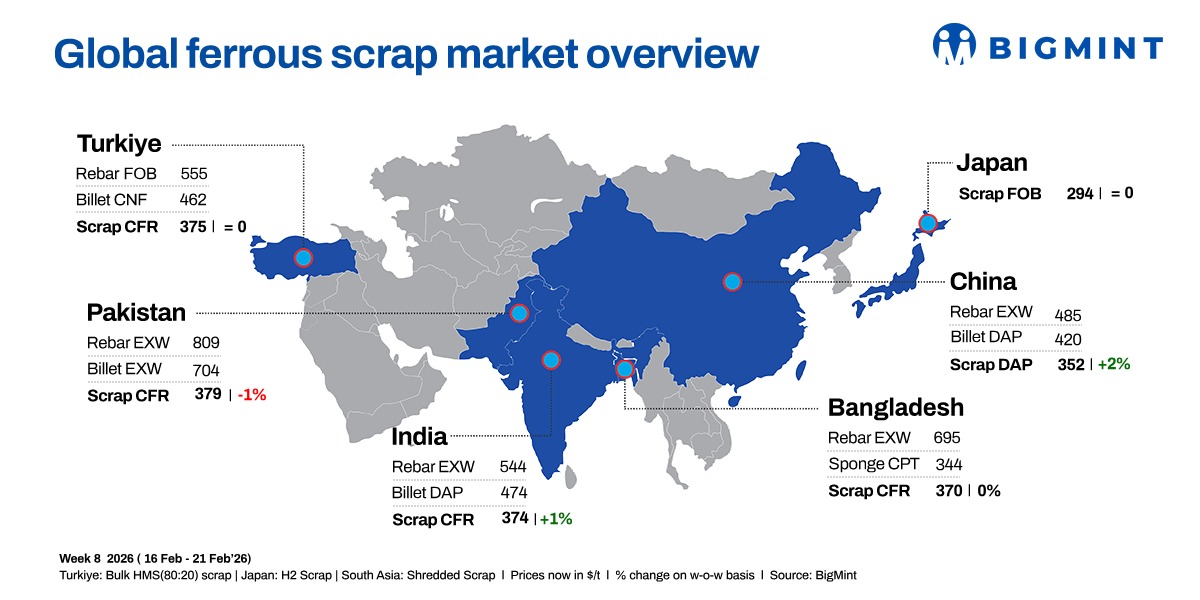
- Turkiye stable; Pakistan softens ahead Ramadan
- Bangladesh improves; Japan firm, US exports fall
Global ferrous scrap markets remained largely muted in the week ended 20 February, with markets in Turkiye and India remaining steady amid cautious mill buying, while Pakistan softened on weak demand. Bangladesh sentiment improved post-election. Japan stayed firm on strong tender results, whereas US exports declined y-o-y despite stable pricing.
Turkiye: Deep-sea imported scrap prices in Turkiye remained mostly stable to slightly lower w-o-w, as weak downstream steel demand and cautious mill buying limited upward momentum. US-origin HMS 80:20 hovered around $375-376/t CFR, while EU/Baltic-origin material was heard near $372-374/t CFR, with a few selective bookings concluded within this range.
Despite winter-related supply constraints in northern Europe and tight US availability offering some support, mills stayed cautious due to squeezed rebar margins, Ramadan-related slowdown, and maintenance outages. Although deal activity improved slightly toward the end of the week, overall sentiment remained balanced to subdued, with active sellers capping any significant upside.
Additionaly, Turkiye’s ferrous scrap imports declined to 18.74 million tonnes (mnt) in CY’25, down 7% y-o-y from 20.07 mnt in CY’24. This was despite crude steel production increasing 3% y-o-y to 38.10 mnt in 2025 from 36.90 mnt in 2024.
India: Imported scrap prices into India remained largely steady w-o-w, with some variation by origin and port. HMS 80:20 was indicated at $350-355/t CFR at Chennai, Mundra, and Nhava Sheva, while shredded was heard at $368-375/t. UK and European-origin offers dominated the market, with selective quotations from the US, Australia, Brazil, West Africa, and Latin America. Buyer bids were typically $5-10/t below offers, reflecting cautious sentiment.
Trading was limited, with a few deals concluded for HMS, bundles, and turning borings. Chennai saw relatively better demand than the west coast, though mills largely continued hand-to-mouth buying.
Around 5,000-6,000 t was booked during the week, including nearly 1,500-2,000 t of HMS at $330-355/t, along with turning borings, HMS bundles, and HMS 60:40.
Pakistan: Imported shredded scrap prices in Pakistan softened over the week, while demand remained weak ahead of Ramadan. EU/UK-origin shredded was mostly quoted around $377-382/t CFR Port Qasim, whereas UAE-origin offers were higher at $390-395/t CFR. Buyers, however, maintained lower target levels, keeping a noticeable gap between bids and offers and limiting fresh transactions.
Some selective deals were concluded, including UAE fabrication scrap and HMS 80:20 at relatively lower prices, highlighting cautious and price-sensitive buying. With mill utilisation still low and production plans conservative.
Bangladesh: Imported ferrous scrap prices in Bangladesh remained mostly stable w-o-w, as post-election sentiment improved and mills gradually resumed production. UK/EU-origin shredded was heard around $371/t CFR Chattogram, while HMS hovered near $350-360/t, with limited but steady buying interest.
Australian-origin offers stayed firm, with HMS 80:20 at $360/t and above, HMS 90:10 near $370/t, and shredded at $380-382/t CFR. Buyer bids trailed at $372-375/t, reflecting continued price-sensitive procurement despite improved sentiment and selective bulk bookings, including a US West Coast cargo.
Japan: H2 scrap at JPY 45,600/t ($297/t) FOB Tokyo Bay, up by JPY 100/t ($1/t) w-o-w, reflecting cautious upward momentum. Tokyo Steel raised its scrap purchase prices by JPY 1,000/t ($6/t) for the second time this month, effective 21 Feb 2026, across all plants except Takamatsu.
US: Export scrap prices remained largely stable, as tight domestic supply and ongoing winter weather limited yard inflows. Addittionaly, US ferrous scrap exports fell 18% y-o-y to 11.16 million tonnes (mnt) in January-November 2025 (11MCY’25) from 13.67 mnt in the same period of 11MCY’24. In November 2025, exports reached 1.23 mnt, up 60% m-o-m but down 3% y-o-y from November 2024.
Leave a Reply