- Turkiye, Japan scrap prices strengthen; South Asia remains mixed
- EU restrictions, Russia controls reshape global scrap trade
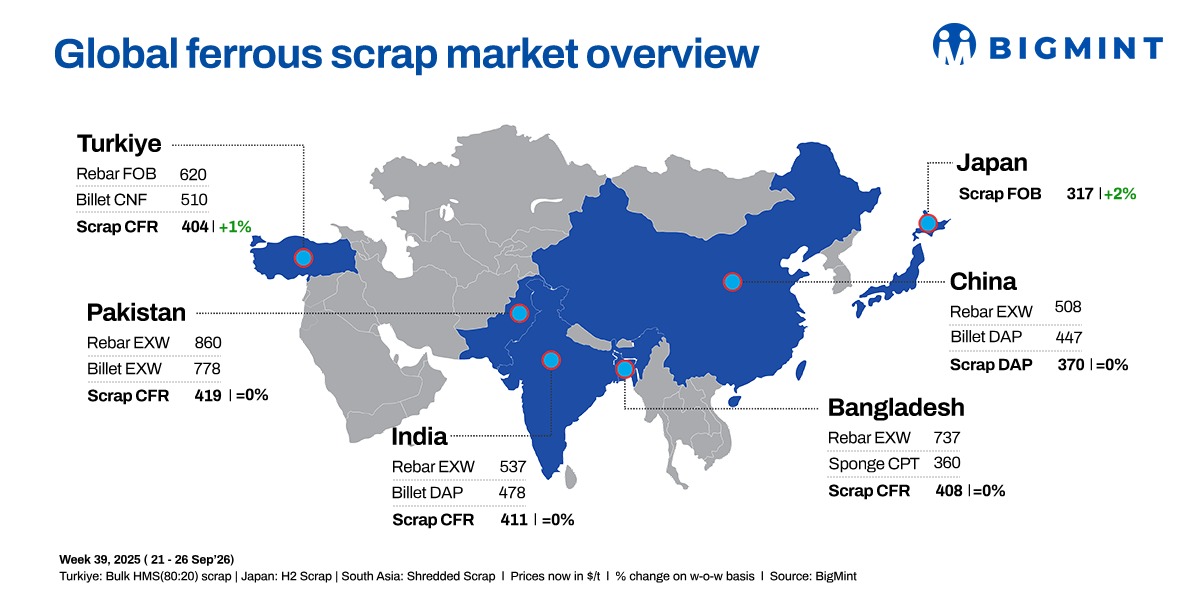
Global ferrous scrap markets remained mixed during the week ended 26 Sept, with Turkiye and Japan strengthening, India and Pakistan subdued, and Bangladesh supported by firm offers. Russia tightened export controls, while proposed EU restrictions raised supply concerns and UAE prices edged higher amid limited buying.
Turkiye: Deep-sea imported scrap market strengthened early in the week before stabilising above $400/t, with US HMS 80:20 reaching around $405-408/t and later assessed at $404/t CFR. Firm mill demand, limited overseas availability and higher freight supported prices, while mills also raised domestic scrap buying prices amid higher import costs.
By the end of the week, US HMS 80:20 was tradable at $400-405/t CFR, with most mills having completed October procurement, limiting fresh activity. Freight has risen by at least $10/t over the past two weeks, while European collection costs remained firm. However, near-peak rebar prices, slower sales and limited room for margin absorption could restrict further scrap price gains.
Russia: Russia has introduced quotas on alloyed steel scrap exports outside the EAEU, with shipments capped at 7,000 t for the remainder of 2026 and 20,000 t in 2027. Higher duties on out-of-quota volumes could limit exports, while the precious metal scrap ban has been extended through November 2026.
India: Imported scrap market remained subdued during the week, with mills adopting need-based buying amid weak domestic steel and DRI prices. HMS 80:20 offers were mostly around $360-375/t CFR, while shredded scrap was offered at $410-425/t. Buying interest remained limited, although a European HMS 80:20 cargo was booked at $375/t CFR Mundra.
Activity stayed thin through the week, with domestic scrap and DRI remaining more competitive than imports. African HMS 80:20 was offered around $380-382/t CFR Nhava Sheva, while Australian and UK-origin material saw mixed offers. By the end of the week, containerised HMS prices had corrected to around $365-368/t levels, despite bulk offers rising to $410/t on stronger regional demand and higher freight.
Near-term buying may remain cautious, though tighter scrap supply and firmer steel sales could support demand, while high freight may keep offers firm. In the last seven days, around 2,000-3,000 t of imported scrap was tracked, including 1,000-1,500 t of EU-origin HMS 80:20, 500-1,000t t of UK shredded and HMS 60:40.
Additionaly, DGFT has withdrawn recognition of 15 pre-shipment inspection agencies (PSIAs) over irregularities in issuing inspection certificates, while Indian scrap importers face port-clearance delays, penalties and higher inspection costs. Meanwhile, Indian recyclers are seeking government intervention over the EU’s proposed metal waste export ban.
Pakistan: Imported scrap market remained rangebound during the week, with shredded scrap assessed at $418-420/t CFR Qasim. Sellers were targeting around $423/t, while buyers held bids at $418-419/t. UK-origin shredded bookings were reported at $417-418/t, while nut and bolt scrap was booked at around $430/t CFR Qasim.
Fresh buying remained limited as mills operated cautiously amid weak steel sales, cash-flow constraints and uncertainty following recent tax changes. High energy costs, flooding and power disruptions also kept domestic scrap procurement selective.
Bangladesh: Imported scrap market remained supported during the week, with Singapore PNS at $420-425/t CFR Chattogram and Malaysian PNS at $410-415/t. Japanese, Singaporean and Hong Kong-origin bulk H2/PNS was indicated at $395-400/t, while US West Coast bulk HMS was around $400/t. Philippine mixed PNS/HMS deals were booked at $376-383/t.
However, trading remained relatively quiet as higher-priced Singaporean and Malaysian cargoes kept buyers cautious. Rising oil prices and concerns over weaker rebar sales also limited fresh buying, despite firm local scrap and rebar prices.
Japan: Japan’s Kanto scrap market strengthened, with FOB Tokyo Bay prices rising JPY 800/t to JPY 49,800/t ($316/t). H2 purchase prices also increased to JPY 47,000-48,000/t, supported by higher mill buying prices and a weaker yen, although balanced supply-demand limited supplier response.
Europe: BIR warned that proposed EU scrap export restrictions could disrupt established recycling flows, particularly affecting India and other Asian markets. EU-27 scrap exports to non-OECD countries reached 2.7-2.8 mnt in H1 2026, while India and Pakistan remain significant buyers. The UK could gain importance as an alternative source for South Asian buyers.
UAE: Scrap prices edged higher during the week, with processed HMS 80:20 assessed at AED 1,030/t ($280/t) DAP Abu Dhabi, up AED 9/t w-o-w, while shredded was around AED 1,125-1,140/t. Fresh buying remained limited as mills focused on completing earlier bookings, with workable HMS levels around AED 1,025-1,035/t. A recent deal was reported at AED 1,010/t for processed HMS, while PNS was around AED 1,080/t for 500-1,000 t.
Leave a Reply