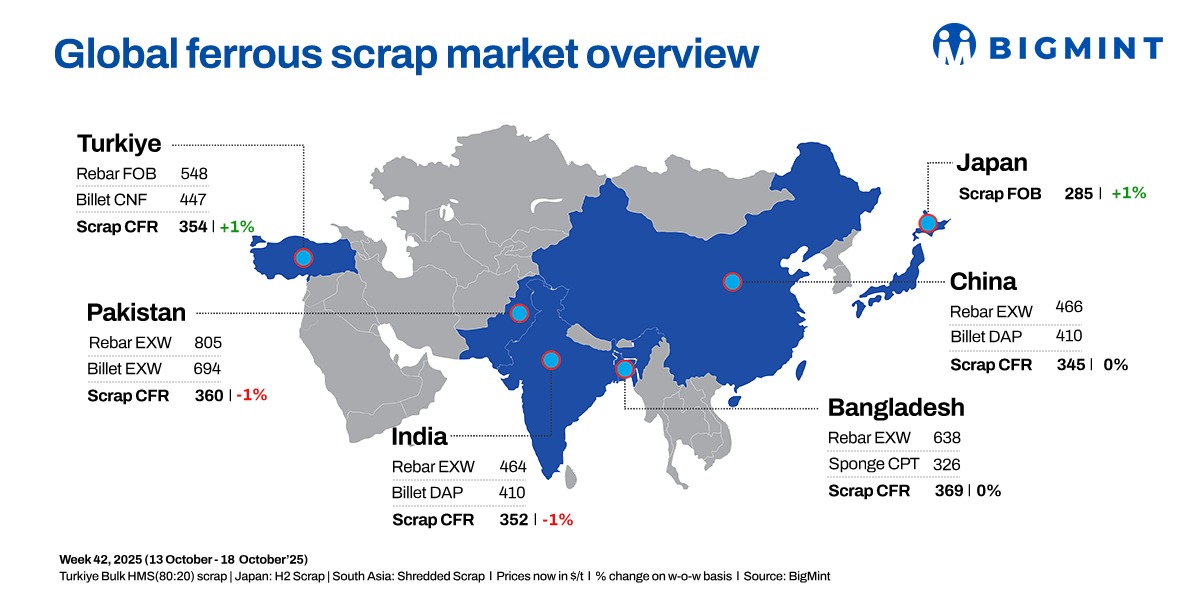
- Firm freights, US cargo bookings keep Turkish prices firm
- Japanese H2 export tags rise, yen weakness pushes up bids
Global imported scrap markets remained mixed, with Turkish demand and tight US supply supporting prices. Meanwhile, South Asian markets were subdued amid weak steel demand, tight liquidity, persistent rains, and slow construction activity.
Turkiye: Turkiye’s imported scrap market saw a slight uptick this week, with US-origin HMS 80:20 traded around $345-353/t CFR. Limited trading activity was driven by weak downstream demand, high ocean freights, and cautious mill buying.
US-origin cargo bookings and firm freights supported prices, but currency shifts, high collection costs, and weak end-user demand kept buyers cautious, with near-term direction dependent on freight, demand, and US-origin availability.
India: India’s imported scrap market remained under pressure, as weak steel demand and tight liquidity curbed buying interest. Ahead of Diwali, trading slowed further as mills focused on managing cash flow and reducing costs. Prices stayed stable but low, reflecting quiet market conditions, with recovery unlikely until post-festival demand improves.
Imported scrap prices to India were at $355/t for shredded and $325/t for HMS 80:20, with most bids at least $5-10/t below offers.
In the last seven days, around 2,500 t of imported scrap were booked, including 1,500 t of HMS 80:20 at $315-320/t, while the rest comprised HMS 90:10 and turning scrap.
Pakistan: Pakistan’s imported scrap market remained subdued throughout the week as weak steel demand, tight liquidity, and slow construction activity restricted buying interest. Mills prioritised cash flow management amid high input costs and logistical challenges, keeping overall trade volumes low.
UK/EU-origin shredded was traded steadily at $360-362/t CFR Port Qasim, while UAE-origin material was offered near $380/t. Domestic scrap prices hovered at around PKR 135,000-138,000/t ($477-487/t), with activity in Punjab particularly slow.
Bangladesh: The imported scrap market was sluggish as weak steel demand, persistent rains, and slow construction activity curbed buying. Mills remained cautious, managing inventories amid subdued sentiment and limited import interest.
Workable levels were heard at around $345/t CFR for Australian HMS 80:20, $364/t for shredded, and $372-375/t for PNS from Singapore and Malaysia. Domestic scrap was traded at BDT 47,000-49,000/t ($386-403/t).
Market activity was minimal, with limited containerised volumes from Southeast Asia. Sentiment is expected to remain weak until construction and liquidity conditions improve.
Japan: H2 scrap export prices rose w-o-w, supported by stronger offers and a weakening yen, which prompted buyers to raise bids amid tight supply. Demand from Vietnam was steady, with BigMint assessing H2 at JPY 42,850/t ($286/t) FOB Tokyo Bay, up JPY 250/t ($2/t) w-o-w.
Despite rising prices, some participants remained cautious, citing weak domestic demand and sluggish finished steel exports as potential limits on further gains. Political uncertainty also emerged after coalition partner Kometo withdrew support, raising questions over Sanae Takaichi’s premiership prospects.
US: Export prices rose w-o-w, driven by strong Turkish demand and East Coast transactions. Turkish mills restocked for November despite high freight amid US-China tensions. Demand in Bangladesh stayed weak due to rains and low steel consumption. Limited US-origin supply is likely to support near-term export prices.
Leave a Reply