- India revises retaliatory duties on US imports
- Country lays out roadmap for metal self-reliance by CY’47
At the close of trading on 11 July 2025, base metals prices on the London Metal Exchange (LME) were a study in contrasts, while copper witnessed a decline of 2.07%. Meanwhile, LME warehouse stocks exhibited varied trends, with copper increasing the steepest, by 14.12%.
On the LME, three-month aluminium prices stood at $2,603/tonne (t), up by 0.50%, while nickel decreasing by 0.6% w-o-w to $15,198/t. Copper prices were at $9,661/t, down 2.07% w-o-w, while zinc increased by 0.53% w-o-w to $2,739/t. Lead was down by 1.80% w-o-w to $2,022/t.

India’s imported aluminium scrap prices inched up w-o-w, influenced by strong global demand and ongoing supply constraints. Tight raw material availability and firm price settlements by a major automaker underpinned the slight price uptrend in certain grades.
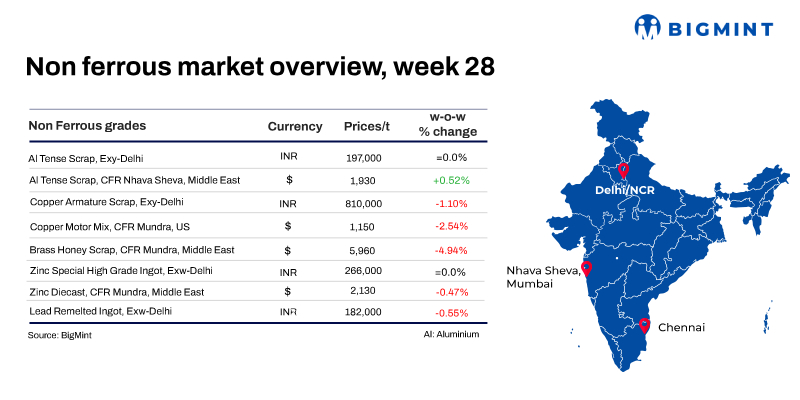
In the domestic market, Tense scrap prices in both Delhi and Chennai remained stable as compared to last week. According to BigMint’s assessment, domestic Tense scrap stood at INR 197,000/t ex-Delhi-NCR and INR 200,000/t ex-Chennai.
Additionally, India’s aluminium ADC12 alloyed ingot prices gained m-o-m in July in north and south India, according to BigMint’s benchmark assessments.
BigMint assessed ADC12 (OEM-approved) settlement prices for July at INR 232,000/t in Delhi and at INR 234,000/t in Chennai. The increase in prices was supported by ongoing shortage of aluminium scrap, a key raw material, used in alloyed ingot production.
Indian copper scrap prices moved down w-o-w, amid a drop in London Metal Exchange (LME) futures. Copper armature scrap was assessed at INR 811,000/t ex-Delhi, down by INR 9,000/t w-o-w, while motors mix stood at $1,150/t, down by $40/t w-o-w.
Copper prices on the London Metal Exchange (LME) remained firm near a three-month high, supported by persistent supply constraints and growing uncertainty over potential US import tariffs.
Domestic copper market sentiment turned positive, as demand showed signs of strengthening despite the ongoing monsoon. Trading activity picked up slightly, with steady inquiries for high-grade material supporting market confidence.
Secondary continuously cast rods (CCRs) (99.90%) were assessed at INR 870,000/t ex-Delhi, down w-o-w. Meanwhile, primary CCR prices stood at INR 900,000/t, stable w-o-w.
India’s zinc ingot market remained range-bound this week amid muted demand and balanced availability. Imported zinc diecast from the Middle East was assessed at $2,130/t CFR Mundra, down by $10/t w-o-w, while domestic zinc ingots stood at INR 266,000/t, largely stable w-o-w.
Prices of zinc ingots from Hindustan Zinc Limited (HZL) stood at INR 272,300/t ex-Jodhpur, up by INR 2,500/t w-o-w.
Lead
Domestic primary lead ingot prices remained steady w-o-w at INR 202,000/t, while re-melted ingots were at INR 182,000/t w-o-w, down by INR 1,000/t. Meanwhile, HZL lead ingots stood at INR 206,800/t ex-Jodhpur, up by INR 500/t w-o-w.
Other updates
India revises retaliatory duties on US imports
India has revised its retaliatory duty proposal against the US over steel and aluminium tariffs, responding to a hike from 25% to 50%. Under WTO norms, India aims to impose equivalent tariffs on select US products, potentially raising duties on $7.6 billion worth of US imports. This move comes amid ongoing talks for a bilateral trade agreement.
Impact of Trump’s 50% copper tariff on India
The US copper tariff has driven COMEX prices up, creating a $2,000/t arbitrage with LME rates. Though India exports little directly to the US, global price volatility may affect trade. Domestic smelting expansions by Adani and JSW could help offset risks and shift focus to new markets.
India’s aluminium and copper roadmap for 2047
To support its $35 trillion economy vision, India plans to scale aluminium production from 4.2 to 37 mnt per annum and copper refining to 5.6 mnt by 2047. With rising demand from EVs, infrastructure, and renewables, the focus is on boosting domestic mining, reducing import reliance, and promoting recycling. Achieving full self-reliance in key inputs like bauxite, alumina, and copper concentrate will require major investments and policy support.
EGA ramps up aluminium recycling
UAE-based EGA has started production at its expanded Spectro Alloys recycling plant in Minnesota, targeting 55,000 t of secondary aluminium billets initially, with full capacity of 165,000 t/year by Q1 2026. The $71 million upgrade is part of EGA’s broader US push, which includes a proposed $4 billion primary aluminium plant in Oklahoma with a planned output of 600,000 t/year.
Leave a Reply