- Turkiye scrap stable, mills eye cheaper Asian billet
- India weak demand, monsoon dampens import activity
Global ferrous scrap prices stayed range bound w-o-w amid sluggish steel demand, monsoon or holiday disruptions, and cautious buying. Key markets like Turkiye, India, Pakistan, and Bangladesh saw muted trade, while Japan and Korea faced currency impacts and rising inventories.
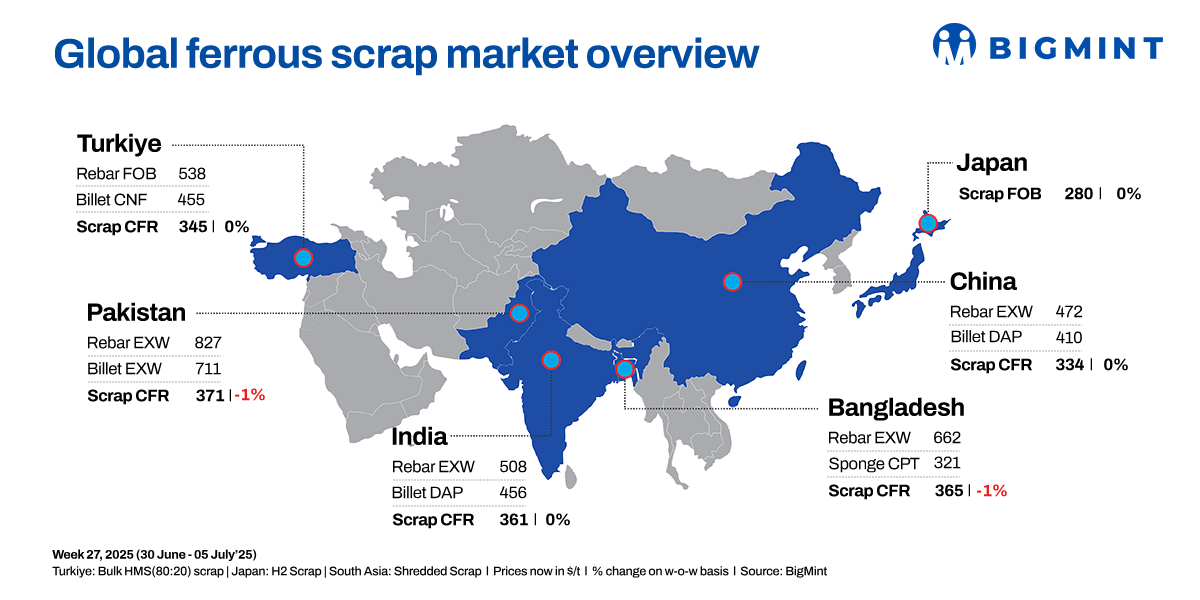
Turkiye: Turkiye’s imported scrap market remained largely steady stable w-o-w with HMS 80:20 scrap of US origin assessed at $345/t CFR. Mills refrained from aggressive bookings amid persistently weak domestic rebar demand and the lure of cheaper billet imports from Asia, which kept overall scrap appetite subdued.
Despite sluggish trade, US and European recyclers maintained firm offer levels, buoyed by high collection costs and a stronger euro. Sellers targeted offers around $345-350/t CFR, but mills resisted, seeking at least $5-7/t lower.
European holidays and logistics issues curbed scrap availability, limiting trade. A rise in Asian billet prices may revive Turkish scrap demand.
India: India’s imported scrap market remained subdued in the first week of July due to weak steel demand, monsoon disruptions, and the availability of cheaper domestic alternatives like sponge iron. Shredded scrap offers hovered at $360-365/t CFR Nhava Sheva, while bids stayed lower at $355-360/t, limiting trade.
HMS 80:20 offers ranged $330-345/t CFR from UK and West Africa, but Indian buyers bid lower at $325-330/t for UK cargoes. Traders reported minimal inquiries as mills held back from fresh purchases.
Last week, around 8,000-9,000 t of imported scrap were booked into India, including HMS 1, busheling scrap, and HMS 80:20, with prices ranging from $320-343/t for HMS grades and $370/t for busheling.
Pakistan: Pakistan’s imported scrap market stayed largely quiet through July, weighed down by Muharram holidays, persistent monsoon rains, and weak downstream steel demand. Mills operated at just 35-40% capacity, limiting appetite for new scrap bookings. UK/EU-origin shredded scrap prices settled at $371/t CFR Qasim, down $1/t from last week’s $373/t, reflecting thin trading and cautious sentiment.
Buyers stayed sidelined, monitoring the impact of policy changes, weak construction demand, and weather-related logistical constraints, keeping the market subdued heading into August.
Bangladesh: Bangladesh’s imported scrap market remained subdued throughout this week, weighed down by monsoon-related construction slowdowns, post-Eid seasonality, and cautious mill sentiment. Mills operated below capacity, focusing on securing cargoes for August-September rather than immediate arrivals. UK/EU-origin shredded scrap settled at $365/t CFR Chattogram, down $1/t from last week’s $368/t, reflecting muted market enthusiasm.
Bulk HMS from the US West Coast saw sporadic bookings at $346-350/t CFR, while other grades like HMS 80:20 hovered around $350-355/t CFR. Higher-grade scrap, including PNS and busheling, remained quoted at $375-390/t CFR but attracted little buying interest.
Traders reported sluggish rebar sales and cost pressures from recent budget and tax changes, which kept mills cautious.
Japan: H2 scrap export market softened in early July as a stronger yen eroded competitiveness. Offers to Vietnam were at $313-320/t CFR, but bids stayed lower around $313-315/t amid weak demand, a soft VND, and seasonal slowdowns. BigMint assessed H2 down JPY 100/t w-o-w at JPY 40,400/t (\$280/t) FOB Tokyo Bay.
Tokyo Steel cut bids by JPY 500/t ($3/t) across key plants, citing rising inventories. New H2 prices were JPY 40,500/t ($281/t) in Tahara, JPY 40,000/t ($278/t) in Nagoya, Okayama, Kansai, and JPY 38,000/t ($264/t) in Takamatsu.
Vietnam: Vietnam’s imported scrap market stayed slow as buyers remained cautious amid currency volatility and weak steel demand. Japanese H2 offers were at $313-320/t CFR, with bids lower at $313-315/t. US bulk HMS 80:20 held at $345/t CFR, but buyers countered at $335/t.
Domestically, rebar prices stayed flat amid poor construction demand. Rainy season disruptions and a weaker dong further weighed on sentiment.
South Korea: Imported scrap market stayed weak as mills cut purchase prices by KRW 10,000/t ($7/t) amid slow demand and rising inventories. Scrap stocks rose 15% to 822,000 t in early July, driven by central region mills preparing for summer production cuts. Traders stayed cautious as inflows outpaced consumption, though the rainy season may cause temporary supply tightness.
Armenia: Extended its ferrous and non-ferrous scrap export ban until 1 Feb’26 to secure local supply for its metal industry, after first imposing it on 7 Nov’24. High import costs make domestic scrap crucial. Steel output has since increased, with scrap use forecast to grow 65-70% to 250,000 t/year, aiming to cut import dependence and support strategic metal sectors.

Leave a Reply