- South African cargo tightness supports prices despite slower Indian buying
- Met coke remains firm as limited supply offsets coking coal weakness
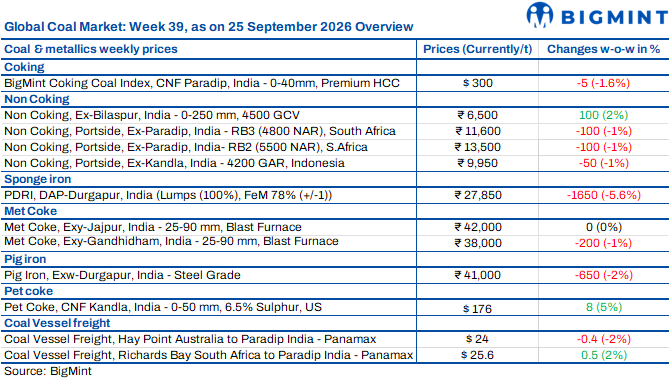
Coal market sentiment remained firm but mixed in the week ended 26 September 2026. Domestic coal availability stayed tight, supporting prices. South African coal remained supported by limited cargo availability and steady overseas demand, although Indian buying slowed at elevated levels. Indonesian coal softened slightly on weak industrial demand, while met coke remained firm amid constrained availability and softer coking coal costs.
Indonesian coal prices ease amid cautious buying
Indian portside Indonesian thermal coal prices declined w-o-w during the week ended 25 September as weak industrial demand and cautious spot buying weighed on activity. 5,000 GAR prices fell INR 100/t to INR 11,800/t at Kandla and INR 11,700/t at Vizag, while 4,200 GAR prices eased INR 50/t to INR 9,950/t and INR 9,850/t, respectively. 3,400 GAR at Navlakhi dropped INR 50/t to INR 7,950/t. However, downside remained limited as thermal power-plant stocks fell around 5% w-o-w to 23.4 mnt, covering around seven days of consumption, with nearly 80 plants at critical levels. Firm replacement costs and tight domestic availability also supported the market.
South African coal prices stay firm
South African thermal coal prices remained firm despite slower buying. Ex-Paradip RB2 (5,500 NAR) fell INR 100/t w-o-w to INR 13,500/t, while RB3 also declined INR 100/t to INR 11,500/t. Ex-Vizag, RB2 dropped INR 200/t to INR 13,400/t, and RB3 fell INR 200/t to INR 11,400/t as of 25 September. FOB RBCT offers for 5,500 NAR stood at $106-110/t against bids of $102-104/t, while CFR India offers were around $129-130/t. Overseas demand, including from Bangladesh, and limited cargo availability supported prices. However, weaker sponge iron demand reduced fresh buying. PDRI ex-Durgapur fell INR 1,650/t w-o-w to INR 27,850/t, reflecting weak downstream sentiment. Port stocks fell, while cyclone rains disrupted coastal handling.
Domestic coal prices strengthen further
Domestic coal prices continued to rise during the week as demand remained firm, while availability tightened due to lower SECL auction frequency during the monsoon. Ex-Bilaspur 4,500 GCV coal increased INR 100/t w-o-w to INR 6,500/t, while 5,000 GCV coal rose INR 200/t to INR 8,300/t as of 25 September 2026. High imported coal prices also encouraged consumers across industries to shift towards domestic coal, adding to demand and supporting prices.
Washed coal prices stay firm on ROM shortage
Washed coal prices remained supported by continued ROM coal shortages and limited availability. 38-39% FC (5,000 GCV) washed coal FOR Raipur had risen INR 400/t w-o-w to INR 9,150/t as of 23 September. Sellers continued to face difficulty in securing raw material, restricting production and keeping offers elevated. A deal was reported at INR 9,100/t FOR Raipur. Despite weaker sponge iron demand, limited physical availability continued to provide support to washed coal prices.
Met coke prices stay stable amid tight supply
India’s met coke market remained broadly stable during the week ended 24 September, with BF-grade prices unchanged at INR 42,000/t ex-Jajpur and down INR 200/t to INR 38,000/t ex-Gandhidham, while foundry-grade coke held at INR 39,000/t ex-Rajkot. Tight domestic and imported availability continued to support prices, with Indonesian BF-grade met coke assessed at $370/t CFR India and supplies reportedly booked through mid-November. However, softer coking coal prices, with Australian PHCC down $8/t to $275/t FOB, and weaker steel demand limited further gains. PCI demand also increased as buyers sought alternatives amid constrained coke availability, while lower pig iron prices reflected subdued downstream demand.
US NAPP coal inventories remain tight
Indian North Appalachian (NAPP) coal availability remained tight in late September as retail inventories stayed at low levels and prices remained elevated. Retail NAPP and Illinois Basin (ILB) stocks had fallen 80% to 72,824 t in August from 365,902 t in January. Weekly stocks declined further to 40,661 t by Week 37, against 625,670 t a year earlier. Retail prices were around INR 18,000-18,500/t ex-warehouse, with some offers reaching INR 19,000/t. Despite lower weekly lifting, demand remained as purchases stayed largely need-based. Around 1.6 mnt of NAPP cargoes were scheduled to arrive in India between late September and early November, which could improve availability, although Baltimore loading delays remained a risk.
Petcoke prices approach $180/t CFR India
Petcoke replacement costs strengthened sharply as US Gulf Coast prices and freight increased. USGC 6.5% sulphur petcoke reached $98/t FOB on 23 September, up $5/t w-o-w, while CFR India rose to $170/t, up $7/t w-o-w. A recent cargo was heard concluded at $174-175/t CFR west coast India, pushing replacement indications towards $180/t. Some October-November cargo economics could approach $185/t CIF west coast India if current costs persisted. Cement buyers became increasingly cautious at elevated prices, with some considering domestic refinery supplies and coal alternatives. However, expanding cement capacity and expected post-monsoon demand continued to support underlying fuel requirements.
Coal freights strengthen amid firm fixtures
India-bound coal freight rates strengthened in the week ended 25 September as firmer fixtures supported owner expectations despite thin cargo enquiries. Australia-Paradip Panamax freight eased $0.4/t w-o-w to $24/t, while RBCT-Paradip increased $0.5/t to $25.6/t amid owner support. Supramax rates rose, with East Kalimantan-Navlakhi increasing $1.5/t to $23/t and South Kalimantan-Navlakhi gaining $1.8/t to $22.2/t. Approaching Asian holidays limited fresh fixing, particularly in Indonesia and Australia, while earlier higher fixtures supported sentiment. The BDI increased 4.1% w-o-w to 3,473, with Panamax rising 4.4% and Supramax 1.1%. Elevated bunker costs supported freight ideas, although limited cargo flow kept activity subdued and selective.
Leave a Reply