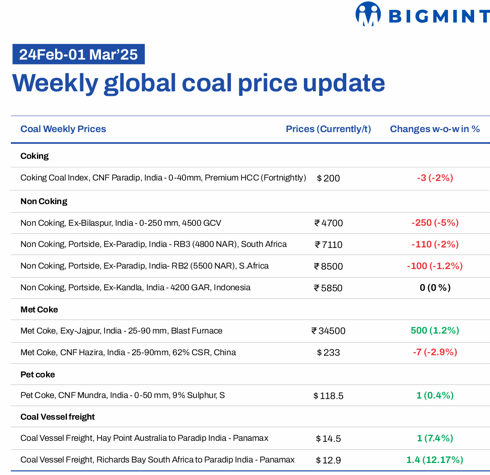
Indian portside thermal coal prices continued to decline as domestic coal availability improved, reducing demand for imports. South African coal prices remained weak. Domestic met coke prices in India rose amid supply constraints, but trades remained sluggish. Meanwhile, China’s coke prices dropped further due to weak steel demand and high inventories.
Portside South African thermal coal prices in India drop to 1-year low
RB2 (5500 NAR) thermal coal prices at Gangavaram fell to INR 8,500/tonne (t), while RB3 (4800 NAR) dropped to INR 7,100/t, down by INR 50/t. Higher domestic coal availability reduced demand for imported coal, leading to weaker bids. Portside thermal coal stocks rose 3.6% w-o-w to 13.04 mnt.
Indonesian non-coking coal tags at Indian ports rise in tandem with global prices
Prices of Indonesian non-coking coal at Indian ports have experienced a moderate uptick, largely influenced by global rise in prices amid currency depreciation and higher freight rates. Coal prices at Indian ports have shown mixed trends for the different grades. At Kandla, the price of 5000 GAR coal rose by INR 50/t, reaching INR 7,700/t. Similarly, high-GCV 5000 GAR coal at Vizag also saw a slight increase to INR 7,600/t.
Domestic thermal coal prices fall w-o-w
Domestic thermal coal prices declined by INR 200/t, with 4500 GCV at INR 4,700/t and 5000 GCV at INR 5,700/t exw-Bilaspur. Sponge iron prices increased to INR 26,600/t exw-Rourkela, up INR 800/t. Portside coal prices may remain under pressure as domestic coal remains preferred.
Domestic met coke prices rise but trades remain slow
India’s domestic met coke prices increased, with 25-90 mm BF-grade coke at INR 34,500/tonne (t) exw-Jajpur and INR 32,000/t exw-Gandhidham, both up INR 800/t w-o-w. Limited import bookings and lower port inventories supported higher domestic offers. However, trades at these prices remain slow. Merchant coke plants are hesitant to restart production due to uncertainty over quantitative restrictions beyond June.
Imported met coke bookings remained weak, while China cut coke purchase prices for the tenth time since October, lowering them by RMB 50-55/t. Australian PHCC prices dropped $3/t w-o-w to $187/t FOB. Meanwhile, steel-grade pig iron prices in Durgapur rose by INR 1,050/t to INR 33,850/t exw. Met coke prices may stay firm amid supply concerns.
China’s coke prices fall again as weak demand persists
China’s metallurgical coke prices dropped by RMB 50-55/t ($6.9-7.6/t) on 25 February, marking the tenth price cut since October. Offers for wet-quenching quasi-first-grade coke in Shanxi fell to RMB 1,180-1,300/t, while dry-quenching coke in Shandong stood at RMB 1,550-1,620/t, exw with VAT. Mysteel’s composite coke price declined by RMB 43.7/t d-o-d to RMB 1,362.6/t.
BigMint’s coking coal index drops as global prices continue to fall
BigMint’s premium hard coking coal (PHCC) index stood at $200/tonne (t) CNF Paradip, India, on 28 February, down from $203/t on 15 February. Prices have been declining since the start of 2025. Indicative offers were at $201/t CFR east coast India. A recent 30,000 t PHCC deal was concluded at $198/t CFR India.
Australian PHCC prices dropped to $187/t FOB, down by $3/t w-o-w due to lower bids and concerns over China’s steel output cuts.
India’s imported pet coke prices rise slightly
Imported pet coke prices in India increased by $0.5-1.5/t w-o-w, reaching $118-121/t CFR on the west coast and $122-124/t CFR on the east coast. The rise was driven by limited US supply for March shipments and increased demand from China.
Coal freight rates in India rise as vessel availability tightens
Coal freight rates increased w-o-w due to rising demand and limited vessel availability. Freight for Australia-India routes rose by $1/t, with Hay Point to Paradip at $14.5/dmt. SAIL booked a Panamax vessel from Australia to Vizag at $15.80/t for late March shipment. South Africa-India freights from RBCT to Paradip increased by $1.4/t to $12.9/t. Indonesia-India freights rose by $2.2/t w-o-w to $13.7/t for East Kalimantan to Paradip. Baltic indices also rose, with the Baltic Dry Index at 981 points, up 189 points w-o-w, indicating higher shipping demand. Port congestion and adverse weather further tightened vessel supply.
Leave a Reply