- Steelmakers resist higher costs as coke prices weaken
- Russian delivery constraints redirect Indian PCI buyers toward Australia
Global steelmaking fuel markets moved in different directions during the week ending 10 October 2026. Premium coking coal softened and Chinese coke prices faced renewed cuts, while PCI strengthened as constrained Russian deliveries encouraged Indian buyers to seek alternatives.
The divergence reflects two competing forces. Weak steelmaking margins are restricting procurement and encouraging buyers to negotiate lower prices. At the same time, supply and delivery constraints are keeping selected grades expensive, limiting the relief available to mills.
India illustrates this tension: domestic coke prices declined during the week, yet shrinking merchant supply continues to sustain imports.

Coking coal: Buyers return, but price resistance persists
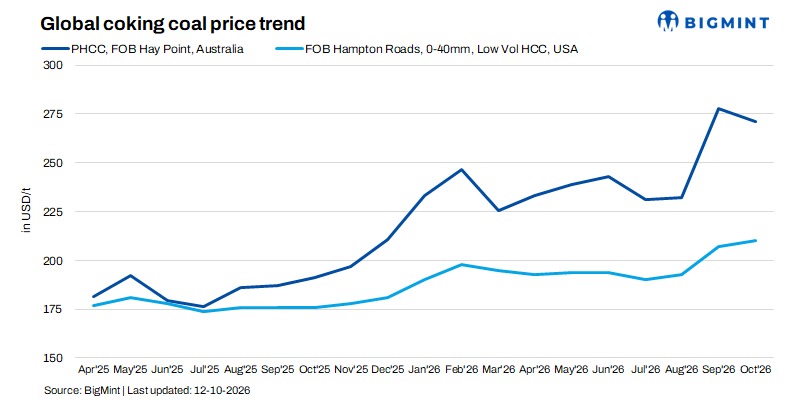
A producer sold 40,000 t of Peak Downs to a Chinese trader at $270/t FOB Australia for November loading, providing a fresh transaction after China’s holiday.
The sale formed part of a broader arrangement involving index-linked pricing. It demonstrates renewed buying interest, but does not establish a market-wide clearing price.
The premium low-vol FOB assessment eased to $268.80/t on 9 October. Chinese domestic spot prices also weakened: premium low-vol coal traded at RMB2,250/t ex-washplant in an auction, RMB58/t below its previous transaction on 29 September.
Buyers were consequently weighing replenishment needs against the possibility of further price declines. Returning enquiries had yet to translate into a broad recovery in procurement.
China: Coke cuts transmit steel margin pressure upstream
China’s first round of coke price reductions took effect on 1 October, with mill purchase prices lowered by RMB100-110/t. By 9 October, some mills had announced a second round, increasing pressure across the raw material chain.
The underlying problem is weak steelmaking profitability. Lower coke costs offer relief, but mills remained under financial pressure and continued buying mainly for immediate requirements.
Coke producers largely maintained operations during the holiday, while inventories increased in some locations. Continued output against cautious purchasing strengthened mills’ negotiating position.
For coking coal suppliers, this creates indirect demand pressure. Coke producers facing lower selling prices have less room to absorb expensive coal, particularly when financing and inventory costs remain substantial.
The effect varies by grade and contract. Spot prices can soften while long-term contract prices and selected seaborne offers remain comparatively firm.
PCI: Delivery constraints outweigh broader demand weakness
PCI showed the clearest supply-driven strength. Mid-vol material rose to $208/t CFR India on 9 October, up $3/t week-on-week. Australian FOB mid-vol prices increased $3.40/t to $187.60/t.
The discount between Australian mid-vol and low-vol PCI narrowed from $6/t to $3/t, indicating firmer relative pricing for mid-vol material.
Delays and reduced railway allocations affected some Russian suppliers, particularly shipments towards north-western ports serving India. The impact was uneven: some suppliers faced substantial allocation reductions, while others experienced limited disruption.
Constrained forward availability encouraged affected suppliers to prioritise contractual deliveries, leaving less material for fresh spot business. Indian buyers consequently turned increasingly towards Australian PCI, supporting prices despite broader pressure on steelmaking margins.
Earlier Russian transactions provide additional reference points:
- Low-vol PCI: 21,000 t at $201.20/t CFR China, dated 24 September.
- Mid-vol PCI: 21,000 t at $198.50/t CFR China, dated 22 September.
The September China transactions cannot establish an October India price trend. Two mid-vol entries carry different loading descriptions, but their status as separate cargoes remains unconfirmed.
India: Coke prices fall, but merchant availability constrained
Indian BF-grade and foundry coke prices weakened as buyers resisted elevated costs and restricted purchases.
However, the short-term correction sits alongside a structural supply imbalance. BigMint’s provisional H1FY27 figures show total domestic coke production rising approximately 3% to 27.6 mnt, while merchant output fell 36% to 1.6 mnt. Imports increased 46% to 2.8 mnt.
Captive production supports integrated steelmakers’ own operations; it does not automatically expand supply available to independent blast furnaces, pig iron producers and foundries.
Indonesia supplied approximately 1.9 mnt, or 68%, of Indian coke imports. This concentration increases buyers’ exposure to disruptions affecting that origin. Water-related supply constraints have added uncertainty, although the affected facilities and lost export volumes remain unquantified.
Merchant conversion economics also remain difficult. BigMint’s H1 coking coal index increased approximately 34%, compared with a 21% increase in its average ex-Jajpur coke assessment. The different cost bases prevent a direct margin calculation, but the divergence highlights pressure from faster-rising raw-material costs.
Pig iron exports provide an offsetting source of demand. Shipments reached approximately 1.73 mnt during January-September, with September volumes rising to around 420,000 t from 310,000 t in August.
Australian supply recovery offers relief
Tahmoor’s planned restart provides a potential supply addition, but little immediate relief. New operator GM3 is targeting a December restart of longwall operations following completion of the acquisition on 7 October.
Its contribution will depend on restart execution, production ramp-up and existing customer commitments.
BigMint assessment
Weak steel margins and uneven fuel availability are pulling markets in different directions. Coking coal and coke face purchasing resistance, while PCI demonstrates how delivery constraints can support prices independently of wider sentiment.
Near-term direction will depend on Chinese coke cuts and steel output, Russian PCI shipment reliability, Indian merchant coke availability and buyers’ willingness to replenish inventories. A general raw material correction may therefore provide uneven relief: grades needed urgently can remain costly even as other prices soften.
Leave a Reply